

2022 Latest Oracle 1z1-071 Real Exam Dumps PDF
1z1-071 Exam Dumps, 1z1-071 Practice Test Questions
Oracle 1Z0-071: Oracle Database SQL Exam Certification Path
Oracle Certified Expert, Oracle Database 12c: RAC and Grid Infrastructure Manager qualification is available to database development system managers and database administrators with a minimum of 1 year knowledge of RAC and Grid Infrastructure. It is therefore advised that you recognize the principles. You should be able to load, maintain, track and retrieve RAC databases, cluster ware and ASM environments for the purpose of this credential. During the examination you can gain a full understanding of the design of Cluster ware, ASM and RAC databases. After gaining this credential, you possess the opportunity to update, instal, backup and repair, adapt and track these modules. Each of the following certificates or preparation should be obtained by the candidates:
Oracle Database 11g Certified Professional Administrator
Oracle Database 12c: Administration of Clusterware
Oracle 2019 Accredited Specialist Database Management
Oracle Servers 12c: RAC Administration
Oracle Servers 12c Accredited Technical Administrator
Oracle Database 12c: Rapid Clusterware & RAC Admin
Database of Oracle 10g True Systems Clusters Certified Expert Administrator
Oracle Database 12c: ASM Administration.
Certified expert of Oracle, 11g Oracle Real Application Clusters and Grid Infrastructure Administrator
Oracle Database 12c: Accelerated Clusterware & ASM Admin
Self-study courses are excellent sources for planning the test but they do not fulfil the teaching criteria. Oracle University Training Center, Oracle Approved Education Centre, Oracle Authorized Associate, or Oracle Career Growth Initiative must be provided to satisfy these training criteria. Courses can provide live interactive courses, on-demand teaching, learning subscriptions or in-class instructor-led courses.
NEW QUESTION 123
You need to list the employees in DEPARTMENT_ID 20 days in a single row, ordered by HIRE_DATE.
Examine the sample output:
Which query will provide the required output?
- A. SELECT LISTAGG(last_name, '; ') "Emp_list", MIN(hire_date) "Earliest"FROM employeesWHERE department_id = 30;WITHIN GROUP ORDER BY (hire_date);
- B. SELECT LISTAGG(last_name)WITHIN GROUP ORDER BY (hire_date) "Emp_list", MIN(hire_date) "Earliest"FROM employeesWHERE department_id = 30;
- C. SELECT LISTAGG(last_name, '; ') "Emp_list", MIN(hire_date) "Earliest"FROM employeesWHERE department_id = 30;ORDER BY (hire_date);
- D. SELECT LISTAGG(last_name, '; ')WITHIN GROUP ORDER BY (hire_date) "Emp_list", MIN(hire_date) "Earliest"FROM employeesWHERE department_id = 30;
Answer: D
NEW QUESTION 124
Which task can be performed by using a single Data Manipulation Language (DML) statement?
- A. removing all data only from a single column on which a primary key constraint is defined
- B. adding a column with a default value while inserting a row into a table
- C. adding a column constraint while inserting a row into a table
- D. removing all data only from a single column on which a unique constraint is defined
Answer: D
NEW QUESTION 125
View the exhibit and examine the descriptions of the DEPT and LOCATIONS tables.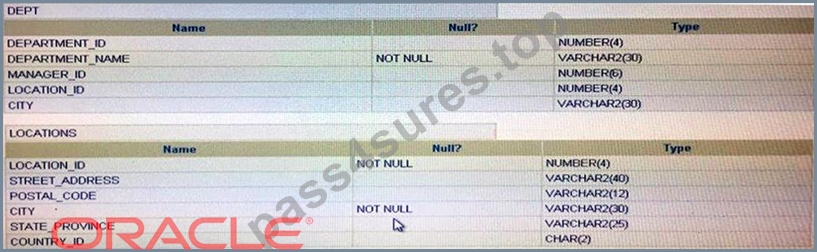
You want to update the CITY column of the DEPT table for all the rows with the corresponding value in the CITY column of the LOCATIONS table for each department.
Which SQL statement would you execute to accomplish the task?
- A. UPDATE dept dSET city = ALL (SELECT cityFROM locations lWHERE d.location_id = l.location_id);
- B. UPDATE dept dSET city = (SELECT cityFROM locations l)WHERE d.location_id = l.location_id;
- C. UPDATE dept dSET city = (SELECT cityFROM locations lWHERE d.location_id = l.location_id);
- D. UPDATE dept dSET city = ANY (SELECT cityFROM locations l)
Answer: C
NEW QUESTION 126
Examine the structure of the SALES table. (Choose two.)
Examine this statement:
SQL > CREATE TABLE sales1 (prod_id, cust_id, quantity_sold, price)
AS
SELECT product_id, customer_id, quantity_sold, price
FROM sales
WHERE 1 = 2;
Which two statements are true about the SALES1 table?
- A. It will have NOT NULL constraints on the selected columns which had those constraints in the SALES table.
- B. It is created with no rows.
- C. It will not be created because of the invalid WHERE clause.
- D. It has PRIMARY KEY and UNIQUE constraints on the selected columns which had those constraints in the SALES table.
- E. It will not be created because the column-specified names in the SELECT and CREATE TABLE clauses do not match.
Answer: A,B
NEW QUESTION 127
Which two statements are true about the COUNT function?
- A. It can only be used for NUMBER data types.
- B. COUNT(*) returns the number of rows in a table including duplicate rows and rows containing NULLs in any column.
- C. COUNT(inv_amt) returns the number of rows in a table including rows with NULL in the INV_AMT column.
- D. COUNT (DISTINCT inv_amt) returns the number of rows excluding rows containing duplicates and NULLs in the INV_AMT column
- E. A SELECT statement using the COUNT function with a DISTINCT keyword cannot have a WHERE clause.
Answer: B,D
NEW QUESTION 128
See the Exhibit and examine the structure of the PROMOTIONS table: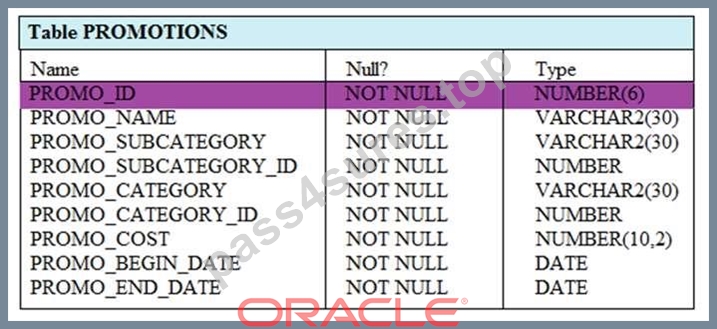
Using the PROMOTIONS table,
you need to find out the average cost for all promos in the range $0-2000 and $2000-5000 in category A.
You issue the following SQL statements: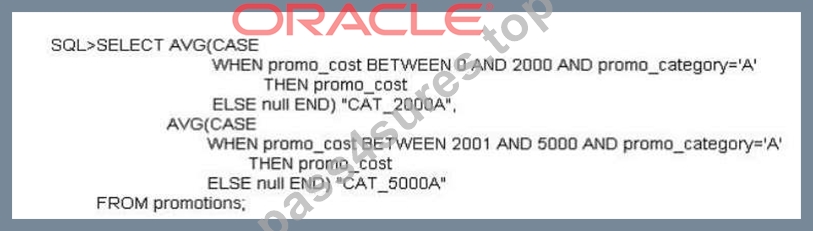
What would be the outcome?
- A. It executes successfully and gives the required result.
- B. It generates an error because CASE cannot be used with group functions.
- C. It generates an error because multiple conditions cannot be specified for the WHEN clause.
- D. It generates an error because NULL cannot be specified as a return value.
Answer: A
Explanation:
CASE Expression
Facilitates conditional inquiries by doing the work of an IF-THEN-ELSE statement:
CASE expr WHEN comparison_expr1 THEN return_expr1
[WHEN comparison_expr2 THEN return_expr2
WHEN comparison_exprn THEN return_exprn
ELSE else_expr]
END
NEW QUESTION 129
View the exhibit and examine the description of the DEPARTMENTSand EMPLOYEEStables.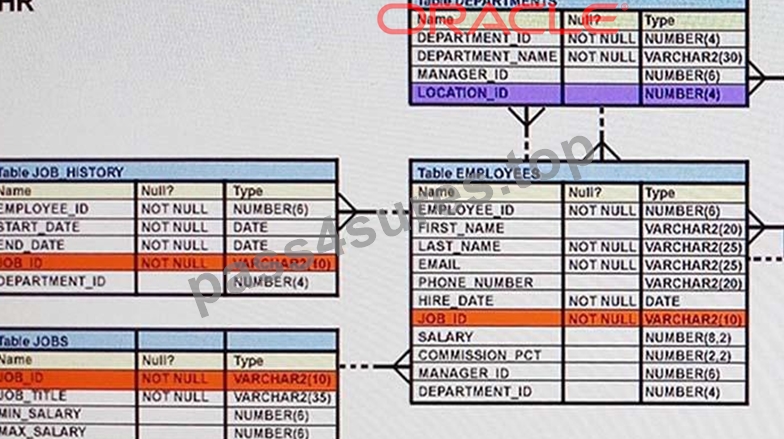
The retrieve data for all the employees for their EMPLOYEE_ID, FIRST_NAME, and DEPARTMENT NAME, the following SQL statement was written:
SELECT employee_id, first_name, department_name
FROM employees
NATURAL JOIN departments;
The desired output is not obtained after executing the above SQL statement. What could be the reason for this?
- A. The EMPLOYEESand DEPARTMENTStables have more than one column with the same column name and data type.
- B. The NATURAL JOINclause is missing the USINGclause.
- C. The DEPARTMENTStable is not used before the EMPLOYEEStable in the FROMclause.
- D. The table prefix is missing for the column names in the SELECTclause.
Answer: A
Explanation:
Explanation/Reference:
Explanation:
Natural join needs only one column to be the same in each table. The EMPLOYEESand DEPARTMENTS tables have two columns that are the same (Department_ID and Manager_ID)
NEW QUESTION 130
View the Exhibit and examine the structure of the ORDER_ITEMS table. (Choose the best answer.) You must select the ORDER_ID of the order that has the highest total value among all the orders in the ORDER_ITEMS table.
Which query would produce the desired result?
- A. SELECT order_idFROM order_itemsWHERE(unit_price*quantity)
MAX(unit_price*quantity)GROUP BY order_id); - B. SELECT order_idFROM order_itemsWHERE(unit_price*quantity) = (SELECT MAX (SUM(unit_price*quantity)FROM order_items) GROUP BY order_id);
- C. SELECT order_idFROM order_itemsWHERE (unit_price*quantity) = (SELECT MAX(unit_price*quantity)FROM order_itemsGROUP BY order_id)
- D. SELECT order_idFROM order_itemsGROUP BY order_idHAVING
SUM(unit_price*quantity) = (SELECT MAX (SUM(unit_price*quantity))FROM order_items GROUP BY order_id);
Answer: D
NEW QUESTION 131
Examine this statement: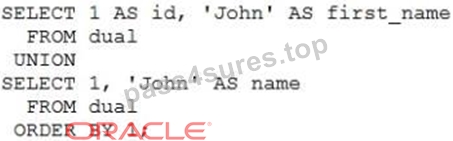
What is returned upon execution?
- A. an error
- B. 2 rows
- C. 1 row
- D. 0 rows
Answer: B
NEW QUESTION 132
Examine the structure of the INVOICE table.
Which two SQL statements would execute successfully? (Choose two.)
- A. SELECT inv_no,NVL2(inv_date,sysdate-inv_date,sysdate)FROM invoice;
- B. SELECT inv_no,NVL2(inv_amt,inv_amt*.25,'Not Available')FROM invoice;
- C. SELECT inv_no,NVL2(inv_date,'Pending','Incomplete')FROM invoice;
- D. SELECT inv_no,NVL2(inv_amt,inv_date,'Not Available')FROM invoice;
Answer: A,C
NEW QUESTION 133
View the Exhibit and examine the structure of the PRODUCT table.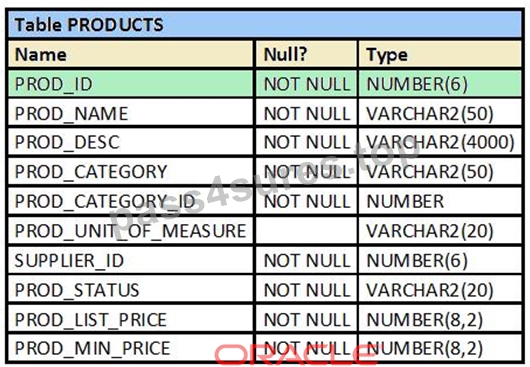
Which two tasks would require subqueries? (Choose two.)
- A. display the number of products whose PROD_LIST_PRICE is more than the average PROD_LIST_PRICE.
- B. display the minimum PROD_LIST_PRICE for each product status
- C. display the total number of products supplied by supplier 102 and have product status as 'OBSOLETE'
- D. display suppliers whose PROD_LIST_PRICE is less than 1000
- E. display all products whose PROD_MIN_PRICE is more than the average PROD_LIST_PRICE of all products, and whose status is orderable
Answer: A,E
NEW QUESTION 134
The first DROPoperation is performed on PRODUCTStable using this command:
DROP TABLE products PURGE;
Then a FLASHBACKoperation is performed using this command:
FLASHBACK TABLE products TO BEFORE DROP;
Which is true about the result of the FLASHBACKcommand?
- A. It recovers the table structure and data but not the related indexes.
- B. It is not possible to recover the table structure, data, or the related indexes.
- C. It recovers only the table structure.
- D. It recovers the table structure, data, and the indexes.
Answer: B
Explanation:
Explanation/Reference:
References:
https://docs.oracle.com/cd/B19306_01/server.102/b14200/statements_9003.htm
NEW QUESTION 135
View the Exhibit and examine the details of the PRODUCT_INFORMATION table. (Choose two.)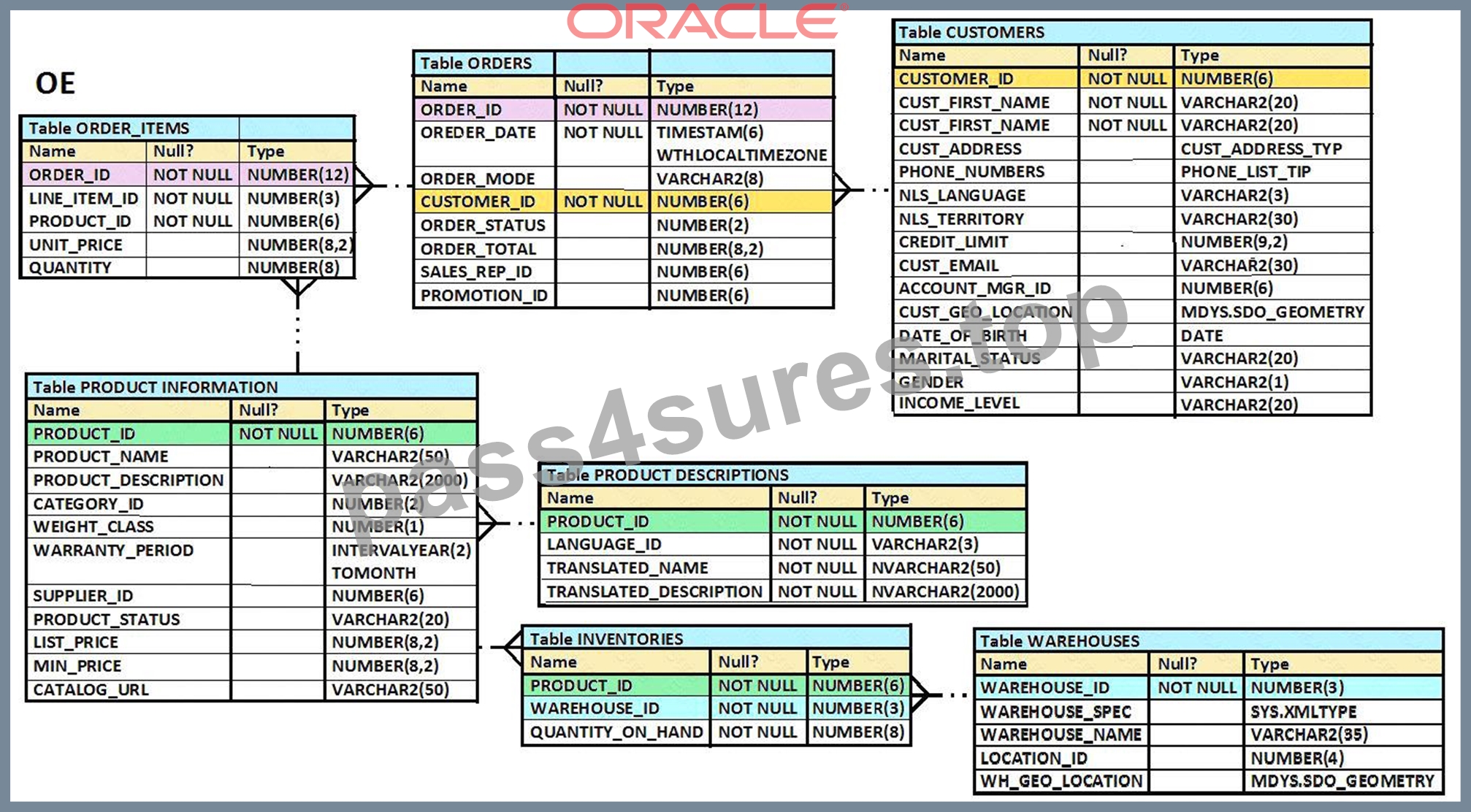
Evaluate this SQL statement:
SELECT TO_CHAR(list_price,'$9,999')
From product_information;
Which two statements are true regarding the output? (Choose two.)
- A. A row whose LIST_PRICE column contains value 11235.90 would be displayed as #######.
- B. A row whose LIST_PRICE column contains value 11235.90 would be displayed as $1,123.
- C. A row whose LIST_PRICE column contains value 1123.90 would be displayed as $1,124.
- D. A row whose LIST_PRICE column contains value 1123.90 would be displayed as $1,123.
Answer: A,C
NEW QUESTION 136
View the Exhibit and examine the structure of the PRODUCTS table.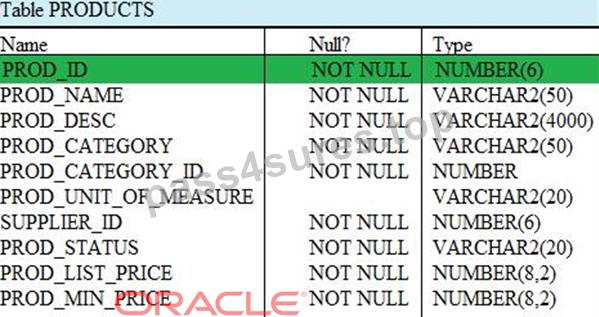
You must display the category with the maximum number of items.
You issue this query: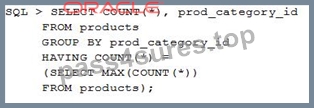
What is the result?
- A. It generates an error because = is not valid and should be replaced by the IN operator.
- B. It executes successfully and gives the correct output.
- C. It generate an error because the subquery does not have a GROUP BY clause.
- D. It executes successfully but does not give the correct output.
Answer: C
NEW QUESTION 137
Which three statements are true regarding the usage of the WITH clause in complex correlated subqueries: (Choose three.)
- A. The WITH clause can hold more than one query.
- B. If the query block name and the table name are the same, then the table name takes precedence.
- C. The query name in the WITH clause is visible to other query blocks in the WITH clause as well as to the main query block
- D. It can be used only with the SELECT clause.
Answer: A,C,D
NEW QUESTION 138
Examine the description of the CUSTOMERS table: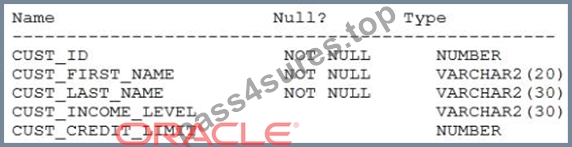
For customers whose income level has a value, you want to display the first name and due amount as 5% of their credit limit. Customers whose due amount is null should not be displayed.
Which query should be used?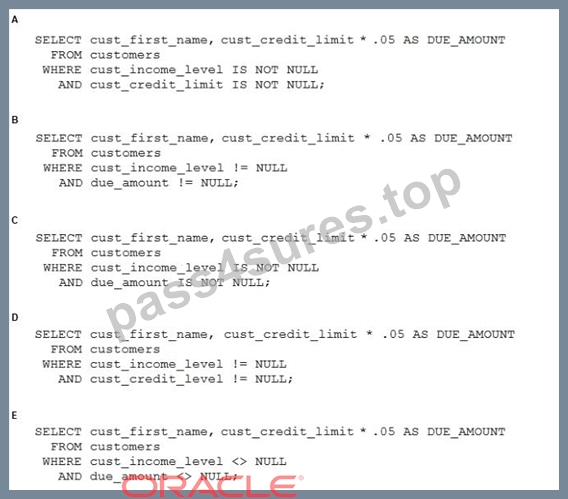
- A. Option A
- B. Option D
- C. Option C
- D. Option E
- E. Option B
Answer: A
NEW QUESTION 139
Examine the description of the PRODUCT_INFORMATION table:
Which query retrieves the number of products with a null list price?
- A. SELECT COUNT(NVL(list_price, 0)) FROM product_information WHERE list_price IS NULL;
- B. SELECT COUNT (list_price) FROM product_information WHERE list_price IS NULL;
- C. SELECT COUNT (list_price) FROM product_information WHERE list_price = NULL;
- D. SELECT COUNT (DISTINCT list_price) FROM product_information WHERE list_price IS NULL;
Answer: A
NEW QUESTION 140
View the Exhibit and examine the structures of the employees and departments tables.
You must update the employees table according to these requirements::
-Update only those employees who work in Boston or Seattle (locations 2900 and 2700).
-Set department_id for these employees to the department id corresponding to London (locationid 2100).
-Set the employees' salary in iocation_id 2100 to 1.1 times the average salary of their department.
-Set the employees' commission In location_id 2100 to 1.5 times the average commission of their department.
You issue this command:
What is the result?
- A. It generates an error because multiple columns cannot be specified together in an UPDATE statement.
- B. It generates an error because a subquery cannot have a join condition in an update statement.
- C. It executes successfully but does not produce the desired update.
- D. It executes successfully and produces the desired update.
Answer: C
NEW QUESTION 141
......
How to Study the Oracle 1Z0-071: Oracle Database SQL Exam
The Oracle 1Z0-071 test is prepared in several respects. Different techniques will be established if you intend to take this test. Applicants may consult online different PDFs and also link to online videos to plan for the examination. Various websites provide realistic tests for the planning of the examination. We recommend taking the 1Z0-071 practice exams since offering the Oracle 1Z0-071 test, applicants must take a qualification course or 1Z0-071 dumps that will also help them study for their exam. The Certification Oracle Database SQL (1Z0-071) is designed for Oracle Database candidates from the University of Oracle, IT students who are looking for powerful SQL database expertise, young programmers who are looking for Oracle certification to have their own certification. The exam confirms a candidate’s understanding of Oracle’s SQL and PL/SQL technologies and builds a foundation for potential growth. The Oracle: 1Z0-071 test candidate should have the order, profound understanding of relational database concepts, data limitation and sorting, multi-table exhibition, use of SET operators, managing sightings, objects with a view to a data dictionary, time zones, tables using DML statements, user access controls, aggregate reporting We know that Oracle technologies in large companies are becoming admirable and trendy and are ready to use them to achieve their desired degree of performance. This increases the market level for these certified professionals. For Oracle Cloud credentials, they will be valid for a period of 18 months from the date they were acquired. The new version of the exam should enable the candidates to be recertified to remain current. Over the year, Oracle cloud certifications are continually updated to keep major product and service updates up-to-date. During the time of Oracle Database certification, it needs to be recertified and upgraded to the present version within 12 months.
PDF (New 2022) Actual Oracle 1z1-071 Exam Questions: https://www.pass4sures.top/Oracle-PL-SQL-Developer-Certified-Associate/1z1-071-testking-braindumps.html
Dumps Moneyack Guarantee - 1z1-071 Dumps UpTo 90% Off: https://drive.google.com/open?id=1j8RO5UUdjGyrFDwROj9T3pL9WE79qFW6