

Latest FCP_FSM_AN-7.2 Practice Test Questions Verified Answers As Experienced in the Actual Test!
Pass Fortinet FCP_FSM_AN-7.2 Exam in First Attempt Easily
Fortinet FCP_FSM_AN-7.2 Exam Syllabus Topics:
| Topic | Details |
|---|---|
| Topic 1 |
|
| Topic 2 |
|
| Topic 3 |
|
| Topic 4 |
|
NEW QUESTION # 20
Refer to the exhibit.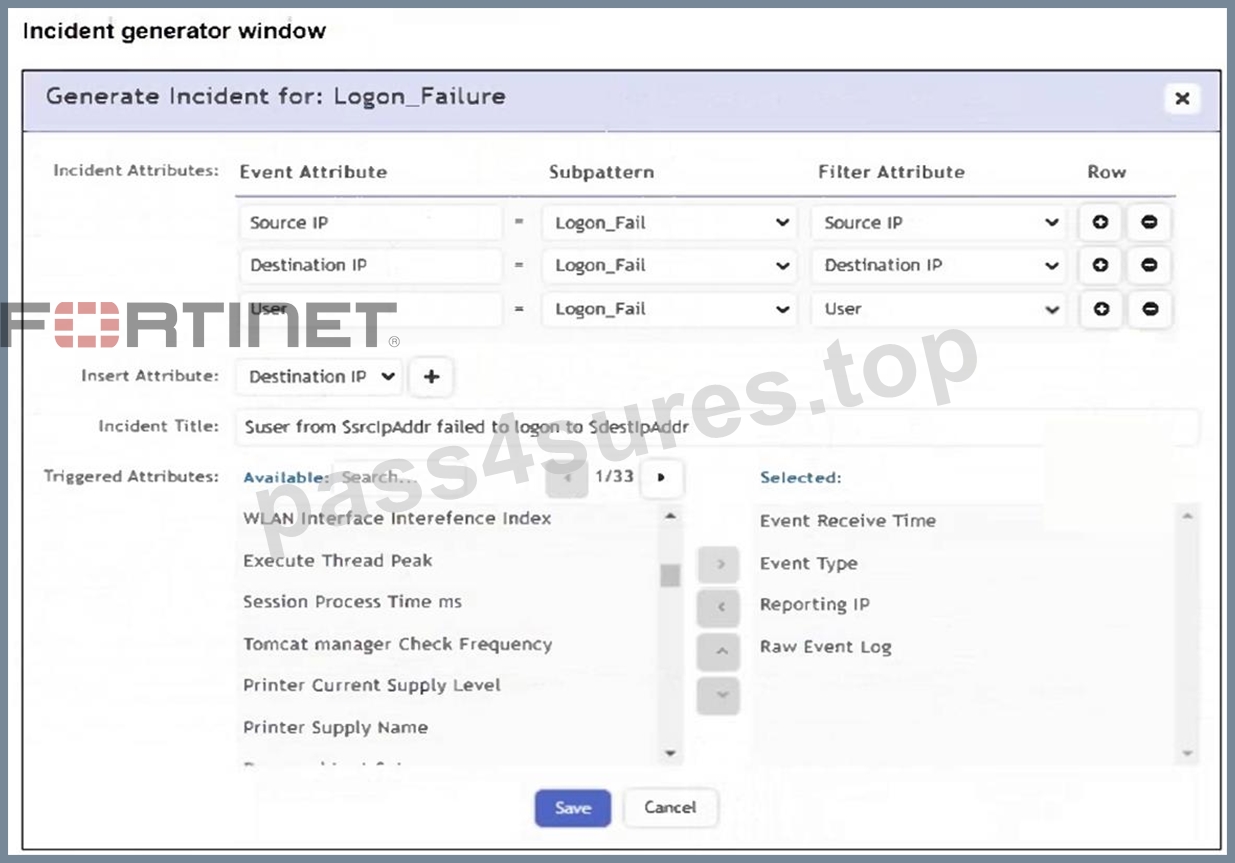
An analyst is trying to generate an incident with a title that includes the Source IP, Destination IP, User, and Destination Host Name. They are unable to add a Destination Host Name as an incident attribute.
What must be changed to allow the analyst to select Destination Host Name as an attribute?
- A. The Destination Host Name must be added as an Event type in the FortiSIEM.
- B. The Destination Host Name must be selected as a Triggered Attribute.
- C. The Destination IP Event Attribute must be removed.
- D. The Destination Host Name must be set as an aggregate item in a subpattern.
Answer: B
Explanation:
For an attribute like Destination Host Name to be used in the incident title, it must first be included in the Triggered Attributes list. Only attributes listed there are available for substitution in the title template (e.g., $destIpAddr, $srcIpAddr).
NEW QUESTION # 21
How can you query the configuration management database (CMDB) in an analytics search?
- A. On the CMDB tab, select an entry, and then click Create Search.
- B. Click Value > Select from CMDB.
- C. On the Admin tab, click CMDB Search.
- D. Click Attribute > Select from CMDB.
Answer: B
Explanation:
In an analytics search, you can query the CMDB by clicking Value > Select from CMDB, which allows you to choose values directly from CMDB entries for the selected attribute, enabling precise filtering based on asset data.
NEW QUESTION # 22
Refer to the exhibit.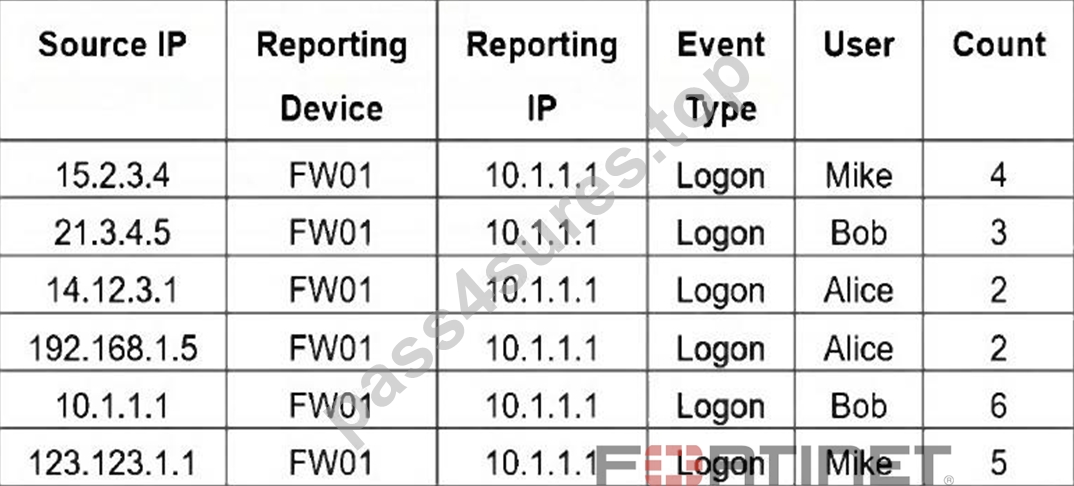
If you group the events by User, Source IP, and Count attributes, how many results will FortiSIEM display?
- A. Six
- B. Five
- C. Three
- D. Two
- E. Four
Answer: A
Explanation:
Grouping by User, Source IP, and Count means that each unique combination of those three attributes will be treated as a separate result. In the table, all six rows have distinct combinations of User, Source IP, and Count - so FortiSIEM will display 6 results.
NEW QUESTION # 23
When configuring anomaly detection machine learning, in which step must you select the fields to analyze?
- A. Schedule
- B. Prepare Data
- C. Design
- D. Train
Answer: B
Explanation:
In the Prepare Data step of configuring anomaly detection in FortiSIEM, you must select the fields to analyze. This step defines the input features that the machine learning model will evaluate during training and detection.
NEW QUESTION # 24
Refer to the exhibit.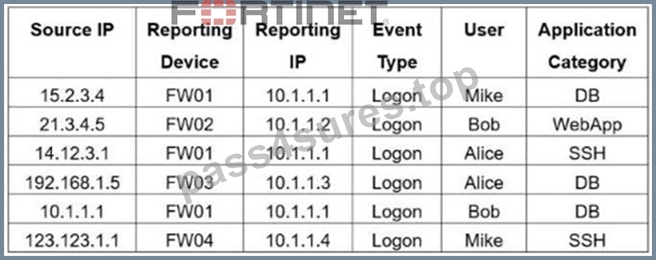
If you group the events by Reporting Device, Reporting IP, and Application Category, how many results will FortiSIEM display?
- A. Five
- B. Six
- C. Two
- D. Four
- E. One
Answer: A
Explanation:
Grouping by Reporting Device, Reporting IP, and Application Category yields five unique tuples: (FW01, 10.1.1.1, DB), (FW02, 10.1.1.2, WebApp), (FW01, 10.1.1.1, SSH), (FW03, 10.1.1.3, DB), and (FW04, 10.1.1.4, SSH).
NEW QUESTION # 25
Refer to the exhibit.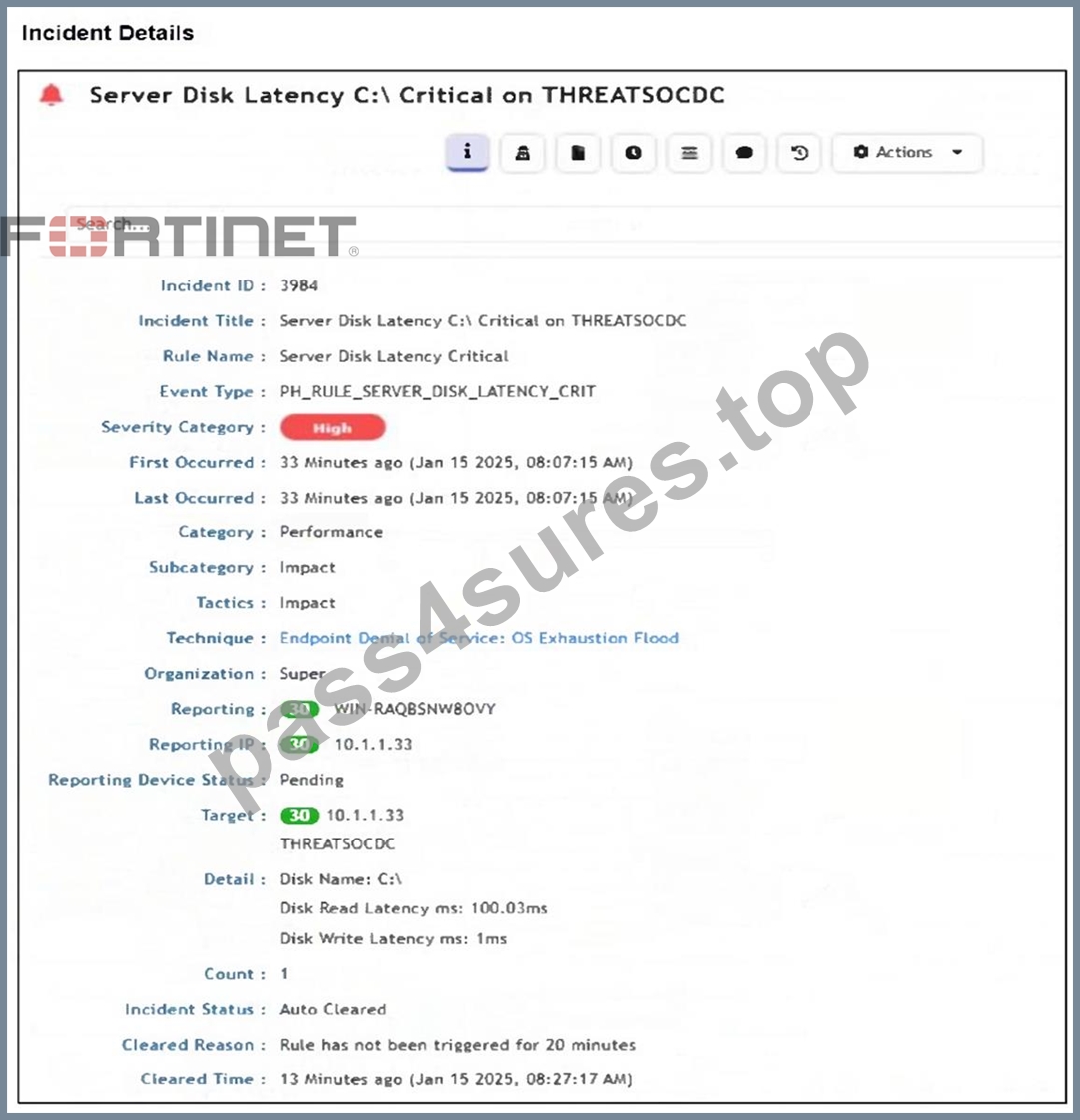
How was this incident cleared?
- A. The incident was cleared automatically by the rule.
- B. FortiSIEM cleared the incident automatically after 24 hours.
- C. The analyst manually cleared the incident from the incident table.
- D. The endpoint was rebooted and sent an all-clear signal to FortiSIEM.
Answer: A
Explanation:
The Incident Status shows "Auto Cleared", and the Cleared Reason states: "Rule has not been triggered for 20 minutes." This indicates that the incident was automatically cleared by the rule logic after a defined period of inactivity.
NEW QUESTION # 26
Which information can FortiSIEM retrieve from FortiClient EMS through an API connection?
- A. ZTNA tags
- B. Host software versions
- C. Host login credentials
- D. FortiSIEM license
Answer: A
Explanation:
FortiSIEM can retrieve ZTNA tags from FortiClient EMS through an API connection, enabling dynamic user and device classification for policy enforcement and incident response.
NEW QUESTION # 27
Which running mode takes the most time to perform machine learning tasks?
- A. Local auto
- B. Forecasting
- C. Local
- D. Regression
Answer: C
Explanation:
In Local mode, FortiSIEM performs machine learning tasks using the full dataset without optimization shortcuts, making it the most time-consuming mode compared to Local Auto, Forecasting, or Regression.
NEW QUESTION # 28
Refer to the exhibit.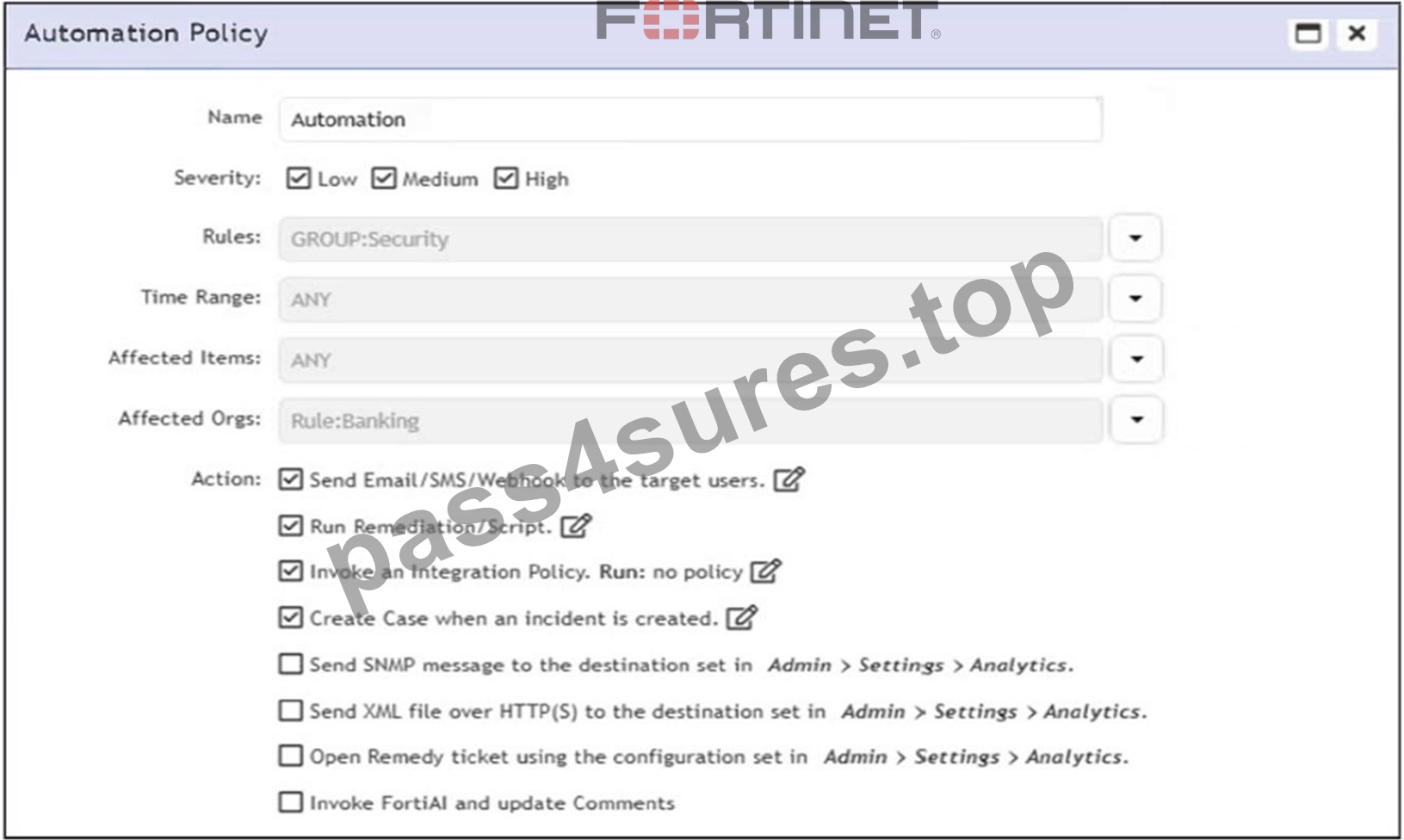
According to the automation policy configuration shown in the exhibit, what happens if an associated rule triggers?
- A. FortiSIEM performs all selected actions.
- B. FortiSIEM fails to the integration policy, because no policy is defined.
- C. FortiSIEM sends an email, because that is first on the list.
- D. FortiSIEM runs the remediation script, because that takes precedence over all other options.
Answer: A
Explanation:
When an associated rule triggers, FortiSIEM performs all selected actions in the automation policy. In this case, it will send an email/SMS/webhook, run the remediation script, invoke the integration policy (even if none is currently defined), and create a case. All checked actions are executed.
NEW QUESTION # 29
Which statement about thresholds is true?
- A. FortiSIEM uses only device thresholds for security metrics.
- B. FortiSIEM uses global and per device thresholds for performance metrics.
- C. FortiSIEM uses fixed, hardcoded global and device thresholds for all performance metrics.
- D. FortiSIEM uses only global thresholds for performance metrics.
Answer: B
Explanation:
FortiSIEM evaluates performance metrics against both global thresholds, which apply system-wide, and per-device thresholds, which can be customized for individual devices. This dual approach allows flexibility in monitoring while ensuring consistent baseline alerting.
NEW QUESTION # 30
How does FortiSIEM update the incident table if a performance rule triggers repeatedly?
- A. FortiSIEM generates a new incident each time the rule triggers, and updates the First Seen and Last Seen timestamps.
- B. FortiSIEM updates the Incident Count value and Last Seen timestamp.
- C. FortiSIEM changes the incident status to Repeated, and updates the Last Seen timestamp.
- D. FortiSIEM generates a new incident based on the Rule Frequency value, and updates the First Seen and Last Seen timestamps.
Answer: B
Explanation:
When a performance rule triggers repeatedly, FortiSIEM updates the existing incident by incrementing the Incident Count and refreshing the Last Seen timestamp. This avoids flooding the incident table with duplicates while still tracking repeated occurrences.
NEW QUESTION # 31
Refer to the exhibit.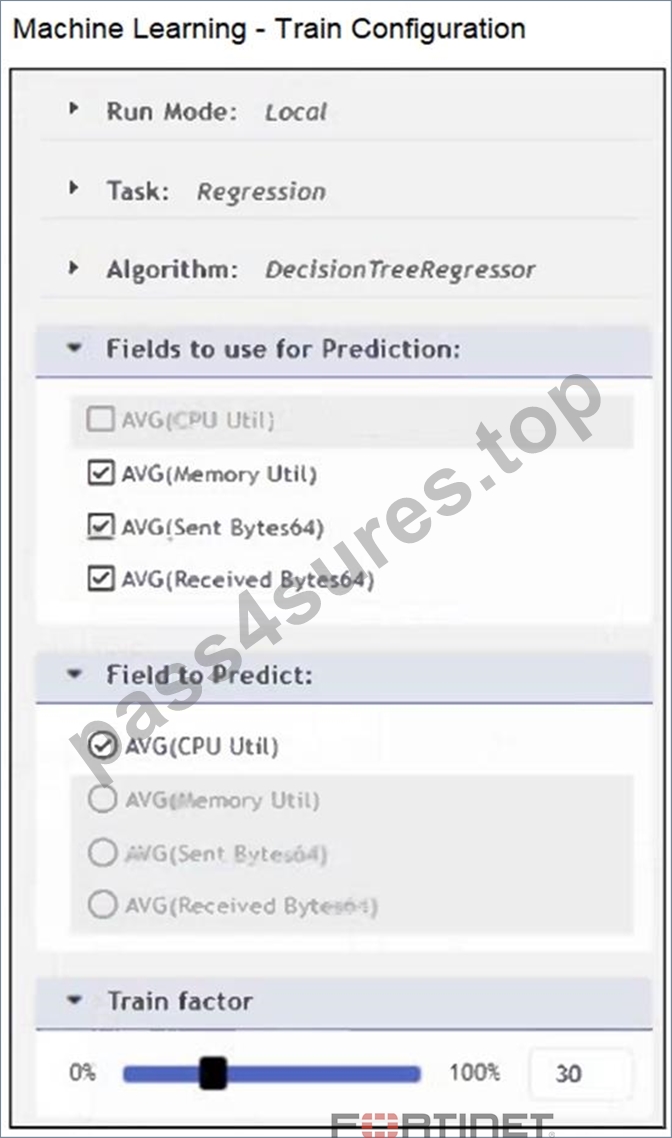
The configuration shown in the exhibit is incorrect.
What must you change to allow this configuration to be successfully applied to FortiSIEM?
- A. Only one AVG type field must be selected under Fields to use for Prediction.
- B. Run Mode must be set to ML.
- C. The Train factor must be 70% or greater.
- D. The selection in Fields to use for Prediction and Field to Predict must match.
Answer: B
Explanation:
The Run Mode is set to Local, which is not valid for training machine learning models in FortiSIEM. To apply this configuration correctly, the Run Mode must be set to ML, which enables proper model training and prediction using selected fields.
NEW QUESTION # 32
Refer to the exhibit.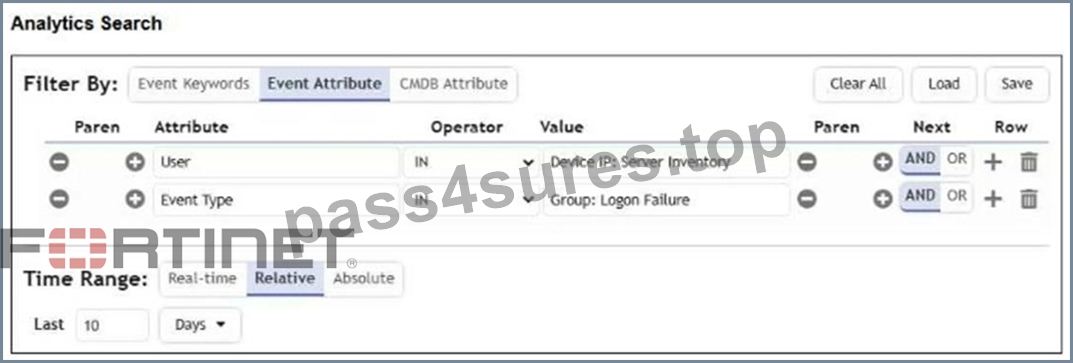
The analyst is troubleshooting the analytics query shown in the exhibit.
Why is this search not producing any results?
- A. The Boolean operator is wrong between the attributes.
- B. You cannot reference User and Event Type attributes in the same search.
- C. The inner and outer nested query attribute types do not match.
- D. The Time Range is set incorrectly.
Answer: C
Explanation:
The issue is that the "User" attribute is incorrectly assigned a Device IP group value, which is a mismatch of attribute types. "User" expects a user name or identity, not a device IP group. This mismatch between the attribute type and the provided value causes the search to return no results.
NEW QUESTION # 33
Refer to the exhibit.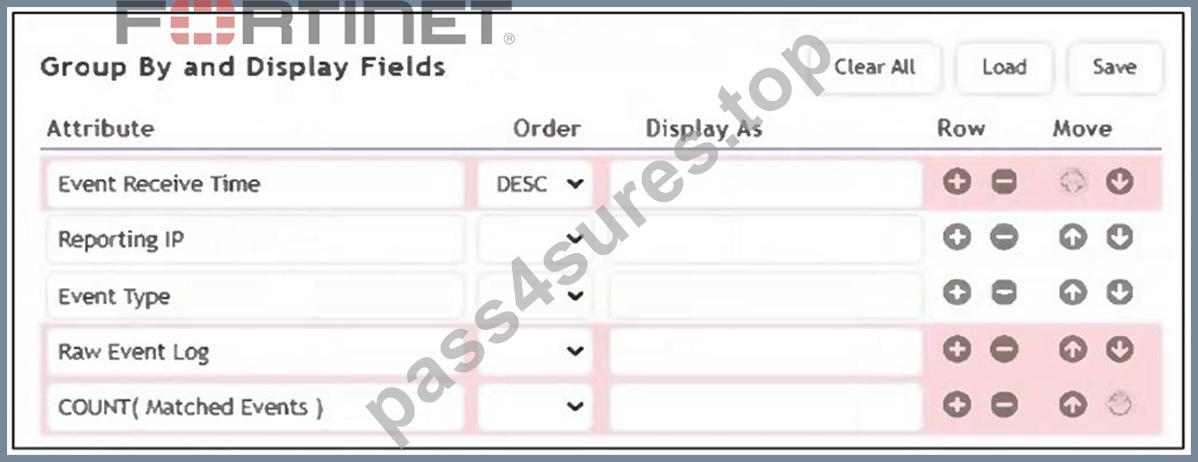
As shown in the exhibit, why are some of the fields highlighted in red?
- A. The Event Receive Time attribute is not available for logs.
- B. The attribute COUNT(Matched Events) is an invalid expression.
- C. Unique values cannot be grouped B.
- D. No RAW Event Log attribute information is available.
Answer: C
Explanation:
The fields are highlighted in red because unique values such as Event Receive Time and Raw Event Log cannot be used in group-by operations. Grouping requires aggregatable or consistent values across events, while these fields are unique to each event, making them incompatible for grouping.
NEW QUESTION # 34
......
We offers you the latest free online FCP_FSM_AN-7.2 dumps to practice: https://www.pass4sures.top/Fortinet-Certified-Professional-Security-Operations/FCP_FSM_AN-7.2-testking-braindumps.html
The Most Efficient FCP_FSM_AN-7.2 Pdf Dumps For Assured Success : https://drive.google.com/open?id=1n4V76E-UP4MTOSBsoW7-sjwI7knMNT72