

Get Instant Access of 100% Real Appian ACD201 Exam Questions with Verified Answers
Exam Dumps for the Preparation of Latest ACD201 Exam Questions
Appian ACD201 Exam Syllabus Topics:
| Topic | Details |
|---|---|
| Topic 1 |
|
| Topic 2 |
|
| Topic 3 |
|
| Topic 4 |
|
NEW QUESTION # 36
There are two record types, ABC and XYZ, with sync enabled. The XYZ record type is added as a relationship into the ABC record type.
A user has Viewer permission to the ABC record type but does not have access to the XYZ record type.
A site page is presented to the user where the data is sourced from the ABC record type and its related record type the XYZ reference.
What information does the user see on the site page?
- A. Page does not load and an error message is presented: "The record type [identifier=XYZ] does not exist, has been deleted, or you do not have sufficient privileges to access its data."
- B. Page is presented to the user and the data references to the XYZ record type appear as "null".
- C. Page is presented to the user with the XYZ record type data and fields references redacted.
Answer: A
Explanation:
Because the interface references fields on the XYZ record type, the user must have at least Viewer permission on XYZ as well as on ABC. Since the user lacks access to XYZ, the query cannot be executed and the page fails to load, displaying the error:
"The record type [identifier = XYZ] does not exist, has been deleted, or you do not have sufficient privileges to access its data."
NEW QUESTION # 37
A process was recently pushed to the Prod environment. However, users are reporting that a task on this process is experiencing slow response times when they try to input data.
What is the most likely reason for this issue?
- A. Exception timers on tasks are set to values that are too low.
- B. The task is assigned to too many users.
- C. The process uses too many hidden variables.
- D. There are too many SAIL components on the task.
Answer: D
Explanation:
Having too many SAIL components on the task can cause slow response times for users, as the interface may take longer to render and process inputs, impacting performance.
NEW QUESTION # 38
Which section of the Interface Performance View explains the contribution towards the overall evaluation time of the current function, rule, or parameter?
- A. Precedent Functions and Rules
- B. Descendant Rules
- C. Parameters and Direct Children
Answer: C
Explanation:
The "Parameters and Direct Children" section of the Interface Performance View explains the contribution towards the overall evaluation time of the current function, rule, or parameter.
NEW QUESTION # 39
You need to configure Appian user authentication against an external directory server. The requirement is to use the same corporate logon information without single sign-on (SSO).
Which authentication type should you use?
- A. OpenID Connect authentication
- B. LDAP authentication
- C. PIEE user authentication
Answer: B
Explanation:
LDAP authentication allows users to log in with their corporate credentials by authenticating against an external directory server, without requiring single sign-on (SSO).
NEW QUESTION # 40
You're redesigning user interfaces to achieve more efficient space usage.
Which layout component is the best choice for displaying an interface with a vertical meaningful order of components?
- A. a!columnsLayout()
- B. a!sideBySideLayout()
- C. a!cardLayout()
Answer: A
Explanation:
a!columnsLayout() is best for organizing and displaying components in a vertical order with efficient space usage, as it supports arranging items in structured, responsive columns.
NEW QUESTION # 41
Your client wants their customers to be able to schedule appointments directly from their website without going to an Appian user environment.
You need to build an embedded interface to be added to your client's web page. The style of the embedded interface should be consistent with the host web page.
Which three custom styling options can be configured in the Themes section of embedded interfaces?
(Choose three.)
- A. Page background color
- B. Web font stylesheet URL
- C. Font Family
- D. Asymmetrical layout
- E. Two or three column layout
Answer: A,B,C
Explanation:
Page background color - You can customize the background color to match the host webpage's theme.
Font family - You can set the font family to ensure the embedded interface aligns with the client's branding.
Web font stylesheet URL - This allows the use of custom web fonts, further aligning the style with the host site.
NEW QUESTION # 42
The synced record Task has a self-referential relationship defined in the column parentTaskId. There is a many-to-one record relationship between the id and parentTaskId called parentTask.
For a given task ID, you need to return the task name and the parent task name.
What should you do?
- A. Create a sync-time custom record field on the Task record called parentName. Specify this field to return in the query field selection.
- B. Use a!queryRecordType() filtered on the task id once to return the task name and parent task ID. Query the record again to return the parent task name.
- C. Use a!queryRecordType() with a filter on the task id, with fields specified to return recordType!Task.
name and recordType!Task.parentTask.name.
Answer: C
Explanation:
Using a!queryRecordType() with a filter on the task ID and specifying both recordType!Task.name and recordType!Task.parentTask.name in the fields will efficiently return both the task name and its parent task name in a single query.
NEW QUESTION # 43
An insurance company's product details are currently distributed across numerous database tables, encompassing over 60 to 70 fields.
You need to implement a product comparison tool for business users to compare up to three insurance products simultaneously, with all the product details in a tabular format.
Refer to the following sample format: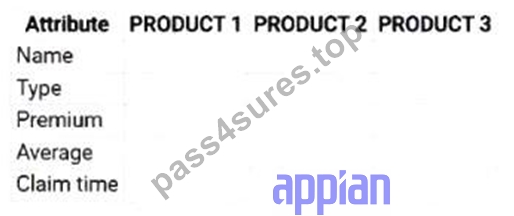
Which object should be used to transform the data into the required format?
- A. VCCCiews
- B. Stored procedure
- C. Record type with relationships
Answer: A
Explanation:
Database views are ideal for transforming complex, distributed product data into a single, flattened structure tailored for reporting or comparison. In this case, a view can pivot the 60-70 fields and organize them by attribute (e.g., Name, Type, Premium) across multiple product columns, enabling a tabular comparison layout like the one shown. Views also optimize performance and reduce transformation overhead in the interface layer.
NEW QUESTION # 44
Your client wants to configure user authentication using single sign-on (SSO) in their cloud environment.
Which two authentication types should you use to support this requirement? (Choose two.)
- A. PIEE user authentication
- B. Appian authentication
- C. OpenID Connect authentication
- D. LDAP authentication
Answer: B,C
Explanation:
OpenID Connect authentication supports single sign-on (SSO) by integrating with external identity providers.
Appian authentication can work in conjunction with SSO configurations as part of a hybrid setup or fallback mechanism.
NEW QUESTION # 45
You're developing a record view for a case management system that enables users to upload files to a specific location within an external records application.
Your requirements are:
In this record view, there should be a record action that allows the user to upload a file to the interface and configure the metadata (name, author, file size) before submitting.
If the file is larger than 250MB, the user will be notified that the file will be uploaded overnight.
Once the file has been successfully uploaded, the file will appear on the record view and the user can interact with the file.
Which two pieces of user-facing information must be captured from this business process so that you can develop this record view? (Choose two.)
- A. The location of where the file will be uploaded to in the external records application.
- B. The email of the system administrator so that an email can be sent to them if the integration fails.
- C. How the user wishes to interact with these files in the record view - as a grid or a series of card layouts.
- D. The time of file upload if the file is less than 250MB.
Answer: A,C
Explanation:
You need to know the target location in the external records application to properly upload the file.
Understanding how users want to interact with files (grid or card layout) is essential for designing the record view interface.
NEW QUESTION # 46
You need to select a plug-in to meet a specific requirement and several plug-ins can do the job.
What are three key factors to consider? (Choose three.)
- A. Is the plug-in open source or proprietary?
- B. What are the limitations of the plug-in?
- C. Is the plug-in approved for use in the Cloud?
- D. What is the size of the plug-in?
- E. Who is the creator of the plug-in?
- F. What are the compatible Appian versions?
Answer: B,C,F
Explanation:
Limitations of the plug-in help you understand constraints or potential issues that could impact your implementation.
Compatible Appian versions ensure the plug-in will work correctly in your current and future environments.
Cloud approval status is essential for Appian Cloud environments, as only approved plug-ins are permitted for deployment.
NEW QUESTION # 47
What are two advantages of database normalization? (Choose two.)
- A. Minimizing data redundancy.
- B. Minimizing the number of tables that need to be created.
- C. Enforcing data integrity.
- D. Simplifying query statements to read data.
Answer: A,C
Explanation:
Database normalization enforces data integrity by structuring data and relationships to prevent anomalies.
It minimizes data redundancy by ensuring each piece of information is stored only once, reducing duplication.
NEW QUESTION # 48
You need to implement a requirement where a third-party system starts a process in Appian. The third-party system can invoke a service only through Web Services Description Language (WSDL).
What should you do to start the process in Appian?
- A. Create a default WSDL URL using process model UUID.
- B. Create a custom plug-in.
- C. Expose process model as a web service.
Answer: C
Explanation:
To allow a third-party system to start a process in Appian using WSDL, you should expose the process model as a web service. This generates a WSDL endpoint that the external system can invoke.
NEW QUESTION # 49
After reviewing the latest Expression performance logs, you notice you have several expressions contributing to slow interface or process performance.
Which two conditions will lead to a higher risk associated with slow-performing expressions? (Choose two.)
- A. When the expression is used in a local variable.
- B. When the expression is a custom function plug-in.
- C. When the expression is used frequently or by many concurrent users.
- D. When the expression is evaluated on a mobile device.
Answer: B,C
Explanation:
When the expression is used frequently or by many concurrent users.
A slow-running rule that executes a large number of times - or is triggered by many users at once - multiplies its performance impact, raising the overall risk flagged in the expression-performance logs.
When the expression is a custom function plug-in.
Custom Java plug-ins can introduce additional processing overhead (or poorly optimized code). If such functions are slow, they typically appear near the top of performance logs and carry a higher risk score.
NEW QUESTION # 50
An application consists of a record type with sync enabled. This record type is used as a source to create a read-only grid.
A field "Number of days since created" is configured in the interface and a logic is implemented to calculate the number of days since a record is created in the application.
You need to implement sorting on this field.
What should you do?
- A. Add sortField: "Number of days since created" configuration for the gridColumn that needs to be sorted.
- B. Sorting is not possible on custom record type fields. Instead, create a view with a custom field and use the field from the view for sorting.
- C. Create a custom record type field and use it in the sorting configuration.
Answer: C
Explanation:
Creating a custom record type field to calculate "Number of days since created" allows you to use this field in the sorting configuration of your read-only grid.
NEW QUESTION # 51
You need to connect to an external system using OAuth 2.0: SAML Bearer Assertion Flow authentication type, which requests access to an API on of a signed in user.
This standard has several steps involved with the SAML Bearer Assertion Flow.
Which two steps should you perform to connect to the external system? (Choose two.)
- A. Confiqure SAML for sinqle siqn-on (SSO).
- B. Register the connection in the third-party system
- C. Use an a!authorizationLink() on the relevant interface.
- D. Generate a service account key in third-party systems.
Answer: A,B
Explanation:
Configure SAML for single sign-on (SSO).
The bearer-assertion flow relies on an existing SAML SSO configuration so Appian can issue a signed SAML assertion on behalf of the signed-in user.
Register the connection in the third-party system.
You must register (or "trust") Appian's client/certificate with the external system so it will accept the SAML assertion and issue an OAuth 2.0 access-token for the user.
NEW QUESTION # 52
What are three ways to optimize the memory usage of a process model? (Choose three.)
- A. Decrease the number of process variables.
- B. Minimize the use of subprocesses in the model.
- C. Pass data directly to activity nodes and smart services.
- D. Configure process variables as parameters.
- E. Avoid storing large blocks of text in process variables.
- F. Divide large nodes into multiple smaller nodes.
Answer: C,D,E
Explanation:
Passing data directly to activity nodes and smart services reduces unnecessary use of process variables, optimizing memory.
Configuring process variables as parameters limits their lifespan and persistence, saving memory.
Avoiding large blocks of text in process variables minimizes memory consumption within the process model.
NEW QUESTION # 53
You're creating a new entity-backed record type without data sync enabled. Users in the "ACME Supervisors" group must be able to access the Delete Case related action on the record summary view.
What are two valid steps that you should perform to grant users the appropriate access?
- A. Add the "ACME Supervisors" group as a Viewer to the data store mapped to the record.
- B. Add the "ACME Supervisors" group as a member of the "Database Editors" group and grant DELETE privileges.
- C. Update the record action security for "Delete Case" and include the "ACME Supervisors" group within the visibility settings.
- D. Grant Viewer permissions to the underlying interface object for the Summary view.
Answer: B,C
Explanation:
Adding "ACME Supervisors" as members of "Database Editors" with DELETE privileges allows them to perform delete operations.
Updating the "Delete Case" record action security and including "ACME Supervisors" in the visibility settings ensures they have access to the related action on the record summary view.
NEW QUESTION # 54
You're creating a point-of-sale (POS) system for a customer which can associate the items in a transaction to a customer based on a membership number. The item stock table and the customer sales record are hosted elsewhere and need to be written to via POST APIs from an Appian process model. This all occurs within a transaction process model that you're creating.
Which two steps should you perform to design your process model to improve process memory? (Choose two.)
- A. Add a terminate process node to the end of the process.
- B. Create the two POST APIs as asynchronous subprocesses.
- C. Ensure that the entire process is activity-chained so that the person entering the transaction knows when the process is completed.
- D. Create the two POST APIs as synchronous subprocesses.
Answer: A,B
Explanation:
Creating the POST API calls as asynchronous subprocesses allows them to run independently, reducing memory usage in the main process.
Adding a terminate process node at the end ensures the process completes and releases memory as soon as its work is finished.
NEW QUESTION # 55
You're developing a user input form for a financial services application.
One component of this form requires you to embed an external site (in the form of a URL) that can receive inputs from Appian and return updates as the user interacts with it.
What should you do?
- A. Use an integration to achieve interaction with the embedded site while displaying information in the Appian out-of-the-box Web Content Component. That way you can refresh for updates and interact with the site.
- B. Use the Appian out-of-the-box Web Content Component. It can display content from a URL and provide both additional inputs, or receive updates as the user interacts with the embedded site.
- C. Use a component plug-in to achieve interaction with the embedded site, because this use case requires input-output or event parameters.
Answer: C
Explanation:
A component plug-in is required because the standard Web Content Component in Appian only displays external sites and does not support direct two-way interaction or input/output event handling. A plug-in enables custom integration to allow input and receive updates as users interact with the embedded site.
NEW QUESTION # 56
......
Download Latest & Valid Questions For Appian ACD201 exam: https://www.pass4sures.top/Senior-Developer/ACD201-testking-braindumps.html
Ensure Success With Updated Verified ACD201 Exam Dumps: https://drive.google.com/open?id=1VRYtAWYPKcOF0MepOHVV3keKEqay1v9R