

Databricks Databricks-Certified-Professional-Data-Engineer Exam Dumps - PDF Questions and Testing Engine
Latest Databricks-Certified-Professional-Data-Engineer Exam Dumps for Pass Guaranteed
NEW QUESTION # 86
The following code has been migrated to a Databricks notebook from a legacy workload: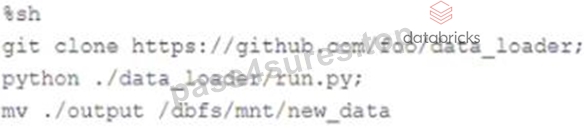
The code executes successfully and provides the logically correct results, however, it takes over 20 minutes to extract and load around 1 GB of data.
Which statement is a possible explanation for this behavior?
- A. Instead of cloning, the code should use %sh pip install so that the Python code can get executed in parallel across all nodes in a cluster.
- B. Python will always execute slower than Scala on Databricks. The run.py script should be refactored to Scala.
- C. %sh executes shell code on the driver node. The code does not take advantage of the worker nodes or Databricks optimized Spark.
- D. %sh does not distribute file moving operations; the final line of code should be updated to use %fs instead.
- E. %sh triggers a cluster restart to collect and install Git. Most of the latency is related to cluster startup time.
Answer: C
Explanation:
https://www.databricks.com/blog/2020/08/31/introducing-the-databricks-web-terminal.html The code is using %sh to execute shell code on the driver node. This means that the code is not taking advantage of the worker nodes or Databricks optimized Spark. This is why the code is taking longer to execute. A better approach would be to use Databricks libraries and APIs to read and write data from Git and DBFS, and to leverage the parallelism and performance of Spark. For example, you can use the Databricks Connect feature to run your Python code on a remote Databricks cluster, or you can use the Spark Git Connector to read data from Git repositories as Spark DataFrames.
NEW QUESTION # 87
A junior developer complains that the code in their notebook isn't producing the correct results in the development environment. A shared screenshot reveals that while they're using a notebook versioned with Databricks Repos, they're using a personal branch that contains old logic. The desired branch nameddev-2.3.9 is not available from the branch selection dropdown.
Which approach will allow this developer to review the current logic for this notebook?
- A. Use Repos to pull changes from the remote Git repository and select the dev-2.3.9 branch.
- B. Use Repos to make a pull request use the Databricks REST API to update the current branch to dev-
2.3.9 - C. Use Repos to checkout the dev-2.3.9 branch and auto-resolve conflicts with the current branch
- D. Use Repos to merge the current branch and the dev-2.3.9 branch, then make a pull request to sync with the remote repository
- E. Merge all changes back to the main branch in the remote Git repository and clone the repo again
Answer: A
Explanation:
This is the correct answer because it will allow the developer to update their local repository with the latest changes from the remote repository and switch to the desired branch. Pulling changes will not affect the current branch or create any conflicts, as it will only fetch the changes and not merge them. Selecting the dev-
2.3.9 branch from the dropdown will checkout that branch and display its contents in the notebook. Verified References: [Databricks Certified Data Engineer Professional], under "Databricks Tooling" section; Databricks Documentation, under "Pull changes from a remote repository" section.
NEW QUESTION # 88
When using the complete mode to write stream data, how does it impact the target table?
- A. Entire stream waits for complete data to write
- B. Target table is overwritten for each batch
- C. Delta commits transaction once the stream is stopped
- D. Stream must complete to write the data
- E. Target table cannot be updated while stream is pending
Answer: B
Explanation:
Explanation
The answer is Target table is overwritten for each batch
Complete mode - The whole Result Table will be outputted to the sink after every trigger. This is supported for aggregation queries
NEW QUESTION # 89
A dataset has been defined using Delta Live Tables and includes an expectations clause: CON-STRAINT valid_timestamp EXPECT (timestamp > '2020-01-01') ON VIOLATION FAIL What is the expected behavior when a batch of data containing data that violates these constraints is processed?
- A. Records that violate the expectation are dropped from the target dataset and loaded into a quarantine table.
- B. Records that violate the expectation are added to the target dataset and recorded as invalid in the event log.
- C. Records that violate the expectation are added to the target dataset and flagged as in-valid in a field added to the target dataset.
- D. Records that violate the expectation are dropped from the target dataset and recorded as invalid in the event log.
- E. Records that violate the expectation cause the job to fail
Answer: E
Explanation:
Explanation
The answer is Records that violate the expectation cause the job to fail.
Delta live tables support three types of expectations to fix bad data in DLT pipelines Review below example code to examine these expectations, Diagram Description automatically generated with medium confidence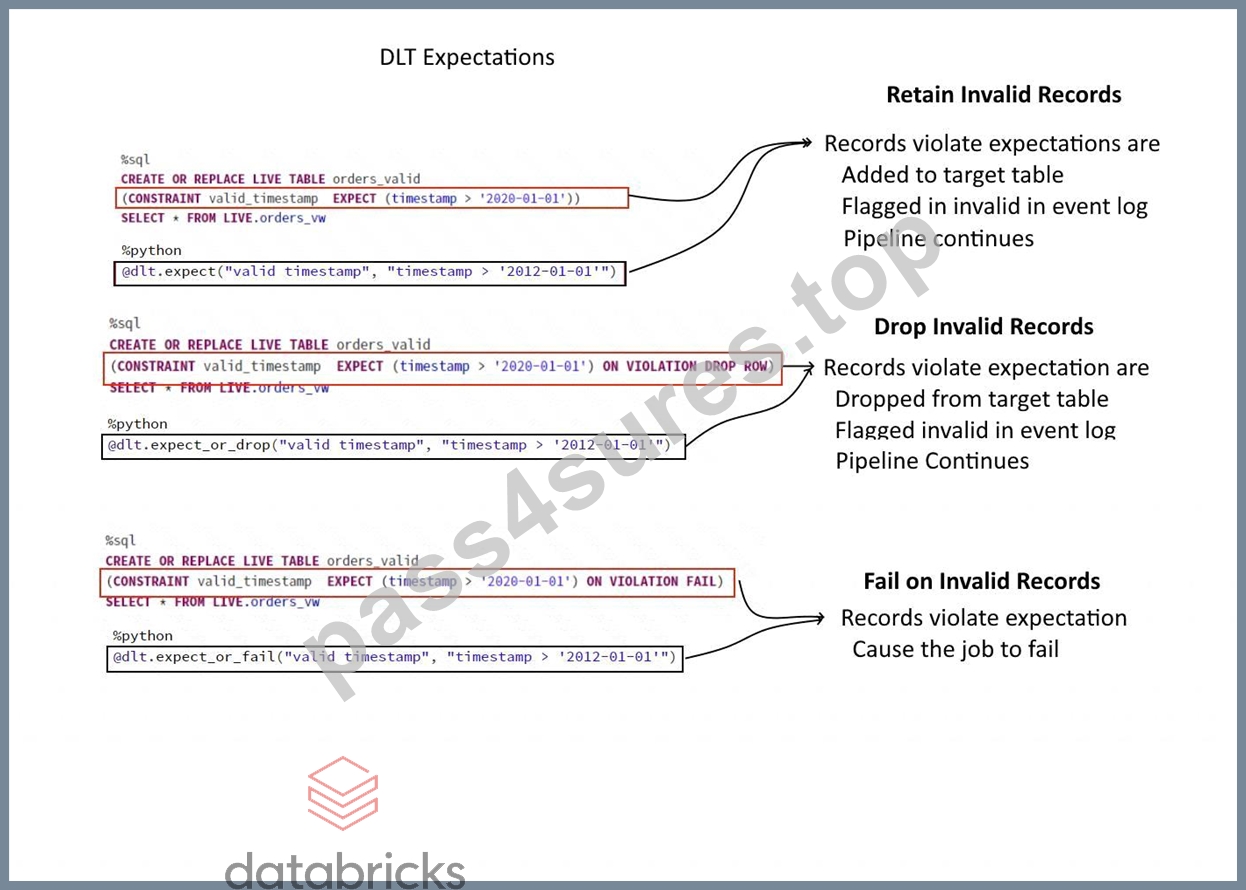
Invalid records:
Use the expect operator when you want to keep records that violate the expectation. Records that violate the expectation are added to the target dataset along with valid records:
SQL
CONSTRAINT valid_timestamp EXPECT (timestamp > '2020-01-01')
Drop invalid records:
Use the expect or drop operator to prevent the processing of invalid records. Records that violate the expectation are dropped from the target dataset:
SQL
CONSTRAINT valid_timestamp EXPECT (timestamp > '2020-01-01') ON VIOLATION DROP ROW Fail on invalid records:
When invalid records are unacceptable, use the expect or fail operator to halt execution immediately when a record fails validation. If the operation is a table update, the system atomically rolls back the transaction:
SQL
CONSTRAINT valid_timestamp EXPECT (timestamp > '2020-01-01') ON VIOLATION FAIL UP-DATE
NEW QUESTION # 90
In order to prevent accidental commits to production data, a senior data engineer has instituted a policy that all development work will reference clones of Delta Lake tables. After testing both deep and shallow clone, development tables are created using shallow clone.
A few weeks after initial table creation, the cloned versions of several tables implemented as Type 1 Slowly Changing Dimension (SCD) stop working. The transaction logs for the source tables show that vacuum was run the day before.
Why are the cloned tables no longer working?
- A. The data files compacted by vacuum are not tracked by the cloned metadata; running refresh on the cloned table will pull in recent changes.
- B. Running vacuum automatically invalidates any shallow clones of a table; deep clone should always be used when a cloned table will be repeatedly queried.
- C. The metadata created by the clone operation is referencing data files that were purged as invalid by the vacuum command
- D. Because Type 1 changes overwrite existing records, Delta Lake cannot guarantee data consistency for cloned tables.
Answer: C
Explanation:
In Delta Lake, a shallow clone creates a new table by copying the metadata of the source table without duplicating the data files. When the vacuum command is run on the source table, it removes old data files that are no longer needed to maintain the transactional log's integrity, potentially including files referenced by the shallow clone's metadata. If these files are purged, the shallow cloned tables will reference non-existent data files, causing them to stop working properly. This highlights the dependency of shallow clones on the source table's data files and the impact of data management operations like vacuum on these clones.
Databricks documentation on Delta Lake, particularly the sections on cloning tables (shallow and deep cloning) and data retention with the vacuum command (https://docs.databricks.com/delta/index.html).
NEW QUESTION # 91
A data engineer needs to capture pipeline settings from an existing in the workspace, and use them to create and version a JSON file to create a new pipeline.
Which command should the data engineer enter in a web terminal configured with the Databricks CLI?
- A. Stop the existing pipeline; use the returned settings in a reset command
- B. Use list pipelines to get the specs for all pipelines; get the pipeline spec from the return results parse and use this to create a pipeline
- C. Use the alone command to create a copy of an existing pipeline; use the get JSON command to get the pipeline definition; save this to git
- D. Use the get command to capture the settings for the existing pipeline; remove the pipeline_id and rename the pipeline; use this in a create command
Answer: D
Explanation:
The Databricks CLI provides a way to automate interactions with Databricks services. When dealing with pipelines, you can use the databricks pipelines get --pipeline-id command to capture the settings of an existing pipeline in JSON format. This JSON can then be modified by removing the pipeline_id to prevent conflicts and renaming the pipeline to create a new pipeline. The modified JSON file can then be used with the databricks pipelines create command to create a new pipeline with those settings.
:
Databricks Documentation on CLI for Pipelines: Databricks CLI - Pipelines
NEW QUESTION # 92
The data engineering team is migrating an enterprise system with thousands of tables and views into the Lakehouse. They plan to implement the target architecture using a series of bronze, silver, and gold tables.
Bronze tables will almost exclusively be used by production data engineering workloads, while silver tables will be used to support both data engineering and machine learning workloads. Gold tables will largely serve business intelligence and reporting purposes. While personal identifying information (PII) exists in all tiers of data, pseudonymization and anonymization rules are in place for all data at the silver and gold levels.
The organization is interested in reducing security concerns while maximizing the ability to collaborate across diverse teams.
Which statement exemplifies best practices for implementing this system?
- A. Because databases on Databricks are merely a logical construct, choices around database organization do not impact security or discoverability in the Lakehouse.
- B. Working in the default Databricks database provides the greatest security when working with managed tables, as these will be created in the DBFS root.
- C. Because all tables must live in the same storage containers used for the database they're created in, organizations should be prepared to create between dozens and thousands of databases depending on their data isolation requirements.
- D. Isolating tables in separate databases based on data quality tiers allows for easy permissions management through database ACLs and allows physical separation of default storage locations for managed tables.
- E. Storinq all production tables in a single database provides a unified view of all data assets available throughout the Lakehouse, simplifying discoverability by granting all users view privileges on this database.
Answer: D
Explanation:
Explanation
This is the correct answer because it exemplifies best practices for implementing this system. By isolating tables in separate databases based on data quality tiers, such as bronze, silver, and gold, the data engineering team can achieve several benefits. First, they can easily manage permissions for different users and groups through database ACLs, which allow granting or revoking access to databases, tables, or views. Second, they can physically separate the default storage locations for managed tables in each database, which can improve performance and reduce costs. Third, they can provide a clear and consistent naming convention for the tables in each database, which can improve discoverability and usability. Verified References: [Databricks Certified Data Engineer Professional], under "Lakehouse" section; Databricks Documentation, under "Database object privileges" section.
NEW QUESTION # 93
You are noticing job cluster is taking 6 to 8 mins to start which is delaying your job to finish on time, what steps you can take to reduce the amount of time cluster startup time
- A. Use All purpose cluster instead to reduce cluster start up time
- B. Reduce the size of the cluster, smaller the cluster size shorter it takes to start the clus-ter
- C. Use SQL endpoints to reduce the startup time
- D. Use cluster pools to reduce the startup time of the jobs
- E. Setup a second job ahead of first job to start the cluster, so the cluster is ready with re-sources when the job starts
Answer: D
Explanation:
Explanation
The answer is, Use cluster pools to reduce the startup time of the jobs.
Cluster pools allow us to reserve VM's ahead of time, when a new job cluster is created VM are grabbed from the pool. Note: when the VM's are waiting to be used by the cluster only cost incurred is Azure. Databricks run time cost is only billed once VM is allocated to a cluster.
Here is a demo of how to setup and follow some best practices,
https://www.youtube.com/watch?v=FVtITxOabxg&ab_channel=DatabricksAcademy
NEW QUESTION # 94
A junior data engineer has configured a workload that posts the following JSON to the Databricks REST API endpoint2.0/jobs/create.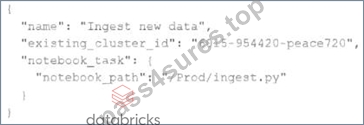
Assuming that all configurations and referenced resources are available, which statement describes the result of executing this workload three times?
- A. The logic defined in the referenced notebook will be executed three times on new clusters with the configurations of the provided cluster ID.
- B. Three new jobs named "Ingest new data" will be defined in the workspace, and they will each run once daily.
- C. Three new jobs named "Ingest new data" will be defined in the workspace, but no jobs will be executed.
- D. The logic defined in the referenced notebook will be executed three times on the referenced existing all purpose cluster.
- E. One new job named "Ingest new data" will be defined in the workspace, but it will not be executed.
Answer: D
Explanation:
This is the correct answer because the JSON posted to the Databricks REST API endpoint 2.0/jobs/create defines a new job with a name, an existing cluster id, and a notebook task. However, it does not specify any schedule or trigger for the job execution. Therefore, three new jobs with the same name and configuration will be created in the workspace, but none of them will be executed until they are manually triggered or scheduled.
Verified References: [Databricks Certified Data Engineer Professional], under "Monitoring & Logging" section; [Databricks Documentation], under "Jobs API - Create" section.
NEW QUESTION # 95
A data team's Structured Streaming job is configured to calculate running aggregates for item sales to update a downstream marketing dashboard. The marketing team has introduced a new field to track the number of times this promotion code is used for each item. A junior data engineer suggests updating the existing query as follows: Note that proposed changes are in bold.
Which step must also be completed to put the proposed query into production?
- A. Run REFRESH TABLE delta, /item_agg'
- B. Increase the shuffle partitions to account for additional aggregates
- C. Remove .option (mergeSchema', true') from the streaming write
- D. Specify a new checkpointlocation
Answer: D
Explanation:
When introducing a new aggregation or a change in the logic of a Structured Streaming query, it is generally necessary to specify a new checkpoint location. This is because the checkpoint directory contains metadata about the offsets and the state of the aggregations of a streaming query. If the logic of the query changes, such as including a new aggregation field, the state information saved in the current checkpoint would not be compatible with the new logic, potentially leading to incorrect results or failures. Therefore, to accommodate the new field and ensure the streaming job has the correct starting point and state information for aggregations, a new checkpoint location should be specified.
Reference:
Databricks documentation on Structured Streaming: https://docs.databricks.com/spark/latest/structured-streaming/index.html Databricks documentation on streaming checkpoints: https://docs.databricks.com/spark/latest/structured-streaming/production.html#checkpointing
NEW QUESTION # 96
The DevOps team has configured a production workload as a collection of notebooks scheduled to run daily using the Jobs Ul. A new data engineering hire is onboarding to the team and has requested access to one of these notebooks to review the production logic.
What are the maximum notebook permissions that can be granted to the user without allowing accidental changes to production code or data?
- A. Can edit
- B. Can run
- C. Can Read
- D. Can manage
Answer: C
Explanation:
Granting a user 'Can Read' permissions on a notebook within Databricks allows them to view the notebook's content without the ability to execute or edit it. This level of permission ensures that the new team member can review the production logic for learning or auditing purposes without the risk of altering the notebook's code or affecting production data and workflows. This approach aligns with best practices for maintaining security and integrity in production environments, where strict access controls are essential to prevent unintended modifications.
Reference: Databricks documentation on access control and permissions for notebooks within the workspace (https://docs.databricks.com/security/access-control/workspace-acl.html).
NEW QUESTION # 97
To reduce storage and compute costs, the data engineering team has been tasked with curating a series of aggregate tables leveraged by business intelligence dashboards, customer-facing applications, production machine learning models, and ad hoc analytical queries.
The data engineering team has been made aware of new requirements from a customer-facing application, which is the only downstream workload they manage entirely. As a result, an aggregate table used by numerous teams across the organization will need to have a number of fields renamed, and additional fields will also be added.
Which of the solutions addresses the situation while minimally interrupting other teams in the organization without increasing the number of tables that need to be managed?
- A. Replace the current table definition with a logical view defined with the query logic currently writing the aggregate table; create a new table to power the customer-facing application.
- B. Configure a new table with all the requisite fields and new names and use this as the source for the customer-facing application; create a view that maintains the original data schema and table name by aliasing select fields from the new table.
- C. Create a new table with the required schema and new fields and use Delta Lake's deep clone functionality to sync up changes committed to one table to the corresponding table.
- D. Add a table comment warning all users that the table schema and field names will be changing on a given date; overwrite the table in place to the specifications of the customer-facing application.
- E. Send all users notice that the schema for the table will be changing; include in the communication the logic necessary to revert the new table schema to match historic queries.
Answer: B
Explanation:
This is the correct answer because it addresses the situation while minimally interrupting other teams in the organization without increasing the number of tables that need to be managed. The situation is that an aggregate table used by numerous teams across the organization will need to have a number of fields renamed, and additional fields will also be added, due to new requirements from a customer-facing application. By configuring a new table with all the requisite fields and new names and using this as the source for the customer-facing application, the data engineering team can meet the new requirements without affecting other teams that rely on the existing table schema and name. By creating a view that maintains the original data schema and table name by aliasing select fields from the new table, the data engineering team can also avoid duplicating data or creating additional tables that need to be managed. Verified Reference: [Databricks Certified Data Engineer Professional], under "Lakehouse" section; Databricks Documentation, under "CREATE VIEW" section.
NEW QUESTION # 98
A data engineer has configured their Databricks Asset Bundle with multiple targets in databricks.yml and deployed it to the production workspace. Now, to validate the deployment, they need to invoke a job named my_project_job specifically within the prod target context. Assuming the job is already deployed, they need to trigger its execution while ensuring the target-specific configuration is respected.
Which command will trigger the job execution?
- A. databricks run my_project_job -t prod
- B. databricks job run my_project_job --env prod
- C. databricks execute my_project_job -e prod
- D. databricks bundle run my_project_job -t prod
Answer: D
Explanation:
Comprehensive and Detailed Explanation From Exact Extract of Databricks Data Engineer Documents:
Databricks Asset Bundles (DABs) enable declarative configuration and deployment of Databricks resources such as jobs, pipelines, and dashboards across multiple environments.
Once deployed, jobs can be executed in a specific target context using the databricks bundle run command, which ensures all environment-specific configurations from the bundle definition (such as parameters, cluster settings, and workspace URLs) are respected.
The -t flag specifies the target environment (e.g., dev, staging, or prod). This ensures that the execution runs with the correct configuration defined under that target in databricks.yml.
Other options (A, B, and C) are invalid because they reference deprecated or incorrect command syntax that doesn't integrate with bundle targets. Therefore, D is the correct and verified answer.
NEW QUESTION # 99
A data engineer is configuring a pipeline that will potentially see late-arriving, duplicate records.
In addition to de-duplicating records within the batch, which of the following approaches allows the data engineer to deduplicate data against previously processed records as it is inserted into a Delta table?
- A. Perform an insert-only merge with a matching condition on a unique key.
- B. Perform a full outer join on a unique key and overwrite existing data.
- C. Set the configuration delta.deduplicate = true.
- D. Rely on Delta Lake schema enforcement to prevent duplicate records.
- E. VACUUM the Delta table after each batch completes.
Answer: A
NEW QUESTION # 100
In order to facilitate near real-time workloads, a data engineer is creating a helper function to leverage the schema detection and evolution functionality of Databricks Auto Loader. The desired function will automatically detect the schema of the source directly, incrementally process JSON files as they arrive in a source directory, and automatically evolve the schema of the table when new fields are detected.
The function is displayed below with a blank:
Which response correctly fills in the blank to meet the specified requirements?
- A. Option C
- B. Option D
- C. Option B
- D. Option A
- E. Option E
Answer: C
Explanation:
Option B correctly fills in the blank to meet the specified requirements. Option B uses the
"cloudFiles.schemaLocation" option, which is required for the schema detection and evolution functionality of Databricks Auto Loader. Additionally, option B uses the "mergeSchema" option, which is required for the schema evolution functionality of Databricks Auto Loader. Finally, option B uses the "writeStream" method, which is required for the incremental processing of JSON files as they arrive in a source directory. The other options are incorrect because they either omit the required options, use the wrong method, or use the wrong format. References:
* Configure schema inference and evolution in Auto Loader:
https://docs.databricks.com/en/ingestion/auto-loader/schema.html
* Write streaming data:
https://docs.databricks.com/spark/latest/structured-streaming/writing-streaming-data.html
NEW QUESTION # 101
When building a DLT s pipeline you have two options to create a live tables, what is the main dif-ference between CREATE STREAMING LIVE TABLE vs CREATE LIVE TABLE?
- A. CREATE STREAMING LIVE table is used in MULTI HOP Architecture
- B. There is no difference both are the same, CREATE STRAMING LIVE will be deprecated soon
- C. CREATE LIVE TABLE is used in DELTA LIVE TABLES, CREATE STREAMING LIVE can only used in Structured Streaming applications
- D. CREATE LIVE TABLE is used when working with Streaming data sources and Incremental data
- E. CREATE STREAMING LIVE TABLE is used when working with Streaming data sources and Incremental data
Answer: E
Explanation:
Explanation
The answer is, CREATE STREAMING LIVE TABLE is used when working with Streaming data sources and Incremental data
NEW QUESTION # 102
A data team is automating a daily multi-task ETL pipeline in Databricks. The pipeline includes a notebook for ingesting raw data, a Python wheel task for data transformation, and a SQL query to update aggregates. They want to trigger the pipeline programmatically and see previous runs in the GUI. They need to ensure tasks are retried on failure and stakeholders are notified by email if any task fails.
Which two approaches will meet these requirements? (Choose 2 answers)
- A. Create a single orchestrator notebook that calls each step with dbutils.notebook.run(), defining a job for that notebook and configuring retries and notifications at the notebook level.
- B. Use Databricks Asset Bundles (DABs) to deploy the workflow, then trigger individual tasks directly by referencing each task's notebook or script path in the workspace.
- C. Create a multi-task job using the UI, Databricks Asset Bundles (DABs), or the Jobs REST API (/jobs/create) with notebook, Python wheel, and SQL tasks. Configure task-level retries and email notifications in the job definition.
- D. Trigger the job programmatically using the Databricks Jobs REST API (/jobs/run-now), the CLI (databricks jobs run-now), or one of the Databricks SDKs.
- E. Use the REST API endpoint /jobs/runs/submit to trigger each task individually as separate job runs and implement retries using custom logic in the orchestrator.
Answer: C,D
Explanation:
Comprehensive and Detailed Explanation From Exact Extract of Databricks Data Engineer Documents:
Databricks Jobs supports defining multi-task workflows that include notebooks, SQL statements, and Python wheel tasks. These can be configured with retry policies, dependency chains, and failure notifications. The correct practice, as stated in the documentation, is to use the Jobs REST API (/jobs/create) or Databricks Asset Bundles to define multi-task jobs, and then trigger them programmatically using /jobs/run-now, CLI, or SDK. This allows the team to maintain full job history, handle retries automatically, and receive alerts via configured email notifications. Using /jobs/runs/submit creates one-off ad hoc runs without maintaining dependency visibility. Therefore, options B and C together satisfy the operational, automation, and governance requirements.
NEW QUESTION # 103
Which of the following SQL commands are used to append rows to an existing delta table?
- A. COPY DELTA INTO table_name
- B. UPDATE table_name
- C. APPEND INTO DELTA table_name
- D. APPEND INTO table_name
- E. INSERT INTO table_name
Answer: E
Explanation:
Explanation
The answer is INSERT INTO table_name
Insert adds rows to an existing table, this is very similar to add rows a traditional Database or Da-tawarehouse.
NEW QUESTION # 104
You were asked to identify number of times a temperature sensor exceed threshold temperature (100.00) by each device, each row contains 5 readings collected every 5 minutes, fill in the blank with the appropriate functions.
Schema: deviceId INT, deviceTemp ARRAY<double>, dateTimeCollected TIMESTAMP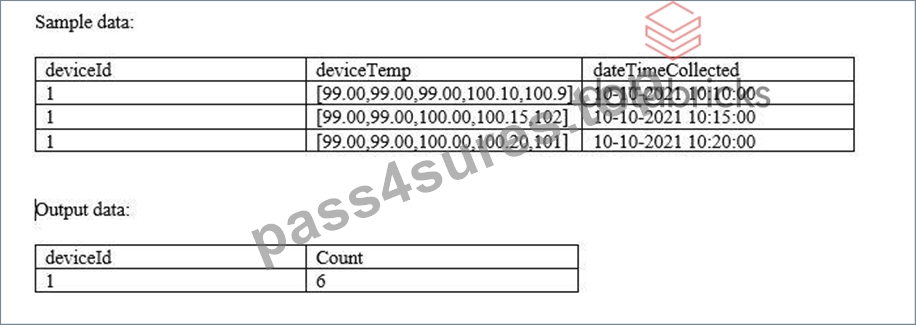
SELECT deviceId, __ (__ (__(deviceTemp], i -> i > 100.00)))
FROM devices
GROUP BY deviceId
- A. SUM, COUNT, SIZE
- B. SUM, SIZE, ARRAY_FILTER
- C. SUM, SIZE, FILTER
- D. SUM, SIZE, SLICE
- E. SUM, SIZE, ARRAY_CONTAINS
Answer: C
Explanation:
Explanation
FILER function can be used to filter an array based on an expression
SIZE function can be used to get size of an array
SUM is used to calculate to total by device
Diagram Description automatically generated
NEW QUESTION # 105
You are currently working on a production job failure with a job set up in job clusters due to a data issue, what cluster do you need to start to investigate and analyze the data?
- A. Existing job cluster can be used to investigate the issue
- B. All-purpose cluster/ interactive cluster is the recommended way to run commands and view the data.
- C. Databricks SQL Endpoint can be used to investigate the issue
- D. A Job cluster can be used to analyze the problem
Answer: B
Explanation:
Explanation
Answer is All-purpose cluster/ interactive cluster is the recommended way to run commands and view the data.
A job cluster can not provide a way for a user to interact with a notebook once the job is submitted, but an Interactive cluster allows to you display data, view visualizations write or edit quries, which makes it a perfect fit to investigate and analyze the data.
NEW QUESTION # 106
......
Reliable Databricks Certification Databricks-Certified-Professional-Data-Engineer Dumps PDF May 18, 2026 Recently Updated Questions: https://www.pass4sures.top/Databricks-Certification/Databricks-Certified-Professional-Data-Engineer-testking-braindumps.html