

Get 100% Passing Success With True CFPS Exam! [Apr-2024]
NFPA CFPS PDF Questions - Exceptional Practice To Certified Fire Protection Specialist (CFPS)
NEW QUESTION # 62
Which of the following would NOT be an appropriate purpose for employing a guard service to protect a property against fire loss?
- A. To carry out procedures for the orderly conduct of some operations on the property
- B. To protect the property at times when the management is not present
- C. To facilitate and control the movement of persons into, out of, and within the property
- D. To perform routine housekeeping and equipment maintenance operations during nonproduction hours
Answer: D
Explanation:
Explanation
The correct answer is C. To perform routine housekeeping and equipment maintenance operations during nonproduction hours would NOT be an appropriate purpose for employing a guard service to protect a property against fire loss. A guard service is typically hired to provide security and protection for a property, not to perform other tasks that are unrelated to fire prevention or control. Housekeeping and equipment maintenance operations should be done by qualified and authorized personnel who are trained and equipped to handle any potential fire hazards. A guard service may not have the necessary skills, tools, or authority to perform these operations safely and effectively.Moreover, these operations may interfere with the guard service's primary duty of monitoring and patrolling the property for any signs of fire or intrusion12345
NEW QUESTION # 63
NFPA 750 defines a low-pressure water mist system as one that operates at or below
- A. 125 psi (8.6 bar).
- B. 175 psi (11.9 bar).
- C. 150 psi (10.3 bar).
- D. 200 psi (13.8 bar).
Answer: C
NEW QUESTION # 64
Computers and other information technology equipment are particularly susceptible to
- A. special extinguishing agents.
- B. heat, steam, and combustion products.
- C. light, hoselines, and airborn dust.
- D. foam, metal powders, and dry chemicals.
Answer: B
Explanation:
Explanation
Computers and other information technology equipment are particularly susceptible to heat, steam, and combustion products, which can damage their sensitive components, cause data loss or corruption, and impair their functionality.Therefore, fire protection for IT equipment should consider the potential sources of heat, steam, and combustion products, such as electrical faults, flammable liquids, dust accumulation, water-based sprinklers, or smoke from adjacent areas, and implement appropriate measures to prevent, detect, and suppress fires, as well as to minimize the exposure of IT equipment to these hazards1234.References:Standard for the Fire Protection of Information Technology Equipment;Fire Protection of Computer Rooms-Legal Obligations and Best Practices - ISACA;Exploring Requirements for Information Technology Equipment;Demystifying IT room protection requirements - Consulting.
NEW QUESTION # 65
The minimum carbon dioxide design concentration for extinguishment of an ethylene fire is
- A. 40%
- B. 49%.
- C. 34%
- D. 43%.
Answer: D
Explanation:
Explanation
The minimum carbon dioxide design concentration for extinguishment of an ethylene fire is43%. This is based on the cup burner method, which is a standard test to determine the flame extinguishing concentration of a gaseous agent for a liquid fuel. Ethylene is a flammable gas that can form a liquid under pressure. The cup burner method involves placing a liquid fuel in a metal cup with a central nozzle, and flowing a gaseous agent through the nozzle to create a diffusion flame. The gaseous agent is gradually increased until the flame is extinguished.The minimum concentration of the gaseous agent required to extinguish the flame is recorded as the flame extinguishing concentration1.According to a study by NIST, the flame extinguishing concentration of carbon dioxide for ethylene was found to be 43%1.This value is also consistent with the NFPA 12 standard, which specifies the minimum design concentrations of carbon dioxide for various fuels, including ethylene2.
NEW QUESTION # 66
Probabilistic fire models are categorized into all of the following EXCEPT
- A. statistical.
- B. behavioral.
- C. network.
- D. simulation.
Answer: C
Explanation:
Explanation
Probabilistic fire models are categorized into network, statistical, simulation, and behavioral models. Network models use graph theory to represent the fire spread and the fire protection system in a building. Statistical models use historical data and probability distributions to estimate the likelihood and consequences of fire scenarios. Simulation models use mathematical equations and numerical methods to describe the physical and chemical processes of fire and its effects on the environment and the occupants. Behavioral models use psychological and sociological theories to predict the human response and evacuation behavior in case of fire.
Network models are not a common category of probabilistic fire models, and they are not mentioned in the sources provided by the user. Therefore, network models are the correct answer.
References:Probabilistic Fire Simulation Assessment Using Simplified Model and Zone Modelling of a Kitchen Fire Scenario;Computer Fire Models for Fire Investigation and Reconstruction;Fire Behavior
NEW QUESTION # 67
What are the two classes of fire models?
- A. Open and closed
- B. Behavioral and theoretical
- C. Field and laboratory
- D. Physical and mathematical
Answer: D
Explanation:
Explanation
The two classes of fire models arephysical and mathematical. Physical fire models are scaled-down representations of real fire scenarios, using laboratory experiments and measurements to study the fire behavior and effects.Physical fire models can be used to test hypotheses, validate mathematical models, and provide empirical data for fire analysis1. Mathematical fire models are numerical or analytical solutions of the equations that govern the fire phenomena, such as heat transfer, fluid dynamics, combustion, and chemical kinetics.Mathematical fire models can be used to simulate fire scenarios, predict fire outcomes, and optimize fire protection systems2. There are two major categories of mathematical fire models: zone models and field models. Zone models divide the fire compartment into two or more homogeneous zones, such as upper and lower layers, and apply mass and energy conservation equations to each zone.Zone models are relatively simple, fast, and easy to use, but they have limitations in accuracy and applicability3. Field models solve the partial differential equations that describe the fire-driven fluid flow and heat transfer in three dimensions, using computational fluid dynamics (CFD) techniques.Field models are more detailed, realistic, and flexible, but they require more computational resources and expertise4.References:
Fire modelling with Computational Fluid Dynamics - BRE Group
Fire modeling programs | NIST
interFIRE, A site dedicated to improving fire investigation worldwide.
Computer Fire Models for Fire Investigation and Reconstruction
NEW QUESTION # 68
Which type of plan review may provide information about a modification such as the removal of an abandoned underground flammable liquid tank?
- A. Final building plan review
- B. As built plan review
- C. Preliminary building plan review
- D. Site plan review
Answer: B
Explanation:
Explanation
An as built plan review is a type of plan review that may provide information about a modification such as the removal of an abandoned underground flammable liquid tank. An as built plan review is conducted after the construction or alteration of a building orsystem is completed and before the final approval or acceptance by the AHJ. An as built plan review verifies that the building or system conforms to the approved plans and specifications and complies with the applicable codes and standards. An as built plan review may also identify any changes or deviations from the original plans that occurred during the construction or alteration process, such as the removal of an underground tank.References:
NFPA 1: Fire Code, 2018 Edition, Section 1.12.8.1.11
Fire Protection Handbook, 20th Edition, Volume 1, Chapter 5, Section 5.2.3.42
NEW QUESTION # 69
Which type of fire alarm system transmits signals that are permanently recorded at a constantly attended supervising station located either at the protected premises or at another location of the property owner?
- A. Central station
- B. Auxiliary
- C. Remote station
- D. Proprietary
Answer: D
Explanation:
Explanation
A proprietary fire alarm system is a type of fire alarm system that transmits signals that are permanently recorded at a constantly attended supervising station located either at the protected premises or at another location of the property owner. A proprietary fire alarm system is owned and operated by the property owner or the owner's agent. A proprietary fire alarm system is intended to provide fire alarm service to a single property or a campus of related properties.References:
NFPA 72: National Fire Alarm and Signaling Code, 2019 Edition, Section 3.3.105.11 Fire Protection Handbook, 20th Edition, Volume 1, Chapter 7, Section 7.2.1.12
NEW QUESTION # 70
When assessing industrial fire risks, the type of risk management conducted depends on the significance of the decision, the complexity of the problem, and
- A. evaluation methodologies.
- B. time and cost limitations.
- C. owner and management expectations.
- D. documentation requirements.
Answer: B
NEW QUESTION # 71
In 1979, the phenomenon of convergence cluster formation in human fire behavior was identified in which of the following?
- A. High-rise apartment building
- B. Wood-frame hotel
- C. University dormitory
- D. Large assembly building
Answer: C
Explanation:
Explanation
The phenomenon of convergence cluster formation in human fire behavior was identified in 1979 in a university dormitory fire. This phenomenon refers to the tendency of people to gather in groups near familiar exits or locations during a fire, rather than seeking alternative escape routes1. This can result in congestion, delay, and increased risk of injury or death2. The university dormitory fire occurred at the Providence College in Rhode Island, where 10 students died and 40 were injured. The fire started in a trash chute and spread to the upper floors. Many students tried to escape through the main stairwell, which became blocked by smoke and flames. Some students jumped from the windows, while others remained trapped in their rooms. The fire revealed the lack of fire safety education, fire drills, and fire protection systems in the dormitory3.
References:
Human Behavior in Fire Emergencies
Human Behavior in Fire: Understanding Human Behavior for Better Fire Safety Design Providence College Dormitory Fire
NEW QUESTION # 72
The minimum width of a doorway in a means of egress to accommodate a person in a wheelchair is
- A. 28 inches (711 mm).
- B. 40 inches (1016 mm).
- C. 36 inches (914 mm).
- D. 32 inches (813 mm).
Answer: D
Explanation:
Explanation
The minimum width of a doorway in a means of egress to accommodate a person in a wheelchair is 32 inches (813 mm).This is based on the requirements of the Americans with Disabilities Act (ADA) and the International Building Code (IBC), which both specify that doors in a path of egress and doors on an accessible route must have a clear opening width of at least 32 inches (813 mm)12. This width allows enough space for a person in a wheelchair to maneuver through the doorway without difficulty. A wider doorway may be preferable for some types of wheelchairs or other assistive devices, but 32 inches (813 mm) is the minimum standard for accessibility and safety.References:DECODED: Calculating the Egress Width of Door Openings - I Dig Hardware;Digital Codes.
NEW QUESTION # 73
What is the occupancy factor used by the Insurance Services Office (ISO) for computing required fire flow for C-3 (Combustible)?
- A. 0.85
- B. 0.75
- C. 1.15
- D. 1.00
Answer: D
NEW QUESTION # 74
The ignition test method that exposes the specimen to a known heat flux from a tungsten-quartz heater is referred to as a
- A. cone calorimeter.
- B. lateral ignition apparatus.
- C. intermediate-scale calorimeter.
- D. fire propagation apparatus.
Answer: A
Explanation:
Explanation
The cone calorimeter is an ignition test method that exposes the specimen to a known heat flux from a tungsten-quartz heater. The cone calorimeter measures the heat release rate, mass loss rate, smoke production, and other parameters of the specimen during the test. The cone calorimeter is widely used to evaluate the flammability and fire behavior of materials and products.References:
NFPA 557: Standard for Determination of Fire Loads for Use in Structural Fire Protection Design, 2017 Edition, Section 5.3.2.11 NFPA 556: Guide on Methods for Evaluating Fire Hazard to Occupants of Passenger Road Vehicles,
2019 Edition, Section 4.3.22
Fire Protection Handbook, 20th Edition, Volume 1, Chapter 3, Section 3.2.2.23
NEW QUESTION # 75
For wet-pipe automatic sprinkler systems, the only proper way to test the operation of a vane-type water flow alarm initiating device is to open the
- A. valve at the inspector's test connection.
- B. alarm test by-pass valve at the system's main riser.
- C. main (2 in. diameter) drain.
- D. check valve from the city connection.
Answer: A
Explanation:
Explanation
valve at the inspector's test connection.
For wet-pipe automatic sprinkler systems, the only proper way to test the operation of a vane-type water flow alarm initiating device is to open the valve at the inspector's test connection. This is a small valve that is located at the end of a pipe that is connected to the sprinkler system, usually at the most remote or highest point. The inspector's test connection simulates the flow of a single sprinkler head and activates the vane-type water flow switch, which in turn triggers the fire alarm panel and the external alarm devices.Opening the valve at the inspector's test connection also allows the water to drain from the system, preventing corrosion and freezing1234 Opening the main (2 in. diameter) drain is not a proper way to test the operation of a vane-type water flow alarm initiating device, because it does not create enough flow to activate the switch. The main drain is used to drain the entire sprinkler system for maintenance or repair purposes, and it is usually located at the main riser or the fire department connection.Opening the main drain may also cause a pressure drop in the system, which could affect the performance of the sprinklers1234 Opening the alarm test by-pass valve at the system's main riser is not a proper way to test the operation of a vane-type water flow alarm initiating device, because it does not simulate the actual flow of a sprinkler head.
The alarm test by-pass valve is used to test the operation of the external alarm devices, such as the water motor gong or the electric bell, without activating the fire alarm panel. The alarm test by-pass valve is usually located near the alarm check valve or the water flow switch, and it allows water to flow through a small orifice to the alarm devices.Opening the alarm test by-pass valve does not create enough flow to activate the vane-type water flow switch1234 Opening the check valve from the city connection is not a proper way to test the operation of a vane-type water flow alarm initiating device, because it does not create any flow in the sprinkler system. The check valve from the city connection is used to prevent the backflow of water from the sprinkler system to the city water supply, and it is usually located at the fire department connection or the main riser.Opening the check valve from the city connection does not affect the water flow in the sprinkler system, and it does not activate the vane-type water flow switch1234 References:
Fire Sprinkler Flow Switch & Tamper Switch Inspection & Maintenance3
Sprinkler System Water Flow Device Testing - ORR Protection2
VSR-AT Auto-Test Waterflow Alarm Switch | Potter Electric4
WFDNA Series Vane-type Waterflow Detectors - Steel Fire Equipment5
NEW QUESTION # 76
The computer simu-lation egress model that is often referred to as the hydraulic model and also known as
- A. single-parameter estimation model.
- B. behavioral simulation model.
- C. egress model.
- D. movement model.
Answer: D
NEW QUESTION # 77
Explosions or fires from flammable gas or oil fuel vapor-air mixtures may be prevented by ventilation and controls that keep the flammable vapor content below what percent of the lower flammable limit of the vapor-air mixture?
- A. 15%
- B. 35%
- C. 45%
- D. 25%
Answer: D
Explanation:
Explanation
25%
Explosions or fires from flammable gas or oil fuel vapor-air mixtures may be prevented by ventilation and controls that keep the flammable vapor content below 25% of the lower flammable limit (LFL) of the vapor-air mixture, according to the web search results. The LFL is the lowest concentration of a gas or vapor in air that can produce a flash of fire in the presence of an ignition source. Below the LFL, the mixture is too lean to burn. The LFL varies for different gases and vapors, and it is usually expressed as a percentage by volume of air at 25°C and atmospheric pressure. For example, the LFL of methane is 4.4%, which means that a mixture of methane and air with less than 4.4% methane cannot ignite. To prevent explosions or fires, the concentration of flammable gases or vapors should be kept below 25% of their LFL, which is equivalent to
1.1% methane in this case. Ventilation, natural or mechanical, is one of the methods to achieve this by diluting the flammable gases or vapors with fresh air.Controls, such as gas detectors, alarms, valves, and interlocks, are another method to monitor and regulate the flammable gas or vapor levels and prevent them from reaching dangerous concentrations1234
NEW QUESTION # 78
Power for driving fire pumps is selected on the basis of reliability, adequacy, economy, and
- A. safety.
- B. adaptability.
- C. ecology.
- D. efficiency.
Answer: A
Explanation:
Explanation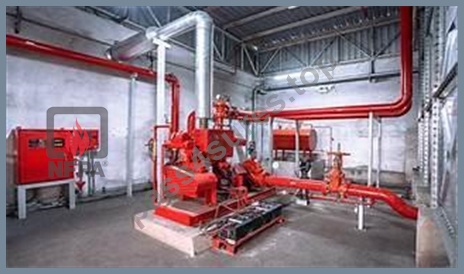
Fire pump
Explore
The correct answer is B.Safety is one of the criteria for selecting the power source for driving fire pumps, according to NFPA 20, Chapter 9.1.1.11. Reliability, adequacy, and economy are the other criteria mentioned in the same chapter. Efficiency, adaptability, and ecology are not explicitly stated as criteria in NFPA 20, although they may be considered as secondary factors in some cases.
1:Pump Installation: Everything About Electric and Diesel Driven Fire ...
NEW QUESTION # 79
What is the maximum allowable travel distance from any part of a smoke compartment to the door in a smoke barrier in a new health care facility?
- A. 50 ft. (15 m).
- B. 150 ft. (46 m).
- C. 100 ft.(30 m).
- D. 200 ft. (60 m).
Answer: D
Explanation:
Explanation
The maximum allowable travel distance from any part of a smoke compartment to the door in a smoke barrier in a new health care facility is 200 ft. (60 m). This is based on NFPA 101: Life Safety Code, 2018 Edition, Chapter 18, Section 18.3.7.3, which states that "the travel distance from any point in a smoke compartment to reach a door in the required smoke barrier shall not exceed 200 ft (61 m)." A smoke compartment is a space within a building that is enclosed by smoke barriers on all sides, including the top and bottom. A smoke barrier is a continuous membrane, or a combination of materials, that is designed to restrict the movement of smoke.A smoke barrier door is a door assembly that is installed in a smoke barrier to allow access between smoke compartments123
NEW QUESTION # 80
The duration of required fire flow in public supply systems ranges from
- A. 2-10 hours.
- B. 3-8 hours.
- C. 1-6 hours.
- D. 1-4 hours.
Answer: D
Explanation:
Explanation
The duration of required fire flow in public supply systems depends on the type of occupancy, construction, and exposure of the building, as well as the availability and reliability of the water supply. According to NFPA
1, Fire Code, Table 18.4.5.1.2, the minimum duration of fire flow for most occupancies ranges from 1 to 4 hours, with some exceptions for high-rise buildings, health care facilities, and special hazards. The fire flow duration is intended to provide enough water for fire suppression and exposure protection until the fire is under control or extinguished.References: NFPA 1, Fire Code, 2023 Edition, Section 18.4.5.1.2 and Table 18.4.5.1.2; NFPA Fire Protection Handbook, 21st Edition, Chapter 9, Section 9.2.2.
NEW QUESTION # 81
What are the human health effects of exposure for two minutes at a concentration of less than 50 ppm of hydrogen fluoride?
- A. Mild eye and upper respiratory tract irritation.
- B. Moderate eye and upper respiratory tract irritation.
- C. Moderate irritation of all body surfaces.
- D. Slight eye and nasal irritation.
Answer: A
Explanation:
Explanation
According to the CDC, exposure to hydrogen fluoride at concentrations of less than 50 ppm for two minutes may cause mild eye and upper respiratory tract irritation. The severity of the effects depends on the concentration, duration, and route of exposure, as well as the individual's susceptibility. Higher concentrations or longer exposures can cause more serious health effects, such as pulmonary edema, skin burns, or systemic toxicity.References:CDC | Facts About Hydrogen Fluoride (Hydrofluoric Acid); [Hydrogen Fluoride (HF) | Medical Management Guidelines | Toxic Substance Portal | ATSDR]2; [Hydrogen Fluoride and Hydrofluoric Acid (HF) - GOV.UK]3.
NEW QUESTION # 82
......
CFPS dumps - Pass4sures - 100% Passing Guarantee: https://www.pass4sures.top/Fire-Protection-Specialist/CFPS-testking-braindumps.html
Fast, Hands-On CFPS exam: https://drive.google.com/open?id=1LWPutVv9zZHllPtylw6ANfKcbnGgU0bi