

Pass Adobe AD0-E724 Exam with Guarantee Updated 148 Questions
Latest AD0-E724 Pass Guaranteed Exam Dumps Certification Sample Questions
NEW QUESTION # 74
Which method type can be intercepted by plugins?
- A. static
- B. final
- C. public
Answer: C
Explanation:
In Magento, plugins (Interceptors) can only intercept public methods. This is because the plugin system relies on Magento's object manager to dynamically create proxy classes that can intercept method calls. Since private and final methods are not accessible from outside the class they are defined in, and static methods are not called on an object instance, these method types cannot be intercepted. This mechanism allows for the extension and customization of Magento's core behavior in a transparent and non-intrusive manner.
NEW QUESTION # 75
A custom theme Is being developed in the Adobe Commerce store, and the developer needs to override the current parent theme styles.
Which less file should the developer use to achieve this goal?
- A. _source.less
- B. _hemeless
- C. _theme.override.less
Answer: B
Explanation:
To override the current parent theme styles in a custom theme being developed for Adobe Commerce, the developer should use the_theme.lessfile. This file is specifically designed for customizing and overriding the default styles provided by the parent theme, making option B the correct choice. The_theme.lessfile is a central place for theme-specific customizations.
NEW QUESTION # 76
A developer defined a new table in db.schema.xml while creating a new module.
What should be done to allow the removal of columns from the database when deleting them from db.schema.
xml?
- A. The removable columns should be defined in db_schema_whitelist.json.
- B. The removable columns should be defined in db.schema_blacklist.json.
- C. The columns should have "removable" attribute set to "true" in the db.schema.xml.
Answer: A
Explanation:
If a developer wants to allow the removal of columns from the database when deleting them fromdb.schema.
xml, they need to define the removable columns in thedb_schema_whitelist.jsonfile. This file will tell Magento which columns can be removed from the database.
To allow columns to be removed from the database when they are deleted fromdb_schema.xml, they must be listed in thedb_schema_whitelist.jsonfile. This file acts as a reference for which database schema elements are safe to modify or delete, providing a safeguard against unintentional data loss during schema updates.
NEW QUESTION # 77
An Adobe Commerce developer is tasked with creating a custom block that will be displayed on every page in the footer of the site.
After completing and optimizing the development, the developer notices that the block takes too much time to be generated on each page and decides to store it in the system cache after enabling it for all cache groups.
What would be the minimum requirement to achieve this?
- A. Set a value for cache_key data property of the block.
- B. Set a value for the cache_Lifetime data property of the block.
- C. Set values for both cache_lifetime and cache_key data properties of the block.
Answer: B
NEW QUESTION # 78
On the Adobe Commerce Cloud Project Web Interface, what will be performed when clicking on the "Delete" button of an integration environment?
- A. The environment is marked as "inactive", the git branch is still present but the database is deleted.
- B. The environment is marked as "inactive", the git branch and the database are still present.
- C. The environment is completely deleted. Including git branch and database.
Answer: C
Explanation:
On the Adobe Commerce Cloud Project Web Interface, clicking on the "Delete" button of an integration environment will completely delete the environment, including the associated git branch and database. This action is irreversible and is used to remove an environment that is no longer needed. The environment, once deleted, frees up resources for the project and cannot be restored.
NEW QUESTION # 79
Which index mode is valid?
- A. Update on invalidate
- B. Update on save
- C. Update on refresh
Answer: B
Explanation:
"Update on save" is a valid index mode in Magento, where the index is set to update automatically whenever a change is saved. This mode ensures that the index remains up-to-date with the latest data changes, such as product or category updates, immediately reflecting these changes on the storefront. This real-time indexing is crucial for maintaining data accuracy and consistency across the Magento site, especially in dynamic environments with frequent updates.
NEW QUESTION # 80
How would a developer add a sensitive environment-specific configuration value on an Adobe Commerce Cloud project?
- A. Add sensitive Environment-specific variable in the Project Web Interface.
- B. Use the Cloud CLI for Commerce command Mgento-cloud config:set to add the configuration
- C. Connect to the server using SSH and add the configuration in the app/etc/config.php file.
Answer: A
Explanation:
To add a sensitive environment-specific configuration value on an Adobe Commerce Cloud project, the developer should use the Project Web Interface. This interface allows for the secure entry of sensitive data, which is then encrypted and stored securely. This method ensures that sensitive information is not exposed in the codebase or version control.
NEW QUESTION # 81
A merchant wants to include taxes In an Adobe Commerce store. Which option can have a tax class assigned to it?
- A. Category
- B. Order
- C. Shipping
Answer: C
Explanation:
According to the Adobe Commerce User Guide, a tax class can be assigned to either a product or a customer group in Adobe Commerce. A product tax class determines how a product is taxed, while a customer tax class determines how a customer is taxed based on their location and group membership. Shipping is considered as a product tax class in Adobe Commerce, and it can be assigned to different shipping methods or rates. The other options are not valid for assigning a tax class.
In Adobe Commerce, tax classes can be assigned to products and shipping. Categories, however, do not have tax classes assigned to them directly. Tax classes applied to shipping allow merchants to specify how taxes should be calculated for shipping costs, making option B the correct answer. Orders and categories do not have direct associations with tax classes in the same way products and shipping do.
NEW QUESTION # 82
An Adobe Commerce developer wants to generate a list of products using ProductRepositorylnterf ace and search for products using a supplier_id filter for data that is stored in a standalone table (i.e., not in an EAV attribute).
Keeping maintainability in mind, how can the developer add the supplier ID to the search?
- A. Write a before plugin On \Magento\Framework\Api\SearchCriteria\CollectionProcessorInterface: :
process(). Iterate through the $searchCriteria
provided for supplier_id, and if found, apply the needed join and filter to the passed scollection. - B. Write a before plugin on \Hagento\catalogVtodel\ProductRepository: :geti_ist() and register the search criteria passed. Write an event observer to 0 listen for the event cataiog_product_coiiection_ioad_before. Iterate through the registered search criteria, and if found, apply the needed join and filter to the events scollection.
- C. Add a CUStOm filter to the Virtual type
"agento\Catalog\Model\Api\SearchCriteria\CollectionProcessor\ProductFilterProce5sor for supplier_id field. In the custom filter, apply the needed join and filter to the passed $collection.
Answer: C
Explanation:
The developer can add a custom filter to the virtual type
Magento\Catalog\Model\Api\SearchCriteria\CollectionProcessor\ProductFilterProce5sor for supplier_id field.
In the custom filter, the developer can apply the needed join and filter to the passed $collection. This is the recommended way to extend the search criteria for products using dependency injection and plugins. Verified References: [Magento 2.4 DevDocs] [Magento Stack Exchange] In Adobe Commerce, when you need to add a custom filter for a non-EAV attribute stored in a standalone table, the most maintainable approach is to create a custom filter for ProductFilterProcessor. This processor allows for customized search criteria handling, which can be extended to include custom joins and filters without altering core functionality or relying on plugins and observers.
* Why Custom Filter in ProductFilterProcessor is Preferred:
* The ProductFilterProcessor within SearchCriteria\CollectionProcessor is specifically designed to handle filtering of product collections. By extending this with a custom filter, the developer can implement joins and filters on standalone tables.
* This approach is modular and reusable, allowing any code that utilizes ProductRepositoryInterface to apply the supplier_id filter seamlessly.
* Implementation of Custom Filter:
* Define a custom filter class that implements the required logic to join the standalone table and apply the supplier_id filter.
* Register this custom filter with a virtual type in di.xml for ProductFilterProcessor, so it can process the supplier_id as part of the search criteria.
* Why Options A and C are Less Suitable:
* Option A relies on an event observer, which is less modular and may have performance implications since it requires listening to every product collection load event.
* Option C, while functional, involves modifying CollectionProcessorInterface::process(), which is more generic and not specifically tailored for product collection filtering.
NEW QUESTION # 83
What does a URL Rewrite do?
- A. It updates the URL that is stored on the server.
- B. It changes the way a URL appears in the browser
- C. It updates the URL to a domain that is not being Indexed.
Answer: B
Explanation:
A URL Rewrite in Magento changes the way a URL appears in the browser. This is particularly useful for improving the readability and SEO of a URL. For example, a URL rewrite can be used to transform a long and complex URL into a shorter and more user-friendly version. It's important to note that while a URL rewrite changes the URL's appearance in the browser, it doesn't change the actual location of the resource on the server. This distinction is crucial for understanding how Magento handles URL rewrites and redirects, facilitating a more intuitive navigation structure within the store without altering the underlying server resources.
NEW QUESTION # 84
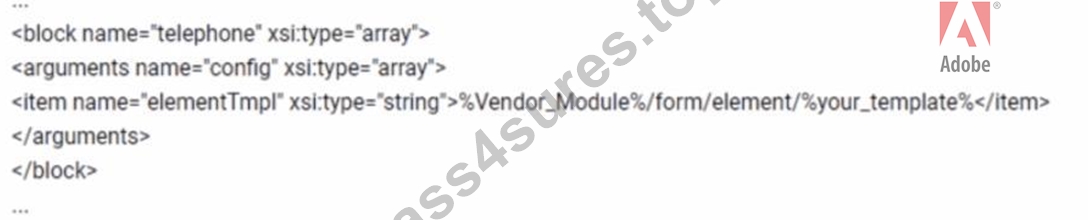
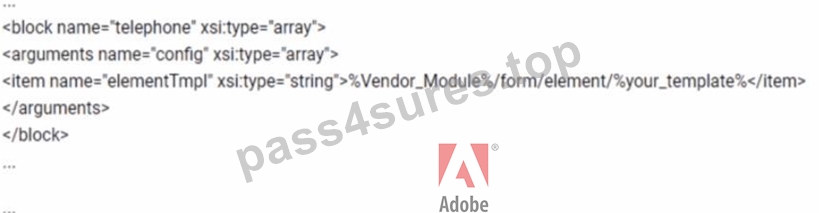
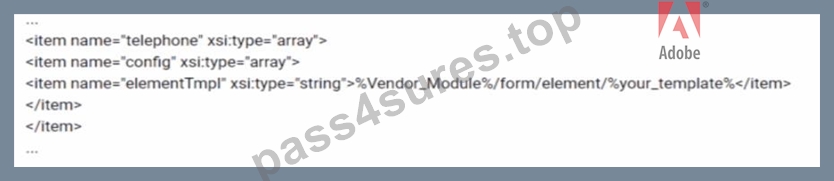
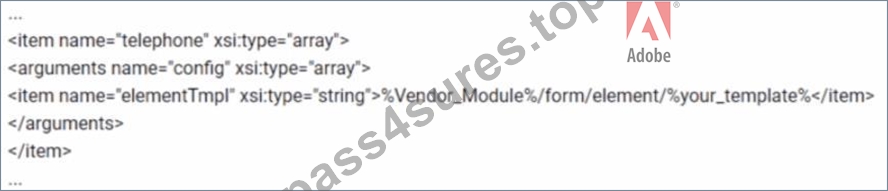
A client would like to add an image icon in front of the telephone field to the shipping address form on a checkout page. What is the correct way to modify the Ul component to set a custom template file for the field?
- A.
- B.
- C.
- D.
Answer: B
Explanation:
To add an image icon in front of the telephone field in the shipping address form on the checkout page, the correct way is to modify the UI component by setting a custom template file for the field. The snippet in option B is the correct one because it uses the<block>element and sets theelementTmplto the custom template path within theargumentsnode under theconfignode. This modification will instruct Magento to use the specified custom template file for rendering the telephone field, allowing for the addition of an image icon in front of it.
NEW QUESTION # 85
Which type of product has the ability to build customizable products from a variety of options?
- A. Virtual
- B. Grouped
- C. Bundle
Answer: C
Explanation:
A bundle product is a product that is made up of a collection of other products. This type of product is ideal for selling products that are often purchased together, such as a printer and ink cartridges.
A bundle product in Adobe Commerce has the ability to build customizable products from a variety of options. Bundle products are ideal for creating custom kits or packages where customers can choose from options for each component. For example, building a custom computer setup from selected components like monitors, keyboards, CPUs, etc. Grouped products are collections of standalone products that can be purchased individually, and virtual products are intangible items.
NEW QUESTION # 86
Which type of product would assist a seller who would like to offer an electronic version of an album for sale and sell each song individually?
- A. Configurable
- B. Downloadable
- C. Simple
Answer: B
Explanation:
The type of product that would assist a seller in offering an electronic version of an album and selling each song individually is a Downloadable product. In Adobe Commerce, a Downloadable product type is specifically designed for selling digital products such as music files, which customers can download. This type of product allows sellers to upload individual songs and sell them separately or as part of a complete album.
NEW QUESTION # 87
A developer has informed the Adobe Support team about a planned traffic surge on an Adobe Commerce Cloud project that will take place in a little over 48 hours.
What is an advantage of this prior notice?
- A. When the traffic arrives, extra server resources will be available.
- B. The Support team will monitor the website during that time
- C. The project will temporarily use an upgraded Fastly plan
Answer: B
Explanation:
Informing the Adobe Support team about a planned traffic surge allows them to monitor the website during that time. With prior notice, the support team can ensure that they are prepared to quickly respond to any issues that arise due to the surge. While extra server resources or an upgraded Fastly plan may be possible outcomes, the primary advantage of advance notice is proactive monitoring and support during expected high traffic events.
NEW QUESTION # 88
What database engine is part of the infrastructure of Adobe Commerce Cloud projects?
- A. MariaDB
- B. Percona
- C. MySQL
Answer: A
Explanation:
The database engine that is part of the infrastructure of Adobe Commerce Cloud projects is MariaDB.
MariaDB is a fork of MySQL that offers improved performance, scalability, and security features.
The database engine that is part of the infrastructure of Adobe Commerce Cloud projects is MariaDB. Adobe Commerce Cloud is configured to use MariaDB, which is a binary drop-in replacement for MySQL and is chosen for its performance, reliability, and feature set.
NEW QUESTION # 89
What will happen if a developer fails to mention the start date in the "From" field when creating a price rule?
- A. The price rule will go into effect as soon as it is saved
- B. The price rule will not be saved.
- C. The price rule will be saved, but it will not go into effect until the start date is added
Answer: A
Explanation:
If a developer fails to mention the start date in the "From" field when creating a price rule, the price rule will be saved. However, the price rule will not go into effect until the start date is added.
If a developer fails to mention the start date in the "From" field when creating a price rule in Adobe Commerce, the system will default to the current date, and the price rule will go into effect as soon as it is saved. The absence of a start date means there is no delay in the activation of the rule, and it becomes effective immediately upon saving.
NEW QUESTION # 90
A developer wants to deploy a new release to the Adobe Commerce Cloud Staging environment, but first they need the latest code from Production.
What would the developer do to update the Staging environment?
- A. 1. Log in to the Project Web Interface.
2. Choose the Staging environment, and click Merge - B. 1. Checkout to Production environment
2. Use the magento-cloud synchronize <environment-ID> Commerce CLI Command - C. 1, Log in to the Project Web Interface.
2. Choose the Staging environment, and click Sync
Answer: C
Explanation:
To update the Staging environment with the latest code from the Production environment on an Adobe Commerce Cloud project, the developer would log in to the Project Web Interface, choose the Staging environment, and then click Sync. This action synchronizes the environments, bringing the latest changes from Production into Staging.
NEW QUESTION # 91
A new custom module is built for the existing Adobe Commerce store. A merchant has requested a few frontend updates. For this, a developer has to implement a custom style.
What is the location of the less file that will be included by default?
- A. view/{area}/web/css/style less
- B. view/{area}/web/css/source/main less
- C. view/{area}/web/css/source/_module.less
Answer: B
Explanation:
Theview/{area}/web/css/source/main.lessfile is the default less file that is included by default. This file contains the main styles for the module.
In a custom module in Adobe Commerce, the default location for including custom LESS styles is typically view/{area}/web/css/source/_module.less. However, the most commonly used file for adding global styles is view/{area}/web/css/source/_extend.less. Theview/{area}/web/css/style.lessfile is not standard, and the main.lessfile is used as an entry point for compilation but typically does not contain custom styles directly.
NEW QUESTION # 92
A product has been added to the Adobe Commerce Store, and it contains a value for the custom product attribute. A merchant reports that the attribute value is not displayed in the Additional Information tab on the product detail page.
Which action will correct this problem?
- A. The attribute property "Use in Product Tab' must be set to "yes"
- B. The attribute property "Visible on Catalog Pages on Storefront" must be set to "yes".
- C. The attribute must be moved to the specific group in the attribute set
Answer: B
Explanation:
The "Visible on Catalog Pages on Storefront" attribute property determines whether or not the attribute value is displayed in the Additional Information tab on the product detail page. If this property is set to "no", the attribute value will not be displayed.
For a custom product attribute to be displayed in the Additional Information tab on the product detail page in Magento, it needs to be visible on the catalog pages on the storefront. This visibility is controlled by the attribute property "Visible on Catalog Pages on Storefront". When this property is set to "yes", Magento includes the attribute in the Additional Information tab, making it visible to customers browsing the product.
This setting ensures that only relevant and intended attributes are shown on the storefront, allowing for better product information management and customer experience.
NEW QUESTION # 93
An Adobe Commerce developer is about to deploy a critical feature to their Adobe Commerce Cloud (Pro Plan) production. They want to create a snapshot in order to be able to rollback if there is an issue with the feature.
How would they create the snapshot?
- A. Create a ticket to Adobe Commerce Cloud support.
- B. Use the Cloud CLI for Commerce dedicated command.
- C. Use the dedicated button on Project Web Interface.
Answer: B
Explanation:
To create a snapshot before deploying changes in Adobe Commerce Cloud (Pro Plan), the recommended approach is to use the Cloud CLI, which provides a dedicated command for creating snapshots. This allows for quick rollback if any issues arise post-deployment.
* Creating a Snapshot with Cloud CLI:
* The Adobe Commerce Cloud CLI tool includes commands for managing snapshots, which capture the current state of code and data, ensuring you have a restore point before making critical changes.
* Why Option B is Correct:
* The Cloud CLI is the most direct way to create a snapshot, giving developers control over when and how snapshots are generated. Option A is incorrect as there is no button for snapshot creation in the Web Interface, and Option C is unnecessary as support is not required to create a snapshot.
NEW QUESTION # 94
A Project Architect needs to add a new developer who needs to be able to push code in an Adobe Commerce Cloud project. No integration with a third-party repository provider is setup.
What two actions would be required to ensure the developer has access? (Choose Two.)
- A. The Adobe Commerce admin user must be created and the developer's SSH public key must be added on their local system
- B. The developer needs to add SSH public key in the Cloud Account dashboard settings
- C. The developer's email must be added under Users in the Cloud Project Web Ul
- D. The developer's SSH public key must be added into a file named ~/.ssh/authorized_keys
Answer: B,C
Explanation:
To ensure the developer has access to push code in an Adobe Commerce Cloud project, the developer's email must be added under Users in the Cloud Project Web UI and the developer needs to add SSH public key in the Cloud Account dashboard settings. The Cloud Project Web UI is a web interface that allows managing and configuring Adobe Commerce Cloud projects and environments. The developer's email must be added under Users to grant them access to the project and assign them a role and permissions. The Cloud Account dashboard settings is a web interface that allows managing and configuring Adobe Commerce Cloud accounts and SSH keys. The developer needs to add SSH public key in the settings to enable secure connection to the project and environments via SSH. Verified References: [Magento 2.4 DevDocs]
NEW QUESTION # 95
Which command invalidates the index?
- A. bin/magento Indexerinvalldate <lndex_name>
- B. bin/magento indexer:reset <index_name>
- C. bin/magento indexerreindex <index_name>
Answer: B
Explanation:
The commandbin/magento indexer:reset <index_name>is used to invalidate a specific index in Magento.
When an index is invalidated, it flags the index as 'Invalid' in the Index Management section of the Magento Admin, indicating that the data is out of sync and needs to be updated. This command does not perform the reindexing itself but prepares the specified index for reindexing by marking it as needing an update. This is an important step in ensuring that the Magento storefront reflects the most current data.
NEW QUESTION # 96
A merchant has noticed an error in the checkout. The accessed URL is /checkout.
Where can the developer find the responsible controller in the Magento.Checkout module?
- A. Controller/lndex/lndex.php
- B. Controller/Checkout/lndex.php
- C. Controller/lndex/Checkout.php
Answer: B
Explanation:
The controller responsible for handling the /checkout URL is located in Controller/Checkout/Index.php in the Magento.Checkout module1. This controller extends from \Magento\Checkout\Controller\Index\Index, which implements the execute() method that renders the checkout page1.
In the Magento_Checkout module, the responsible controller for the /checkout URL can be found in Controller/Checkout/Index.php. This controller handles the index action for the checkout process, initiating the checkout page when a customer navigates to /checkout. The organization of controllers in Magento follows a convention where the URL path corresponds to the directory structure within the module, making it easier to locate and understand the functionality associated with specific routes.
NEW QUESTION # 97
Which CLI command should be used to determine that static content signing is enabled?
- A. bin/magento config:show dev/static/sign
- B. bin/magento config:show dev/static/status
- C. bin/magento config:show dev/static/sign/status
Answer: A
Explanation:
After a thorough search of the provided documents, I couldn't find a direct reference to the specific CLI command for determining if static content signing is enabled in Magento. However, the typical command for checking configuration settings in Magento isbin/magento config:show <path>, where<path>is the configuration path for the setting you wish to view. Based on Magento's configuration path patterns and the options provided, the most logical choice would beB. bin/magento config:show dev/static/sign, although this cannot be confirmed without further context or documentation.
NEW QUESTION # 98
Which attribute option restricts Catalog EAV attributes to only certain product types?
- A. show.in
- B. allowed_in
- C. apply_to
Answer: C
Explanation:
Theapply_toattribute option in Magento's Catalog EAV model restricts the use of certain attributes to specific product types. By specifying product types in theapply_tofield, developers can control which attributes are applicable to which types of products, ensuring that attributes are only available where they are relevant and meaningful.
NEW QUESTION # 99
......
New AD0-E724 Test Materials & Valid AD0-E724 Test Engine: https://www.pass4sures.top/Adobe-Commerce/AD0-E724-testking-braindumps.html
AD0-E724 Updated Exam Dumps [2025] Practice Valid Exam Dumps Question: https://drive.google.com/open?id=1oBKiD6ycqJ9dJLf-wpbNmtRhfuCM67bq