

Free Cisco 200-201 Exam Questions and Answer from Training Expert Pass4sures
Top Cisco 200-201 Courses Online
Host-Based Analysis
In the framework of this subject area, which covers 20% of the whole content, the students are required to demonstrate their competence in the following:
- Identifying the elements of Linux and Windows within a supplied outline;
- Interpreting the operating application, system, or command list logs to classify an incident.
- Describing the purpose of attribution in an investigation;
- Identifying the type of evidence utilized based on the provided logs;
- Interpreting the output report of a malware analysis tool;
Certification Path for Cisco Cybersecurity Operations Fundamentals v1.0 (200-201 CBROPS)
This exam is designed for individuals seeking a role as an associate-level cybersecurity analyst and IT professionals desiring knowledge in Cybersecurity operations or those in pursuit of the Cisco Certified CyberOps Associate certification including:
- Current IT professionals
- Recent college graduates with a technical degree
- Students pursuing a technical degree
It has no pre-requisite.
NEW QUESTION 78
How is NetFlow different than traffic mirroring?
- A. NetFlow collects metadata and traffic mirroring clones data
- B. NetFlow generates more data than traffic mirroring
- C. Traffic mirroring costs less to operate than NetFlow
- D. Traffic mirroring impacts switch performance and NetFlow does not
Answer: A
NEW QUESTION 79
A system administrator is ensuring that specific registry information is accurate.
Which type of configuration information does the HKEY_LOCAL_MACHINE hive contain?
- A. currently logged in users, including folders and control panel settings
- B. file extension associations
- C. hardware, software, and security settings for the system
- D. all users on the system, including visual settings
Answer: C
Explanation:
Explanation
https://docs.microsoft.com/en-us/troubleshoot/windows-server/performance/windows-registry-advanced-users
NEW QUESTION 80
DRAG DROP
Drag and drop the technology on the left onto the data type the technology provides on the right.
Select and Place: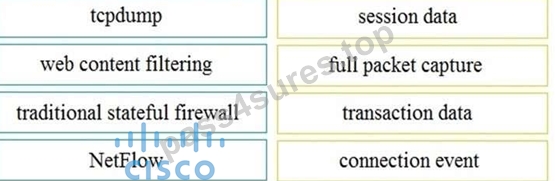
Answer:
Explanation: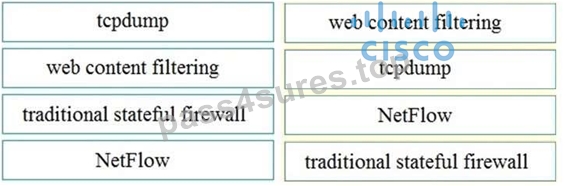
NEW QUESTION 81
Refer to the exhibit.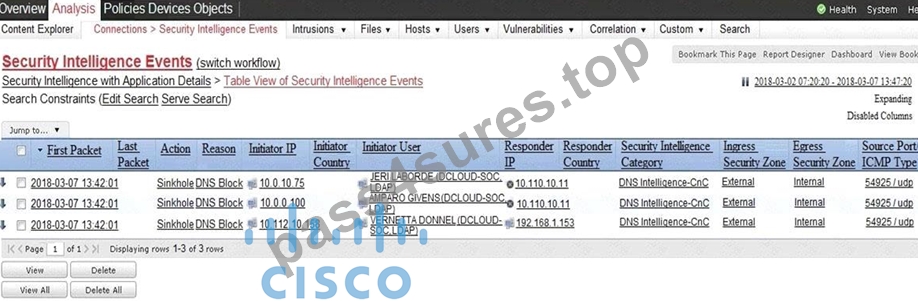
Which two elements in the table are parts of the 5-tuple? (Choose two.)
- A. Ingress Security Zone
- B. First Packet
- C. Initiator User
- D. Initiator IP
- E. Source Port
Answer: D,E
NEW QUESTION 82
What is the difference between discretionary access control (DAC) and role-based access control (RBAC)?
- A. DAC administrators pass privileges to users and groups, and in RBAC, permissions are applied to specific groups
- B. DAC requires explicit authorization for a given user on a given object, and RBAC requires specific conditions.
- C. RBAC access is granted when a user meets specific conditions, and in DAC, permissions are applied on user and group levels.
- D. RBAC is an extended version of DAC where you can add an extra level of authorization based on time.
Answer: B
NEW QUESTION 83
What is an advantage of symmetric over asymmetric encryption?
- A. A key is generated on demand according to data type.
- B. A one-time encryption key is generated for data transmission
- C. It is a faster encryption mechanism for sessions
- D. It is suited for transmitting large amounts of data.
Answer: D
NEW QUESTION 84 
Refer to the exhibit. Which type of log is displayed?
- A. proxy
- B. sys
- C. IDS
- D. NetFlow
Answer: B
NEW QUESTION 85
What is an example of social engineering attacks?
- A. receiving an invitation to the department's weekly WebEx meeting
- B. receiving an unexpected email from an unknown person with an attachment from someone in the same company
- C. sending a verbal request to an administrator who knows how to change an account password
- D. receiving an email from human resources requesting a visit to their secure website to update contact information
Answer: C
NEW QUESTION 86
What causes events on a Windows system to show Event Code 4625 in the log messages?
- A. Another device is gaining root access to the system
- B. A privileged user successfully logged into the system
- C. The system detected an XSS attack
- D. Someone is trying a brute force attack on the network
Answer: D
NEW QUESTION 87
Which two pieces of information are collected from the IPv4 protocol header? (Choose two.)
- A. UDP port to which the traffic is destined
- B. destination IP address of the packet
- C. UDP port from which the traffic is sourced
- D. TCP port from which the traffic was sourced
- E. source IP address of the packet
Answer: B,E
NEW QUESTION 88
Which category relates to improper use or disclosure of PII data?
- A. legal
- B. contractual
- C. regulated
- D. compliance
Answer: C
Explanation:
Section: Security Policies and Procedures
NEW QUESTION 89
Refer to the exhibit.
Which type of log is displayed?
- A. proxy
- B. sys
- C. IDS
- D. NetFlow
Answer: B
NEW QUESTION 90
What is a difference between SOAR and SIEM?
- A. SIEM applications are used for threat and vulnerability management, but SOAR platforms are not
- B. SOAR receives information from a single platform and delivers it to a SIEM
- C. SOAR platforms are used for threat and vulnerability management, but SIEM applications are not
- D. SIEM receives information from a single platform and delivers it to a SOAR
Answer: C
Explanation:
Section: Security Concepts
Explanation
NEW QUESTION 91
What is the practice of giving an employee access to only the resources needed to accomplish their job?
- A. principle of least privilege
- B. organizational separation
- C. separation of duties
- D. need to know principle
Answer: A
NEW QUESTION 92
What is the practice of giving an employee access to only the resources needed to accomplish their job?
- A. principle of least privilege
- B. organizational separation
- C. separation of duties
- D. need to know principle
Answer: A
Explanation:
Section: Security Concepts
NEW QUESTION 93
Which two compliance frameworks require that data be encrypted when it is transmitted over a public network?
(Choose two.)
- A. COBIT
- B. SOX
- C. PCI
- D. HIPAA
- E. GLBA
Answer: C,D
NEW QUESTION 94
What ate two categories of DDoS attacks? (Choose two.)
- A. reflected
- B. scanning
- C. phishing
- D. direct
- E. split brain
Answer: A,D
NEW QUESTION 95
Which two elements are assets in the role of attribution in an investigation? (Choose two.)
- A. threat actor
- B. firewall logs
- C. laptop
- D. session
- E. context
Answer: A,E
Explanation:
Section: Security Policies and Procedures
NEW QUESTION 96
Drag and drop the definition from the left onto the phase on the right to classify intrusion events according to the Cyber Kill Chain model.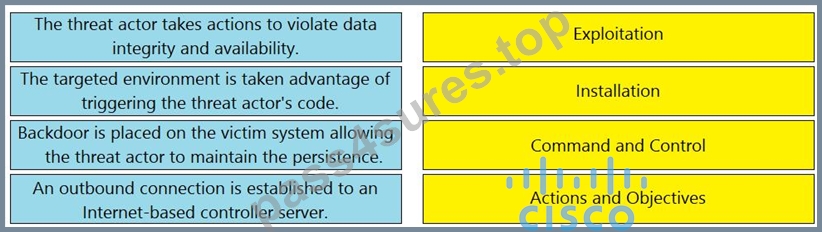
Answer:
Explanation: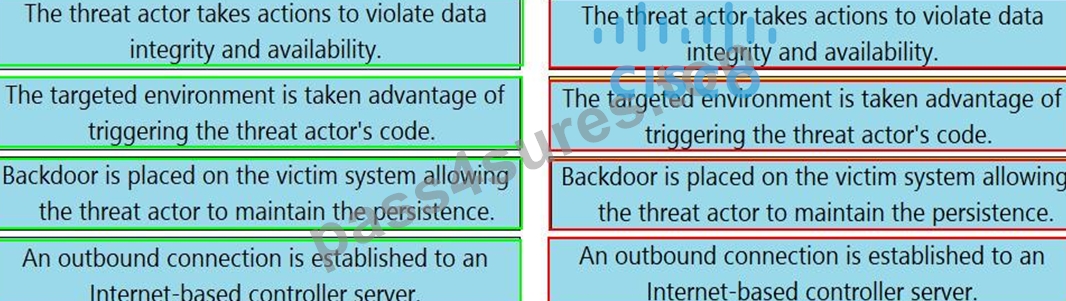
NEW QUESTION 97
What is the difference between inline traffic interrogation (TAPS) and traffic mirroring (SPAN)?
- A. SPAN results in more efficient traffic analysis, and TAPS is considerably slower due to latency caused by mirroring.
- B. TAPS replicates the traffic to preserve integrity, and SPAN modifies packets before sending them to other analysis tools
- C. TAPS interrogation is more complex because traffic mirroring applies additional tags to data and SPAN does not alter integrity and provides full duplex network.
- D. SPAN ports filter out physical layer errors, making some types of analyses more difficult, and TAPS receives all packets, including physical errors.
Answer: D
NEW QUESTION 98
Refer to the exhibit.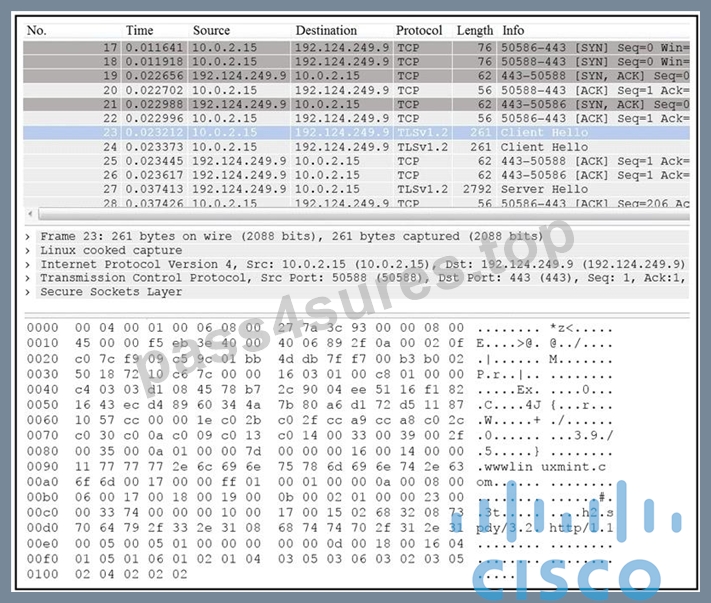
Drag and drop the element name from the left onto the correct piece of the PCAP file on the right.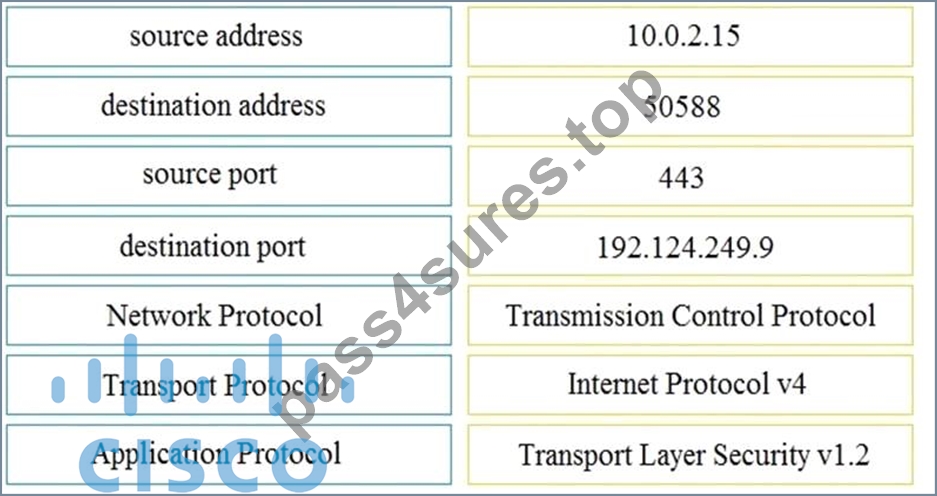
Answer:
Explanation: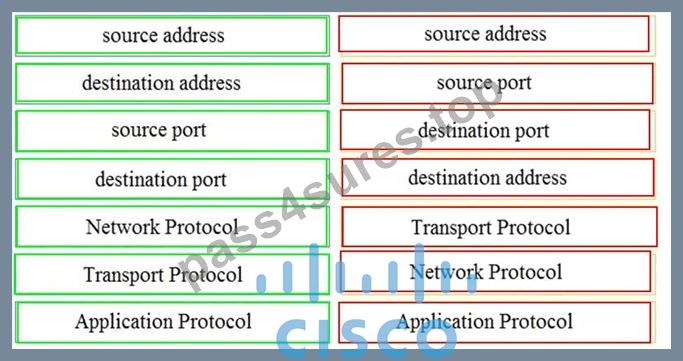
NEW QUESTION 99
A user received an email attachment named "Hr405-report2609-empl094.exe" but did not run it. Which category of the cyber kill chain should be assigned to this type of event?
- A. weaponization
- B. installation
- C. delivery
- D. reconnaissance
Answer: B
NEW QUESTION 100
......
Understanding functional and technical aspects of Cisco Cybersecurity Operations Fundamentals v1.0 (200-201 CBROPS) Security Monitoring
The following will be discussed in CISCO 200-201 exam dumps:
- Full packet capture
- Describe endpoint-based attacks, such as buffer overflows, command and control (C2), malware, and ransomware
- P2P
- Tunneling
- Cipher-suite
- Email content filtering
- TCP dump
- Encapsulation
- Describe web application attacks, such as SQL injection, command injections, and crosssite scripting
- Identify the types of data provided by these technologies
- Transaction data
- Key exchange
- Load balancing
- Web content filtering
- Describe evasion and obfuscation techniques, such as tunneling, encryption, and proxies
- Next-gen firewall
- Alert data
- Describe network attacks, such as protocol-based, denial of service, distributed denial of service, and man-in-the-middle
- Compare attack surface and vulnerability
- Metadata
- Access control list
- Traditional stateful firewall
- Session data
- NetFlow
- Describe social engineering attacks
- Statistical data
- Describe the uses of these data types in security monitoring
- NAT/PAT
- Protocol version
New (2023) Cisco 200-201 Exam Dumps: https://www.pass4sures.top/CyberOps-Associate/200-201-testking-braindumps.html
200-201 Practice Dumps - Verified By Pass4sures Updated 260 Questions: https://drive.google.com/open?id=1atMj3nOXlbgRI-CCrHLivpp53NWe3hq-