

2024 Realistic JN0-636 Dumps are Available for Instant Access
Download Exam JN0-636 Practice Test Questions with 100% Verified Answers
NEW QUESTION # 30
Exhibit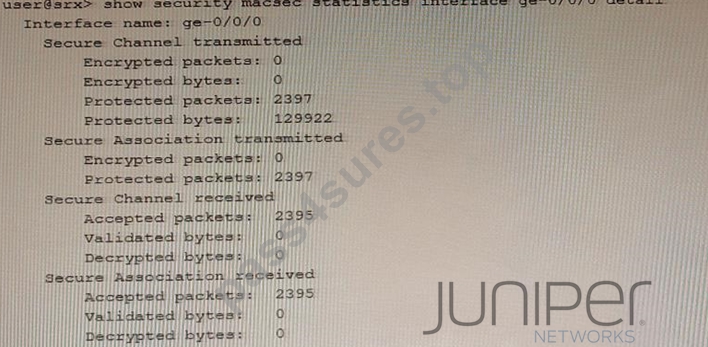
Referring to the exhibit, which two statements are true? (Choose two.)
- A. The data that traverses the ge-0/070 interface is secured by a secure association key.
- B. The data that traverses the ge-070/0 interface can be intercepted and read by anyone.
- C. The data that traverses the ge-O/0/0 interface is secured by a connectivity association key.
- D. The data that traverses the ge-070/0 interface cannot be intercepted and read by anyone.
Answer: A,D
Explanation:
The exhibit shows the output of the show security macsec statistics interface ge-0/0/70 detail command on an SRX Series device. This command displays the statistics for the Media Access Control Security (MACsec) feature on the ge-0/0/70 interface. MACsec is a feature that provides point-to-point security on Ethernet links by using encryption and data integrity checks. MACsec uses two types of keys to secure the traffic: the Connectivity Association Key (CAK) and the Secure Association Key (SAK). The CAK is used for authentication and key exchange between the MACsec peers. The SAK is used for encryption and decryption of the MACsec traffic.
The two statements that are true based on the exhibit are:
The data that traverses the ge-0/0/70 interface is secured by a secure association key. This is because the exhibit shows that the interface has a Secure Channel (SC) and a Secure Association (SA) established. The SC is a logical connection between the MACsec peers that carries the encrypted traffic. The SA is a subset of the SC that contains the SAK and other parameters for encrypting and decrypting the traffic. The exhibit shows that the interface has encrypted and protected packets, which means that the traffic is secured by the SAK.
The data that traverses the ge-0/0/70 interface cannot be intercepted and read by anyone. This is because the exhibit shows that the interface has encryption enabled. The encryption option indicates whether the MACsec traffic is encrypted or not. If encryption is enabled, the traffic is encrypted by the SAK and cannot be viewed by anyone monitoring the link. If encryption is disabled, the traffic is only protected by the SAK and can be viewed by anyone monitoring the link.
NEW QUESTION # 31
Exhibit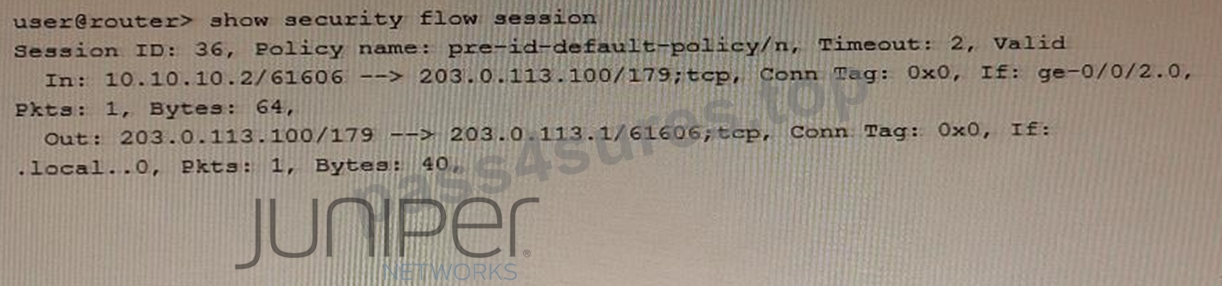
Referring to the exhibit, which type of NAT is being performed?
- A. Static NAT
- B. Persistent NAT
- C. Source NAT
- D. Destination NAT
Answer: C
NEW QUESTION # 32
You are required to deploy a security policy on an SRX Series device that blocks all known for network IP addresses. Which two steps will fulfill this requirement? (Choose two.)
- A. Enable a third-party Tor feed.
- B. Enroll the devices with Juniper ATP Cloud.
- C. Create a custom feed containing all current known MAC addresses.
- D. Enroll the devices with Juniper ATP Appliance.
Answer: C,D
NEW QUESTION # 33
Exhibit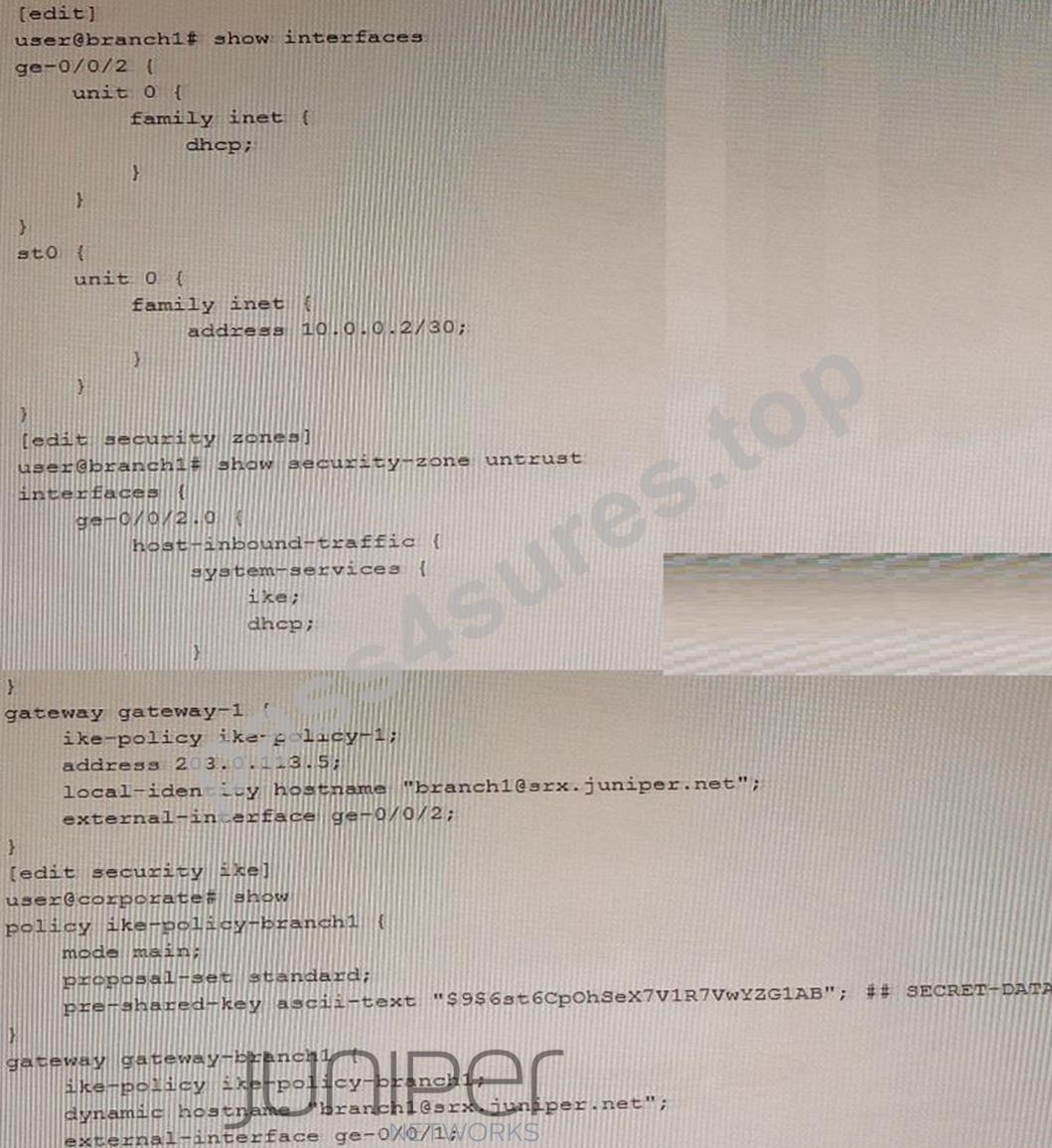
You are trying to configure an IPsec tunnel between SRX Series devices in the corporate office and branch1.
You have committed the configuration shown in the exhibit, but the IPsec tunnel is not establishing.
In this scenario, what would solve this problem.
- A. Change the IKE proposal-set to compatible on the branch1 and corporate devices.
- B. Change the local identity to inet advpn on the branch1 device.
- C. Change the IKE mode to aggressive on the branch1 and corporate devices.
- D. Add multipoint to the st0.0 interface configuration on the branch1 device.
Answer: B
NEW QUESTION # 34
Click the Exhibit button.
user @host> show bgp summary logical-system LSYS1
Groups : 11 Peers : 10 Down peers: 1
Table Tot. Paths Act Paths Suppressed History Damp State
Pending
inet.0 141 129 0 0 0 Peer AS InPkt OutPkt OutQ Flaps Last Up/Dwn
State|#Active/Received/Accepted/Damped...
192.168.64.12 65008 11153 11459 0 26 3d
3:10:43 9/10/10/0 0/0/0/0
192.168.72.12 65009 11171 11457 0 26 3d
3:10:39 11/12/12/0 0/0/0/0
192.168.80.12 65010 9480 9729 0 27 3d
3:10:42 11/12/12/0 0/0/0/0
192.168.88.12 65011 11171 11457 0 25 3d
3:10:31 12/13/13/0 0/0/0/0
192.168.96.12 65012 9479 9729 0 26 3d
3:10:34 12/13/13/0 0/0/0/0
192.168.10.12 65013 111689 11460 0 27 3d
3:10:46 9/10/10/0 0/0/0/0
192.168.11.12 65014 111688 11458 0 25 3d
3:10:42 9/10/10/0 0/0/0/0
192.168.12.12 65015 111687 11457 0 25 3d
3:10:38 9/10/10/0 0/0/0/0
192.68.11.12 650168 9478 9729 0 25 3d
3:10:42 9/10/10/0 0/0/0/0
192.168.13.12 65017 111687 11457 0 27 3d
3:10:30 9/10/10/0 0/0/0/0
192.168.16.12 65017 111687 11457 0 27 1w3d2h
Connect
user@host> show interfaces ge-0/0/7.0 extensive
Logical interface ge-0/0/7.0 (Index 76) (SNMP ifIndex 548) (Generation
141)
...
Security: Zone: log
Allowed host-inbound traffic : bootp dns dhcp finger ftp tftp ident-
reset http https ike netconf
ping reverse-telnet reverse-ssh rloqin rpm rsh snmp
snmp-trap ssh telnet traceroute xnm-clear-text xnm-ssl lsping ntp sip
r2cp
Flow Statistics:
Flow Input statistics:
Self packets: 0
ICMP packets: 0
VPN packets: 0
Multicast packets: 0
Bytes permitted by policy: 0
Connections established: 0
Flow Output statistics:
Multicast packets: 0
Bytes permitted by policy: 0
Flow error statistics (Packets dropped due to):
Address spoofing: 0
Authentication failed: 0
Incoming NAT errors: 0
Invalid zone received packet: 0
Multiple user authentications: 0
Multiple incoming NAT: 0
No parent for a gate: 0
No one interested in self pakets: 0
No minor session: 0
No more sessions: 589723
No NAT gate: 0
No route present: 0
No SA for incoming SPI: 0
No tunnel found: 0
No session for a gate: 0
No zone or NULL zone binding 0
Policy denied: 0
Security association not active: 0
TCP sequence number out of window: 0
Syn-attack protection: 0
User authentication errors: 0
Protocol inet, MTU: 1500, Generation: 1685, Route table: 0
Flags: Sendbcast-pkt-to-re
Addresses, F1ags: Is-Preferred Is-Primary
Destination: 10.5.123/24, Local: 10.5.123.3, Broadcast:
10.5.123.255, Generation: 156
Protocol multiservice, MTU: Unlimited, Generation: 1686, Route table: 0 Policer: Input: __default_arp_policer__
...
An SRX Series device has been configured with a logical system LSYS1.
One of the BGP peers is down.
Referring to the exhibit, which statement explains this problem?
- A. The minimum number of flows is set to high.
- B. The maximum number of allowed flows is set to low.
- C. The allocated memory is not sufficient for this LSYS.
- D. The LSYS license only allows up to ten BGP peerings.
Answer: B
NEW QUESTION # 35
Exhibit
<e ip="img_34.jpg"></e> A. The highlighted incident (arrow) shown in the exhibit shows a progression level of "Download" in the kill chain.
What are two appropriate mitigation actions for the selected incident? (Choose two.)
- A. Immediate response required: Deploy IVP integration (if configured) to confirm if the endpoint has executed the malware and is infected.
- B. Not an urgent action: Use IVP to confirm if machine is infected.
- C. Immediate response required: Wipe infected endpoint hosts.
- D. Immediate response required: Block malware IP addresses (download server or CnC server)
Answer: A,D
Explanation:
The appropriate mitigation actions for the selected incident are to block malware IP addresses (download server or CnC server) and to deploy IVP integration (if configured) to confirm if the endpoint has executed the malware and is infected. This is because the incident shows a progression level of "Download" in the kill chain, which means that the malware has been downloaded and is likely to be executed. Blocking the malware IP addresses can prevent further communication with the malicious server and stop the malware from receiving commands or exfiltrating data. Deploying IVP integration can help verify the infection status of the endpoint and provide additional information about the malware behavior and impact. IVP integration is an optional feature that allows the ATP Appliance to interact with third-party endpoint security solutions such as Carbon Black, Cylance, and CrowdStrike. Reference:
Advanced Threat Prevention Appliance Solution Brief
Advanced Threat Prevention Appliance Datasheet
[Advanced Threat Prevention Appliance Mitigation Actions]
[Advanced Threat Prevention Appliance IVP Integration]
NEW QUESTION # 36
Exhibit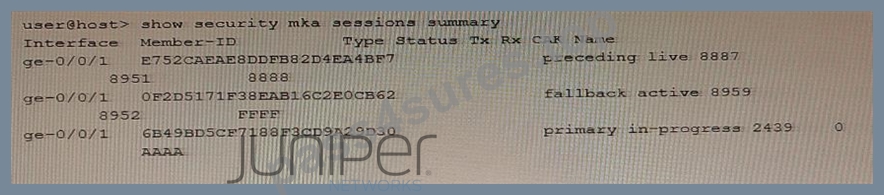
Referring to the exhibit, which two statements are true about the CAK status for the CAK named "FFFP"? (Choose two.)
- A. SAK is not generated using this key.
- B. CAK is not used for encryption and decryption of the MACsec session.
- C. CAK is used for encryption and decryption of the MACsec session.
- D. SAK is successfully generated using this key.
Answer: A,C
NEW QUESTION # 37
SRX Series device enrollment with Policy Enforcer fails To debug further, the user issues the following commandshow configuration services security-intelligence url
https : //cloudfeeds . argon . juniperaecurity . net/api/manifeat. xml
and receives the following output:
What is the problem in this scenario?
- A. Junos Space does not have matching schema based on the
- B. The device is already enrolled with Policy Enforcer.
- C. The device is directly enrolled with Juniper ATP Cloud.
- D. The SRX Series device does not have a valid license.
Answer: D
NEW QUESTION # 38
You are connecting two remote sites to your corporate headquarters site.You must ensure that all traffic is secured and sent directly between sites In this scenario, which VPN should be used?
- A. Layer 2 VPN
- B. IPsec ADVPN
- C. full mesh Layer 3 VPN with EBGP
- D. hub-and-spoke IPsec VPN
Answer: D
NEW QUESTION # 39
Exhibit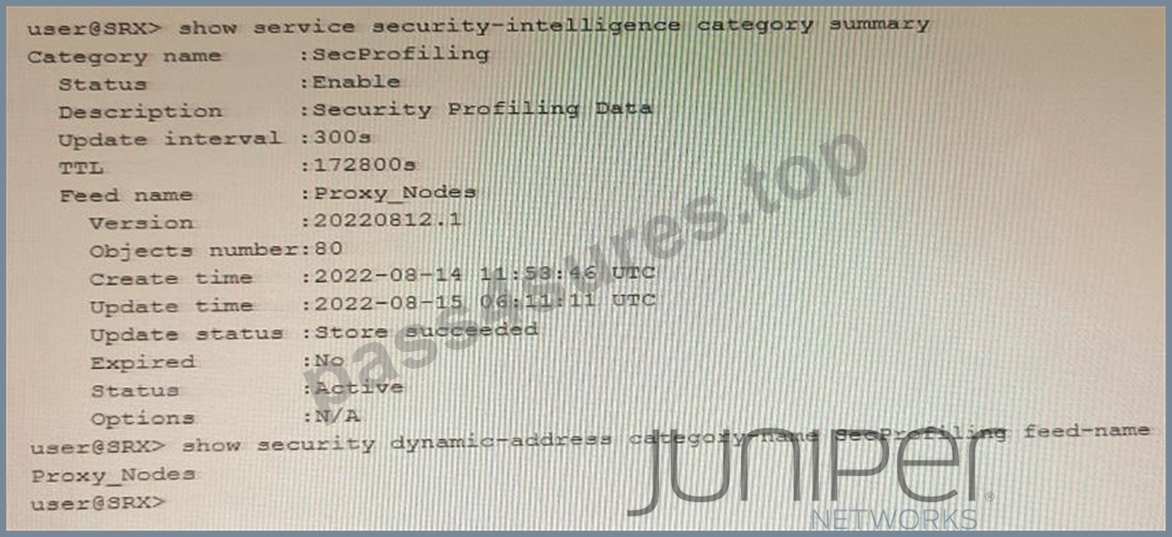
You have recently configured Adaptive Threat Profiling and notice 20 IP address entries in the monitoring section of the Juniper ATP Cloud portal that do not match the number of entries locally on the SRX Series device, as shown in the exhibit.
What is the correct action to solve this problem on the SRX device?
- A. Force a manual download of the Proxy__Nodes feed.
- B. Refresh the feed in ATP Cloud.
- C. Flush the DNS cache on the SRX device.
- D. You must configure the DAE in a security policy on the SRX device.
Answer: C
NEW QUESTION # 40
you configured a security policy permitting traffic from the trust zone to the untrust zone but your traffic not hitting the policy.
In this scenario, which cli command allows you to troubleshoot traffic problem using the match criteria?
- A. show security application-tracking counters
- B. request security policies check
- C. show security match-policies
- D. show security policy-report
Answer: C
Explanation:
To troubleshoot the traffic problem using the match criteria, you need to use the show security match-policies CLI command. The other options are incorrect because:
A) The show security policy-report CLI command displays the policy report, which is a summary of the policy usage statistics, such as the number of sessions, bytes, and packets that match each policy. It does not show the match criteria or the reason why the traffic is not hitting the policy1.
B) The show security application-tracking counters CLI command displays the application tracking counters, which are the statistics of the application usage, such as the number of sessions, bytes, and packets that match each application. It does not show the match criteria or the reason why the traffic is not hitting the policy2.
D) The request security policies check CLI command checks the validity and consistency of the security policies, such as the syntax, the references, and the conflicts. It does not show the match criteria or the reason why the traffic is not hitting the policy3.
Therefore, the correct answer is C. You need to use the show security match-policies CLI command to troubleshoot the traffic problem using the match criteria. The show security match-policies CLI command displays the policies that match the specified criteria, such as the source and destination addresses, the zones, the protocols, and the ports. It also shows the action and the hit count of each matching policy. You can use this command to verify if the traffic is matching the expected policy or not, and if not, what policy is blocking or rejecting the traffic4
NEW QUESTION # 41
Exhibit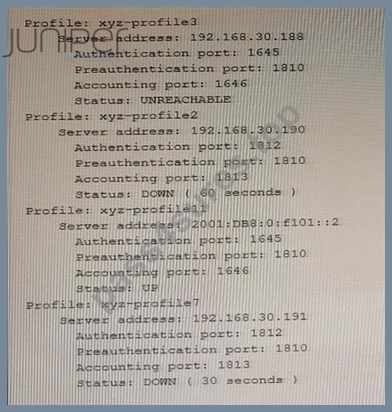
The show network-access aaa radius-servers command has been issued to solve authentication issues.
Referring to the exhibit, to which two authentication servers will the SRX Series device continue to send requests? (Choose TWO)
- A. 192.168.30.188
- B. 192.168.30.191
- C. 192.168.30.190
- D. 200l:DB8:0:f101;:2
Answer: B,C
Explanation:
The SRX Series device will continue to send requests to authentication servers 192.168.30.190 and 192.168.30.191. This is because the exhibit shows the output of the show network-access aaa radius-servers command. This command displays the status of the RADIUS servers configured on the device. In the output, we can see that there are three RADIUS servers configured - 192.168.30.190, 192.168.30.191, and 2001:DB8:0:f101::2. However, the status of the third server is shown as "DOWN". This means that the device is not able to communicate with this server. Therefore, the device will continue to send requests to the other two servers - 192.168.30.190 and 192.168.30.191. Reference: Juniper Security, Professional (JNCIP-SEC) Reference Materials source and documents: https://www.juniper.net/documentation/en_US/junos/topics/reference/command-summary/show-network-access-aaa-radius-servers.html
NEW QUESTION # 42
You want to use selective stateless packet-based forwarding based on the source address.
In this scenario, which command will allow traffic to bypass the SRX Series device flow daemon?
- A. set firewall family inet filter bypass__f lowd term t1 then packet-mode
- B. set firewall family inet filter bypas3_flowd term t1 then virtual-channel stateless
- C. set firewall family inet filter bypaa3_flowd term t1 then skip-services accept
- D. set firewall family inet filter bypass_flowd term t1 then routing-instance stateless
Answer: A
Explanation:
The command that will allow traffic to bypass the SRX Series device flow daemon based on the source address is set firewall family inet filter bypass_flowd term t1 then packet-mode. This command configures a stateless firewall filter named bypass_flowd that has one term t1. The term t1 can match the traffic based on the source address or any other criteria. The term t1 then applies the action packet-mode, which means that the traffic will be forwarded using packet-based processing and will not be sent to the flow daemon for stateful inspection. This feature is known as selective stateless packet-based forwarding and it allows you to use both flow-based and packet-based forwarding on the same device for different types of traffic. You can apply the firewall filter to the input or output direction of an interface to enable selective stateless packet-based forwarding for the traffic passing through that interface. Reference: Juniper Security, Professional (JNCIP-SEC) Reference Materials source and documents: https://www.juniper.net/documentation/en_US/junos/topics/concept/firewall-filter-option-filter-based-forwarding-overview.html https://www.juniper.net/documentation/en_US/junos/topics/example/filter-based-forwarding-example.html
NEW QUESTION # 43
What are two important function of the Juniper Networks ATP appliance solution? (Choose two.).
- A. Filtration
- B. Analysis
- C. Detection
- D. Statistics
Answer: B,C
NEW QUESTION # 44
You have recently configured Adaptive Threat Profiling and notice 20 IP address entries in the monitoring section of the Juniper ATP Cloud portal that do not match the number of entries locally on the SRX Series device, as shown in the exhibit.
What is the correct action to solve this problem on the SRX device?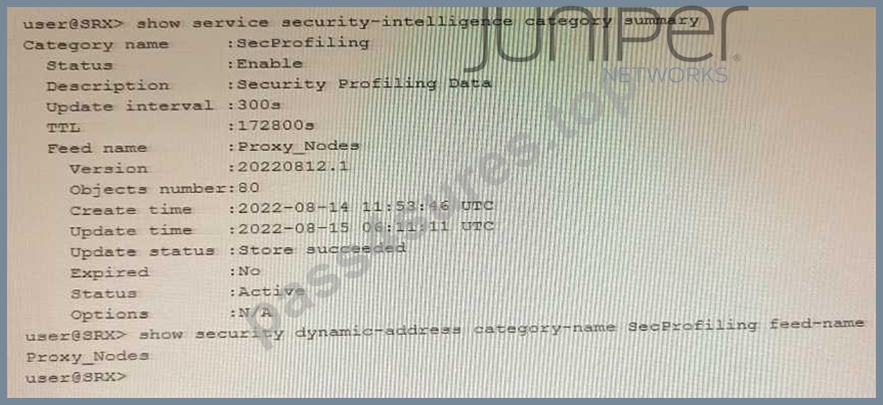
- A. Force a manual download of the Proxy__Nodes feed.
- B. Refresh the feed in ATP Cloud.
- C. Flush the DNS cache on the SRX device.
- D. You must configure the DAE in a security policy on the SRX device.
Answer: C
NEW QUESTION # 45
Exhibit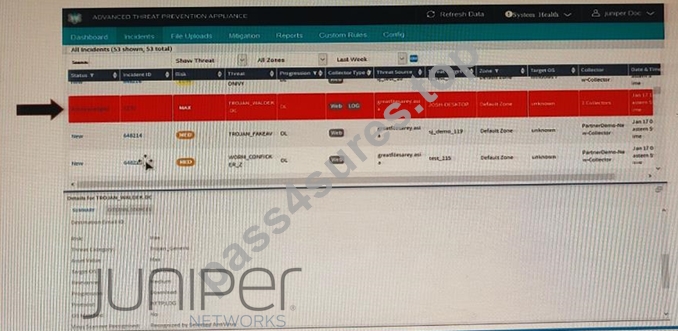
The highlighted incident (arrow) shown in the exhibit shows a progression level of "Download" in the kill chain.
What are two appropriate mitigation actions for the selected incident? (Choose two.)
- A. Immediate response required: Block malware IP addresses (download server or CnC server)
- B. Not an urgent action: Use IVP to confirm if machine is infected.
- C. Immediate response required: Deploy IVP integration (if configured) to confirm if the endpoint has executed the malware and is infected.
- D. Immediate response required: Wipe infected endpoint hosts.
Answer: B,D
NEW QUESTION # 46
You have configured static NAT for a webserver in your DMZ. Both internal and external users can reach the webserver using the webserver's IP address. However, only internal users can reach the webserver using the webserver's DNS name. When external users attempt to reach the webserver using the webserver's DNS name, an error message is received.
Which action would solve this problem?
- A. Use DNS doctoring
- B. Modify the security policy
- C. Disable Web filtering
- D. Use destination NAT instead of static NAT
Answer: A
Explanation:
https://www.juniper.net/documentation/en_US/junos/topics/topic-map/security-dns-algs.html
NEW QUESTION # 47
Exhibit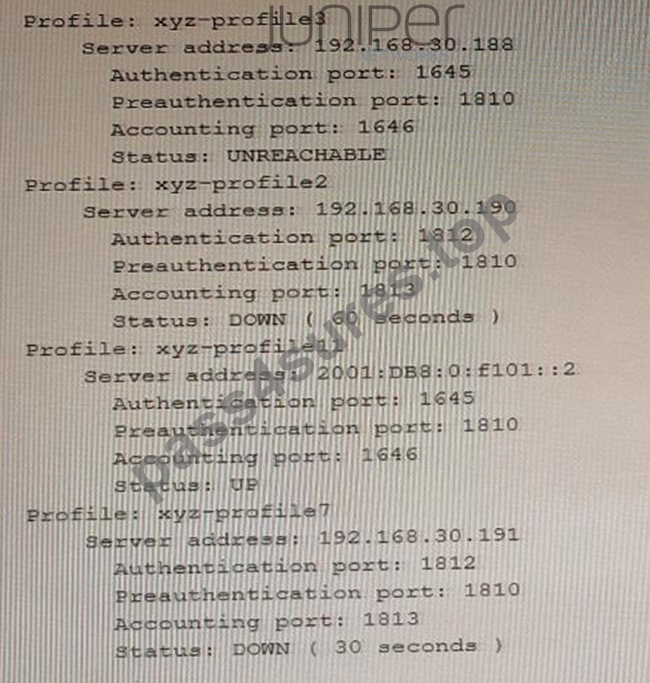
The show network-access aaa radius-servers command has been issued to solve authentication issues.
Referring to the exhibit, to which two authentication servers will the SRX Series device continue to send requests? (ChooseTWO)
- A. 192.168.30.191
- B. 192.168.30.190
- C. 192.168.30.188
- D. 200l:DB8:0:f101;:2
Answer: A,C
NEW QUESTION # 48
You want to identify potential threats within SSL-encrypted sessions without requiring SSL proxy to decrypt the session contents. Which security feature achieves this objective?
- A. Secure Web Proxy
- B. DNS security
- C. infected host feeds
- D. encrypted traffic insights
Answer: D
Explanation:
The security feature that achieves the objective of identifying potential threats within SSL-encrypted sessions without requiring SSL proxy to decrypt the session contents is encrypted traffic insights. Encrypted traffic insights (ETI) is a feature of Juniper ATP Cloud that helps you to detect malicious threats that are hidden in encrypted traffic without intercepting and decrypting the traffic. ETI uses machine learning and behavioral analysis to identify anomalies and suspicious patterns in the encrypted traffic metadata, such as the SSL/TLS handshake, the certificate, the cipher suite, and the session duration. ETI can also leverage third-party feeds and threat intelligence from Juniper ATP Cloud to correlate the encrypted traffic with known indicators of compromise (IoCs). ETI can provide insights into the risk level, the threat category, the threat location, and the threat time of the encrypted traffic. ETI can also trigger mitigation actions, such as blocking, quarantining, or alerting, based on the threat severity and the policy configuration. ETI can help you to improve your security posture and visibility without compromising the privacy and performance of the encrypted traffic. Reference: Juniper Security, Professional (JNCIP-SEC) Reference Materials source and documents: https://www.juniper.net/documentation/en_US/junos/topics/concept/security-atp-cloud-encrypted-traffic-insights-overview.html
NEW QUESTION # 49
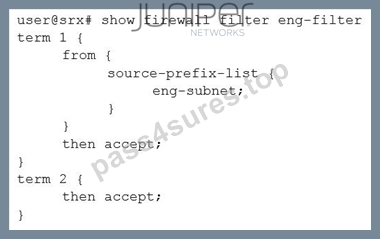
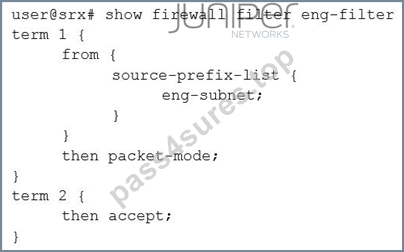
You are asked to configure an SRX Series device to bypass all security features for IP traffic from the engineering department.
Which firewall filter will accomplish this task?
- A.
- B.
- C.
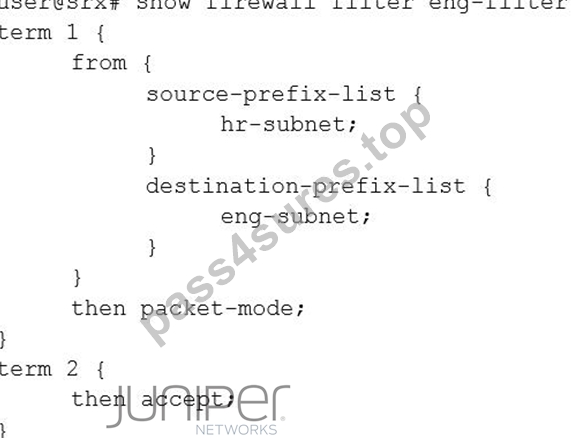
- D.
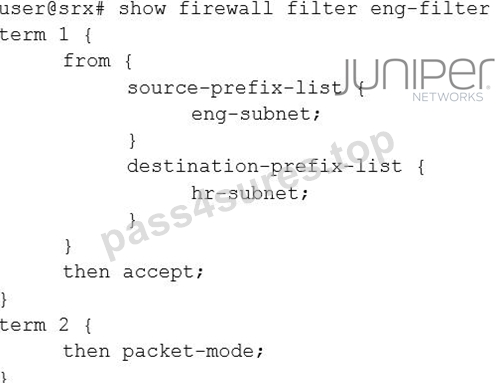
Answer: A
NEW QUESTION # 50
Referring to the exhibit, which two statements are true? (Choose two.)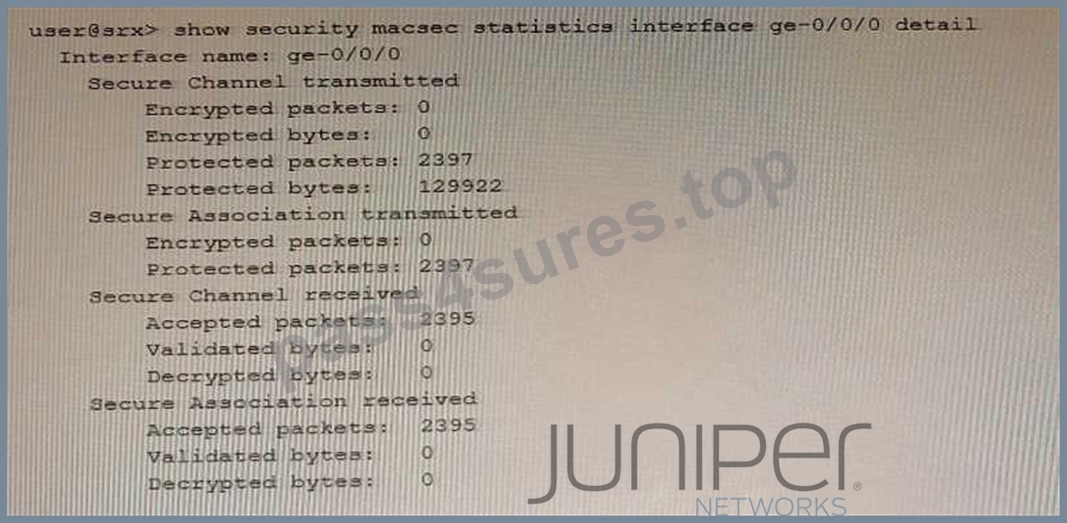
- A. The data that traverses the ge-0/070 interface is secured by a secure association key.
- B. The data that traverses the ge-O/0/0 interface is secured by a connectivity association key.
- C. The data that traverses the ge-070/0 interface cannot be intercepted and read by anyone.
- D. The data that traverses the ge-070/0 interface can be intercepted and read by anyone.
Answer: C,D
NEW QUESTION # 51
Exhibit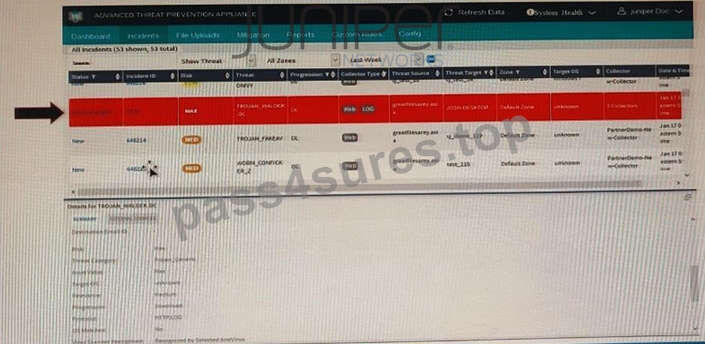
- A. Immediate response required: Deploy IVP integration (if configured) to confirm if the endpoint has executed the malware and is infected.
- B. Not an urgent action: Use IVP to confirm if machine is infected.
- C. Immediate response required: Wipe infected endpoint hosts.
- D. The highlighted incident (arrow) shown in the exhibit shows a progression level of "Download" in the kill chain.
What are two appropriate mitigation actions for the selected incident? (Choose two.) - E. Immediate response required: Block malware IP addresses (download server or CnC server)
Answer: A,E
NEW QUESTION # 52
your company wants to take your juniper ATP appliance into private mode. You must give them a list of impacted features for this request.
Which two features are impacted in this scenario? (Choose two)
- A. Cyber Kill Chain mapping
- B. False Positive Reporting
- C. GSS Telemetry
- D. Threat Progression Monitoring
Answer: B,C
Explanation:
Your company wants to take your Juniper ATP Appliance into private mode. You must give them a list of impacted features for this request. The two features that are impacted in this scenario are:
A) False Positive Reporting. False Positive Reporting is a feature that allows you to report false positive detections to Juniper Networks for analysis and improvement. False Positive Reporting requires an Internet connection to send the reports to Juniper Networks. If you take your Juniper ATP Appliance into private mode, False Positive Reporting will be disabled and you will not be able to report false positives1.
C) GSS Telemetry. GSS Telemetry is a feature that allows you to send anonymized threat data to Juniper Networks for analysis and improvement. GSS Telemetry requires an Internet connection to send the data to Juniper Networks. If you take your Juniper ATP Appliance into private mode, GSS Telemetry will be disabled and you will not be able to contribute to the threat intelligence community2.
The other options are incorrect because:
B) Threat Progression Monitoring. Threat Progression Monitoring is a feature that allows you to monitor the threat activity and progression across your network. Threat Progression Monitoring does not require an Internet connection and can be performed locally by the Juniper ATP Appliance. If you take your Juniper ATP Appliance into private mode, Threat Progression Monitoring will not be impacted and you will still be able to monitor the threat activity and progression3.
D) Cyber Kill Chain mapping. Cyber Kill Chain mapping is a feature that allows you to map the threat activity and progression to the stages of the Cyber Kill Chain framework. Cyber Kill Chain mapping does not require an Internet connection and can be performed locally by the Juniper ATP Appliance. If you take your Juniper ATP Appliance into private mode, Cyber Kill Chain mapping will not be impacted and you will still be able to map the threat activity and progression4.
Reference:
False Positive Reporting
GSS Telemetry
Threat Progression Monitoring
Cyber Kill Chain Mapping
NEW QUESTION # 53
Exhibit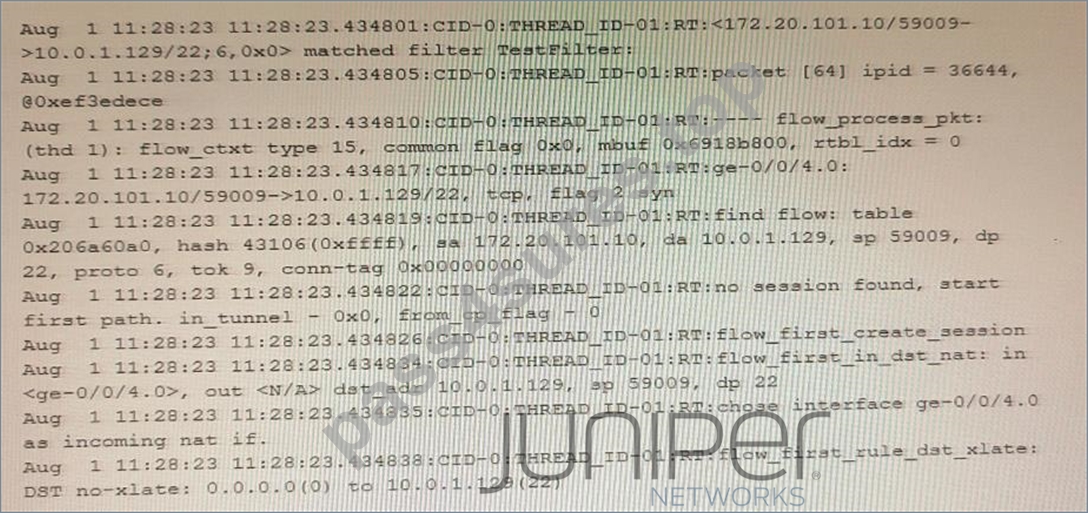
The exhibit shows a snippet of a security flow trace.
In this scenario, which two statements are correct? (Choose two.)
- A. The capture is a packet from the source address 172.20.101.10 destined to 10.0.1.129.
- B. Destination NAT occurs.
- C. An existing session is found in the table.
- D. This packet arrived on interface ge-0/0/4.0.
Answer: A,C
NEW QUESTION # 54
......
Positive Aspects of Valid Dumps JN0-636 Exam Dumps! : https://www.pass4sures.top/JNCIP-SEC/JN0-636-testking-braindumps.html
Share Latest JN0-636Test Practice Test Questions, Exam Dumps: https://drive.google.com/open?id=1xJMAJPpYWVB9EIEXytlb7c_2na5X-iet