

PDF (New 2026) Actual Fortinet NSE5_SSE_AD-7.6 Exam Questions
Dumps Moneyack Guarantee - NSE5_SSE_AD-7.6 Dumps UpTo 90% Off
Fortinet NSE5_SSE_AD-7.6 Exam Syllabus Topics:
| Topic | Details |
|---|---|
| Topic 1 |
|
| Topic 2 |
|
| Topic 3 |
|
| Topic 4 |
|
| Topic 5 |
|
NEW QUESTION # 31
Refer to the exhibit. An administrator is troubleshooting SD-WAN on FortiGate. A device behind branch1_fgt generates traffic to the 10.0.0.0/8 network.
The administrator expects the traffic to match SD-WAN rule ID 1 and be routed over HUB1- VPN1.
However, the traffic is routed over HUB1-VPN3.
Based on the output shown in the exhibit, which two reasons, individually or together, could explain the observed behavior? (Choose two.)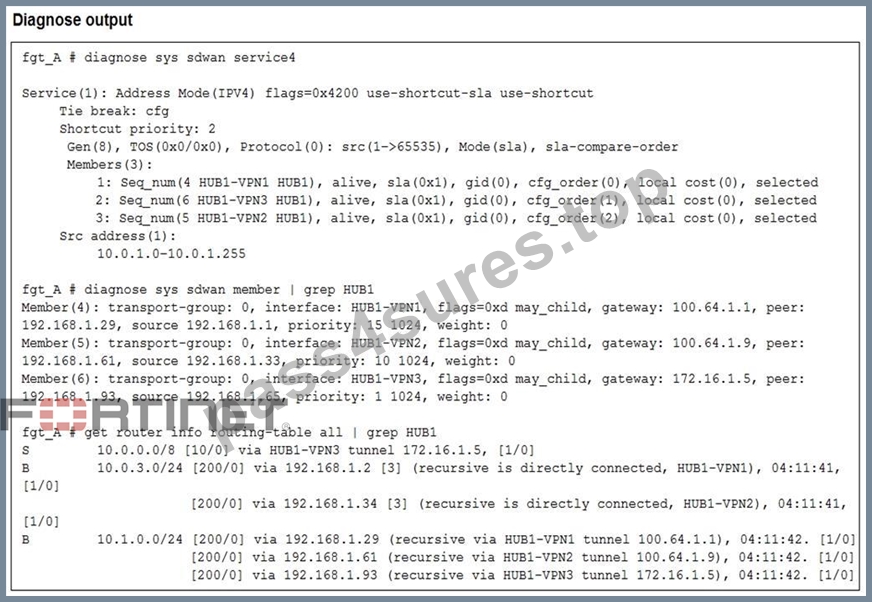
- A. The traffic matches a regular policy route configured with HUB1-VPN3 as the outgoing device.
- B. HUB1-VPN3 has a lower route priority value (higher priority) than HUB1-VPN1.
- C. HUB1-VPN3 has a higher member configuration priority than HUB1-VPN1.
- D. HUB1-VPN1 does not have a valid route to the destination.
Answer: A,D
Explanation: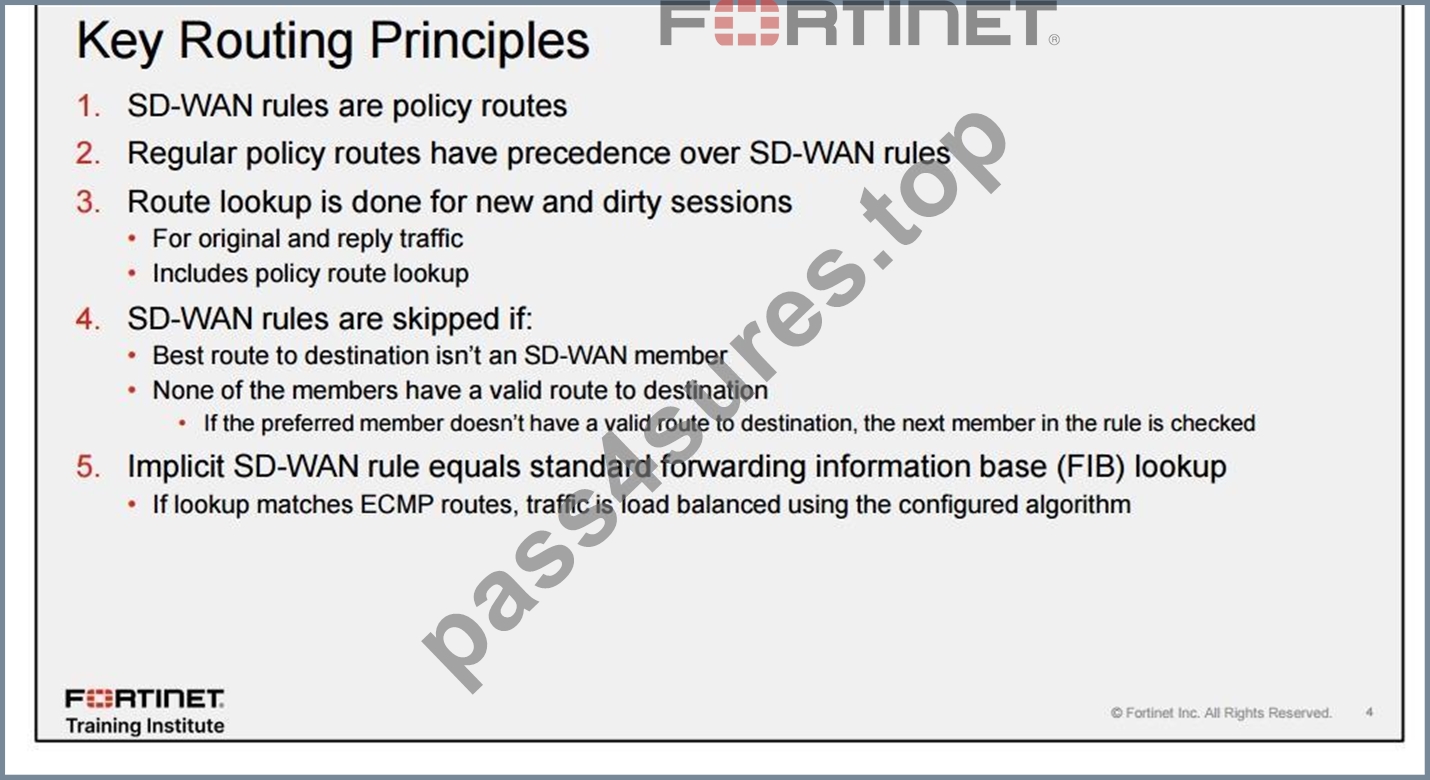
NEW QUESTION # 32
Refer to the exhibit. The exhibit shows output of the command diagnose sys sdwan service collected on a FortiGate device.
The administrator wants to know through which interface FortiGate will steer traffic from local users on subnet 10.0.1.0/255.255.255.192 and with a destination of the social media application Facebook.
Based on the exhibits, which two statements are correct? (Choose two.)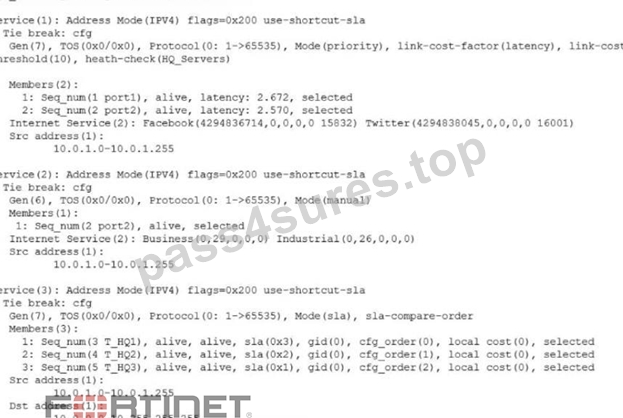
- A. There is no service defined for the Facebook application, so FortiGate applies service rule 3 and directs the traffic to headquarters.
- B. When FortiGate cannot recognize the application of the flow, it load balances the traffic through the tunnels HQ_T1, HQ_T2, HQ_T3.
- C. FortiGate steers traffic for social media applications according to the service rule 2 and steers traffic through port2.
- D. When FortiGate cannot recognize the application of the flow, it steers the traffic through the preferred member of rule 3, HQ_T1.
Answer: B,C
Explanation:
"If a flow is identified as belonging to a defined application category (such as social media), FortiGate will match it to the corresponding service rule (rule 2) and route it through the specified interface, such as port2. However, if the application is not recognized during the session setup, the system defaults to load balancing the traffic using the available tunnels according to the policy for unclassified traffic, ensuring continuous connectivity while waiting for application classification." This guarantees both performance and resilience.
NEW QUESTION # 33
Which two delivery methods are used for installing FortiClient on a user's laptop? (Choose two.)
- A. Download the installer directly from the FortiSASE portal.
- B. Use zero-touch installation through a third-party application store.
- C. Configure automatic installation through an API to the user's laptop.
- D. Send an invitation email to selected users containing links to FortiClient installers.
Answer: A,D
Explanation:
Download from the FortiSASE portal: Administrators can provide users with access to the FortiSASE portal where they can directly download a pre-configured installer. This installer is uniquely tied to the organization's SASE instance, ensuring the client automatically registers to the correct cloud EMS upon installation.
Invitation Email: This is the most common administrative method. The FortiSASE portal (via its integrated EMS) allows administrators to send an invitation email to specific users or groups. This email contains direct download links for various operating systems (Windows, macOS, Linux) and the necessary invitation code for zero-touch registration.
NEW QUESTION # 34
Refer to the exhibit. You want the performance service-level agreement (SLA) to measure the jitter of each member.
Which configuration change must you make to achieve this result?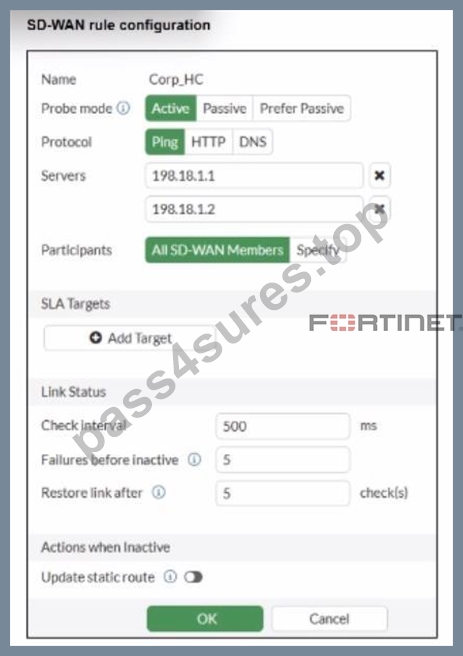
- A. Set the protocol to HTTP.
- B. No change is required.
- C. Add an SLA target and define a jitter threshold.
- D. Specify the participant members.
Answer: B
Explanation:
Implicit Measurement: In FortiOS, once a Performance SLA (Health Check) is configured with an Active probe mode (as seen in the exhibit with Ping selected), the FortiGate automatically begins calculating three key quality metrics for every member interface: Latency, Jitter, and Packet Loss.
Visibility: Even without an SLA Target defined, these real-time measurements are visible in the SD- WAN Monitor and via the CLI command diagnose sys virtual-wan-link health-check
<SLA_Name>.
Active Probes: Because the probe mode is set to Active using the Ping protocol, the FortiGate sends synthetic packets at the defined Check interval (500ms in the exhibit). It calculates jitter by measuring the variation in the round-trip time (RTT) between these consecutive probes.
NEW QUESTION # 35
Refer to the exhibit. How does FortiGate handle the traffic with the source IP 10.0.1.130 and the destination IP 128.66.0.125?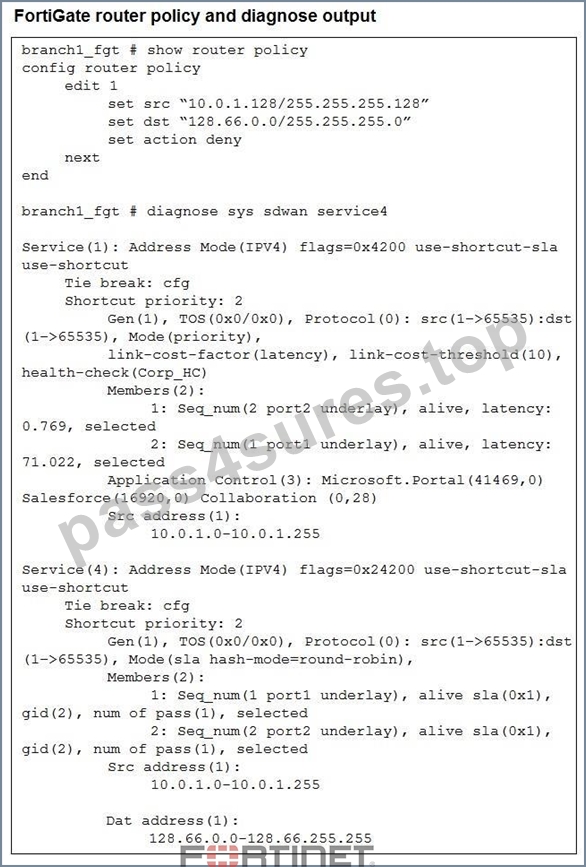
- A. FortiGate routes the traffic flow according to the FIB.
- B. FortiGate drops the traffic flow.
- C. FortiGate load balances the traffic flow through port1 and port2.
- D. FortiGate steers the traffic flow through port2.
Answer: A
Explanation:
On FortiGate, a policy route (PBR) with action deny does not drop the traffic outright. Instead, it prevents the traffic from being steered by that policy route, and the packet is then handed back to the regular routing lookup (FIB):
Source 10.0.1.130 matches 10.0.1.128/25
Destination 128.66.0.125 matches 128.66.0.0/24
Router policy says action deny → do not use this policy route
Result: FortiGate falls back to the FIB (normal routing table).
NEW QUESTION # 36
Refer to the exhibit. You configure SD-WAN on a standalone FortiGate device. You want to create an SD-WAN rule that steers traffic related to Facebook and LinkedIn through the less costly internet link.
What must you do to set Facebook and LinkedIn applications as destinations from the GUI?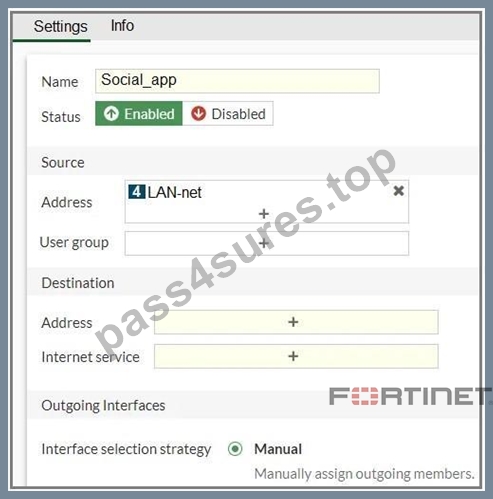
- A. In the Internet service field select Facebook and LinkedIn.
- B. You cannot configure applications as destinations of an SD-WAN rule on a standalone FortiGate device.
- C. Install a license to allow applications as destinations of SD-WAN rules.
- D. Enable the visibility of the applications field as destinations of the SD-WAN rule.
Answer: A
Explanation:
In an SD-WAN rule, you can steer application traffic by using Internet Service Database (ISDB) entries. Facebook and LinkedIn are predefined ISDB objects in FortiGate, so the correct way is to select them in the Internet service field under Destination. This ensures that all traffic to these applications is matched and routed through the chosen (less costly) link.
NEW QUESTION # 37
What is the primary purpose of implementing a dedicated IP in security POPs?
- A. To improve website performance by reducing load times
- B. To implement geolocation rules and source IP address anchoring
- C. To ensure consistent and reliable access for specific users or devices
- D. To provide a unique identifier for logging and monitoring user activities across multiple networks
Answer: B
Explanation:
A dedicated IP in security POPs is used to anchor a user's traffic to a consistent source IP, enabling geolocation-based policies and ensuring applications that rely on fixed source IPs function correctly.
NEW QUESTION # 38
An SD-WAN member is no longer used to steer SD-WAN traffic. You want to update the SD- WAN configuration and delete the unused member.
Which action should you take first?
- A. Delete static route definitions for that interface.
- B. Disable the interface.
- C. Remove the member from the performance service-level agreement (SLA) definitions.
- D. Move the SD-WAN member to the virtual-wan-link zone.
Answer: C
Explanation:
Before an SD-WAN member can be deleted, it must not be referenced anywhere. The most common blocking reference is in Performance SLA definitions. Removing the member from all SLA profiles is the required first step before the system will allow deletion.
NEW QUESTION # 39
You want FortiGate to use SD-WAN rules to steer local-out traffic.
Which two constraints should you consider? (Choose two.)
- A. By default, local-out traffic does not use SD-WAN.
- B. You must configure each local-out feature individually to use SD-WAN.
- C. By default, FortiGate uses SD-WAN rules only for local-out traffic that corresponds to ping and traceroute.
- D. You can steer local-out traffic only with SD-WAN rules that use the manual strategy.
Answer: A,B
Explanation:
By default, local-out traffic does not use SD-WAN → FortiGate normally sends local-out traffic (e.g., DNS, NTP, FortiGuard updates) directly through its interfaces without applying SD-WAN rules.
You must configure each local-out feature individually to use SD-WAN → To steer local-out traffic via SD-WAN, you must explicitly configure the desired local-out features (e.g., DNS, FortiGuard, CAPWAP) to use SD-WAN rules.
NEW QUESTION # 40
An administrator is configuring SD-WAN to load balance their network traffic. Which two things should they consider when setting up SD-WAN? (Choose two.)
- A. When applicable, FortiGate load balances traffic through all members that meet the SLA target.
- B. You can select the outbandwidth hash mode with all strategies that allow load balancing.
- C. Only the manual and lowest cost (SLA) strategies allow SD-WAN load balancing.
- D. SD-WAN load balancing is possible only when using the manual and the best quality strategies.
Answer: A,B
Explanation:
FortiGate load balances traffic across all members that meet the SLA targets, depending on the strategy used.
The outbandwidth hash mode can be selected with load-balancing strategies to distribute traffic based on flow characteristics.
NEW QUESTION # 41
You have configured the performance SLA with the probe mode as Prefer Passive.
What are two observable impacts of this configuration? (Choose two.)
- A. During passive monitoring, the SLA performance rule cannot detect dead members.
- B. FortiGate passively monitors the member if TCP traffic is passing through the member.
- C. After FortiGate switches to active mode, the SLA performance rule falls back to passive monitoring after 3 minutes.
- D. FortiGate can offload the traffic that is subject to passive monitoring to hardware.
- E. FortiGate passively monitors the member if ICMP traffic is passing through the member.
Answer: A,B
Explanation:
In theSD-WAN 7.6 Core Administratorcurriculum, the "Prefer Passive" probe mode is a hybrid monitoring strategy designed to minimize the overhead of synthetic traffic (probes) while maintaining link health visibility. According to theFortiOS 7.6 Administration Guideand theSD-WAN Study Guide, the behavior and impacts are as follows:
* TCP Traffic Requirement (Option E):Passive monitoring relies on the FortiGate's ability to inspect actual user traffic to calculate health metrics such as Latency, Jitter, and Packet Loss. Specifically, it usesTCP traffic(by analyzing TCP sequence numbers and timestamps to calculate Round Trip Time - RTT). If user traffic is flowing through the member interface, the FortiGate uses those real-world sessions for SLA calculations instead of sending its own probes.
* Inability to Detect Dead Members (Option C):A significant limitation of passive monitoring is that it cannot distinguish between a "dead" link and an "idle" link. If there is no traffic, the passive monitor has no data to analyze. Consequently, while in passive mode, the SD-WAN enginecannot detect a dead member. To mitigate this, "Prefer Passive" includes a fail-safe: if no traffic is detected for a specific period (typically3 minutes), the FortiGate will automatically switch toActive mode(sending ICMP/TCP pings) to verify if the link is actually alive.
Why other options are incorrect:
* Option A:Passive monitoring generallydisables hardware offloading (ASIC)for the monitored traffic.
This is because the CPU must inspect every packet header to calculate performance metrics; if the traffic were offloaded to the Network Processor (NP), the CPU would not see the packets, rendering passive monitoring impossible.
* Option B:While active probes often use ICMP,passive monitoringis specifically designed forTCP trafficbecause the TCP protocol's ACK structure allows for accurate RTT and loss calculation without synthetic packets.
* Option D:The "3-minute" timer is actually the trigger to switchfrom passive to activewhen traffic is absent, not the fallback timer to return to passive. The fallback to passive happens as soon as valid TCP traffic is detected again.
According to theFortiSASE 7.6 Administration Guideand theFCP - FortiSASE 24/25 Administratorstudy materials, FortiSASE supports three primary external (remote) authentication sources to verify the identity of remote users (SIA and SPA users). These sources allow organizations to leverage their existing identity infrastructure for seamless onboarding and policy enforcement:
* Security Assertion Markup Language (SAML) (Option A):This is the most common and recommended method for modern SASE deployments. FortiSASE acts as aSAML Service Provider (SP)and integrates withIdentity Providers (IdP)such as Microsoft Entra ID (formerly Azure AD), Okta, or FortiAuthenticator. This enables Single Sign-On (SSO) and Multi-Factor Authentication (MFA).
* Lightweight Directory Access Protocol (LDAP) (Option C):FortiSASE can connect to on-premises or cloud-based LDAP servers (such as Windows Active Directory). This allows the administrator to map existing AD groups to FortiSASE user groups for granular security policy application.
* Remote Authentication Dial-in User Service (RADIUS) (Option E):RADIUS is supported for organizations that use centralized authentication servers or traditional MFA solutions (like RSA SecurID). FortiSASE can query a RADIUS server to validate user credentials before granting access to the SASE tunnel.
Why other options are incorrect:
* OpenID Connect (OIDC) (Option B):While OIDC is a modern authentication protocol similar to SAML, FortiSASE's primary integration for external Identity Providers is currently standardized on SAML 2.0.
* TACACS+ (Option D):Terminal Access Controller Access-Control System Plus is primarily used for administrative access(AAA) to network devices (like logging into a FortiGate CLI or FortiManager).
It is not used for end-user VPN or SASE authentication in the Fortinet ecosystem.
NEW QUESTION # 42
The IT team is wondering whether they will need to continue using MDM tools for future FortiClient upgrades.
What options are available for handling future FortiClient upgrades?
- A. Enable the Endpoint Upgrade feature on the FortiSASE portal.
- B. FortiClient will need to be manually upgraded.
- C. A newer FortiClient version will be auto-upgraded on demand.
- D. Perform onboarding for managed endpoint users with a newer FortiClient version.
Answer: A
Explanation:
According to theFortiSASE 7.6 Feature Administration Guideand the latest updates to theNSE 5 SASE curriculum, FortiSASE has introduced native lifecycle management for FortiClient agents to reduce the operational burden on IT teams who previously relied solely on third-party MDM (Mobile Device Management) or GPO (Group Policy Objects) for every update.
TheEndpoint Upgradefeature, found underSystem > Endpoint Upgradein the FortiSASE portal, allows administrators to perform the following:
* Centralized Version Control: Administrators can see which versions are currently deployed and which "Recommended" versions are available from FortiGuard.
* Scheduled Rollouts: You can choose to upgrade all endpoints or specific endpoint groups at a designated time, ensuring that upgrades do not disrupt business operations.
* Status Monitoring: The portal provides a real-time dashboard showing the progress of the upgrade (e.
g.,Downloading,Installing,Reboot Pending, orSuccess).
* Manual vs. Managed: While MDM is still highly recommended for theinitial onboarding(the first time FortiClient is installed and connected to the SASE cloud), all subsequent upgrades can be handled natively by the FortiSASE portal.
Why other options are incorrect:
* Option B: Manual upgrades are inefficient for large-scale deployments (~400 users in this scenario) and are not the intended "feature-rich" solution provided by FortiSASE.
* Option C: "Onboarding" refers to the initial setup. Re-onboarding every time a version changes would be redundant and counterproductive.
* Option D: While the system canmanagethe upgrade, it is not "auto-upgraded on demand" by the client itself without administrative configuration in the portal. The administrator must still define the target version and schedule.
NEW QUESTION # 43
How is the Geofencing feature used in FortiSASE? (Choose one answer)
- A. To encrypt data at rest on mobile devices in specific countries.
- B. To allow or block remote user connections to FortiSASE POPs from specific countries.
- C. To monitor user behavior on websites and block non-work-related content from specific countries
- D. To restrict access to applications based on the time of day in specific countries.
Answer: B
NEW QUESTION # 44
Which two statements about configuring a steering bypass destination in FortiSASE are correct?
(Choose two.)
- A. Apply condition allows split tunneling destinations to be applied to On-net, Off-net, or both types of endpoints.
- B. Apply condition can be set only to On-net or Off-net, but not both.
- C. You can select from four destination types: Infrastructure, FQDN, Local Application, or Subnet.
- D. Subnet is the only destination type that supports the Apply condition.
Answer: A,C
Explanation:
Steering bypass destinations support four destination types: Infrastructure, FQDN, Local Application, and Subnet.
The Apply condition determines whether the bypass applies to On-net, Off-net, or both endpoint states.
NEW QUESTION # 45
Which statement is true about scheduling a FortiClient upgrade using an endpoint upgrade rule?
- A. An endpoint upgrade rule can be assigned to a user group.
- B. Scheduled upgrades automatically reboot macOS endpoints after installation.
- C. If the scheduled time is already past in the local time zone of the endpoint, installation starts the next day at that time.
- D. When scheduled, the installation always starts immediately if the endpoint is online.
Answer: C
Explanation:
A scheduled FortiClient upgrade is executed according to the endpoint's local time. If the scheduled time has already passed in that time zone, the upgrade is deferred until the same time on the following day.
NEW QUESTION # 46
Which two statements correctly describe what happens when traffic matches the implicit SD-WAN rule? (Choose two.)
- A. Traffic is load balanced using the algorithm set for the v4-ecmp-mode setting.
- B. The session information output displays no SD-WAN service id.
- C. Traffic does not match any of the entries in the policy route table.
- D. The traffic is distributed, regardless of weight, through all available static routes.
- E. FortiGate flags the session with may_dirty and vwl_default.
Answer: B,E
Explanation:
When traffic matches the implicit SD-WAN rule, the session is flagged with may_dirty and vwl_default, indicating it was steered by the default SD-WAN behavior.
Because the implicit rule is used, no specific SD-WAN service is matched, so the session information shows no SD-WAN service ID.
NEW QUESTION # 47
You have configured the performance SLA with the probe mode as Prefer Passive.
What are two observable impacts of this configuration? (Choose two.)
- A. During passive monitoring, the SLA performance rule cannot detect dead members.
- B. FortiGate passively monitors the member if TCP traffic is passing through the member.
- C. After FortiGate switches to active mode, the SLA performance rule falls back to passive monitoring after 3 minutes.
- D. FortiGate can offload the traffic that is subject to passive monitoring to hardware.
- E. FortiGate passively monitors the member if ICMP traffic is passing through the member.
Answer: A,B
Explanation:
When "Prefer Passive" is set, FortiGate attempts to passively monitor the health of SD-WAN members using real application traffic like TCP sessions, collecting statistics such as latency, jitter, and packet loss from actual observed flows.
Passive monitoring does not generate probe packets; it relies entirely on existing traffic. If there is no matching traffic, health check data is unavailable, meaning dead members may go undetected when only passive monitoring is active.
NEW QUESTION # 48
A FortiGate device is in production. To optimize WAN link use and improve redundancy, you enable and configure SD-WAN.
What must you do as part of this configuration update process? (Choose one answer)
- A. Replace references to interfaces used as SD-WAN members in the firewall policies.
- B. Purchase and install the SD-WAN license, and reboot the FortiGate device.
- C. Replace references to interfaces used as SD-WAN members in the routing configuration.
- D. Disable the interface that you want to use as an SD-WAN member.
Answer: A
Explanation:
According to theSD-WAN 7.6 Core Administratorstudy guide and theFortiOS 7.6 Administration Guide, when you are migrating a production FortiGate to use SD-WAN, the most critical step involves reconfiguring how traffic is permitted and routed.
* Reference Removal Requirement: Before an interface (such as wan1 or wan2) can be added as anSD- WAN member, it must be "unreferenced" in most parts of the FortiGate configuration. Specifically, if an interface is currently being used in an activeFirewall Policy, the system will prevent you from adding it to the SD-WAN bundle.
* Firewall Policy Migration (Option A): In a production environment, you mustreplace the references to the physical interfacesin your firewall policies with the newSD-WAN virtual interface(or an SD- WAN Zone). For example, if your previous policy allowed traffic from internal to wan1, you must update that policy so theOutgoing Interfaceis now SD-WAN. This allows the SD-WAN engine to take over the traffic and apply its steering rules.
* Modern Tools: While this used to be a purely manual process, FortiOS 7.x includes anInterface Migration Wizard(found underNetwork > Interfaces). This tool automates the "search and replace" function, moving all existing policy and routing references from the physical port to the SD-WAN object to ensure minimal downtime.
Why other options are incorrect:
* Option B: While you do need to update your routing (e.g., creating a static route for 0.0.0.0/0 pointing to the SD-WAN interface), the curriculum specifically emphasizes the replacement of references in firewall policiesas the primary administrative hurdle, as policies are often more numerous and complex than the single static route required for SD-WAN.
* Option C: You donotneed to disable the interface. It must be up and configured, just removed from other configuration references so it can be "absorbed" into the SD-WAN bundle.
* Option D: SD-WAN is abase featureof FortiOS and doesnot require a separate licenseor a reboot to enable.
NEW QUESTION # 49
Which three reports are valid report types in FortiSASE? (Choose three.)
- A. Endpoint Compliance Deviation Report
- B. Shadow IT Report
- C. Cyber Threat Assessment
- D. Web Usage Summary Report
- E. Vulnerability Assessment Report
Answer: B,D,E
Explanation:
According to theFortiSASE 7.6 Administration Guideand theFCP - FortiSASE 24/25training materials, FortiSASE leverages a cloud-native FortiAnalyzer instance to provide specialized reports. These reports are designed to give administrators visibility into remote user behavior, endpoint health, and cloud application usage.
The three valid and standard report types available directly within the FortiSASE portal are:
* Web Usage Summary Report (Option A):This report provides a high-level overview of web activity across the SASE deployment. It categorizes traffic by website categories (e.g., Social Media, Streaming, Malicious Sites), top users by bandwidth, and blocked requests, helping IT teams understand how internet resources are being consumed by remote workers.
* Vulnerability Assessment Report (Option C):Since FortiSASE integrates with FortiClient and an embedded EMS, it can aggregate vulnerability scan data from managed endpoints. This report lists software vulnerabilities found on user devices (OS-level and application-level), providing a "Security Rating" or posture assessment that is critical for Zero Trust Network Access (ZTNA) enforcement.
* Shadow IT Report (Option D):Leveraging the built-inCASB (Cloud Access Security Broker) capabilities, this report identifies "unsanctioned" or "risky" SaaS applications being used by employees.
It helps organizations discover hidden security risks by cataloging cloud applications that have not been explicitly approved by the IT department.
Why other options are incorrect:
* Endpoint Compliance Deviation Report (Option B):While FortiSASE performs compliance checks via ZTNA tags, this specific name is not a standard "Report Type" template in the portal; compliance is typically monitored via theEndpoint ManagementorZTNA Dashboards.
* Cyber Threat Assessment (Option E):TheCyber Threat Assessment Program (CTAP)is a specific Fortinet sales and auditing tool used to generate a one-time report on a network's security posture (often used for FortiGate evaluations). It is not a native, recurring report type within the day-to-day FortiSASE administration interface.
NEW QUESTION # 50
......
Updated May-2026 Pass NSE5_SSE_AD-7.6 Exam - Real Practice Test Questions: https://www.pass4sures.top/Fortinet-Network-Security-Expert/NSE5_SSE_AD-7.6-testking-braindumps.html
Pass Your Exam With 100% Verified NSE5_SSE_AD-7.6 Exam Questions: https://drive.google.com/open?id=1oom7yZo5zd9ePQMQzii0Xq1WsPd3Q77z