

Get Feb-2026 updated Exam 300-620 Dumps with New Questions
100% Pass Guarantee for 300-620 Exam Dumps with Actual Exam Questions
Cisco 300-620 exam covers various topics, including ACI fabric infrastructure, policies, access policies, endpoint groups, application profiles, and service graphs. Candidates are required to have a deep understanding of these concepts, as well as hands-on experience with the ACI platform. 300-620 exam consists of multiple-choice questions, simulation questions, and drag-and-drop questions, and it lasts for 90 minutes.
NEW QUESTION # 160
A data center administrator is upgrading an ACI fabric. There are 3 APIC controllers in the fabric and all the servers are dual-homed to pairs of leaf switches configured in VPC mode. How should the fabric be upgraded to minimize possible traffic impact during the upgrade?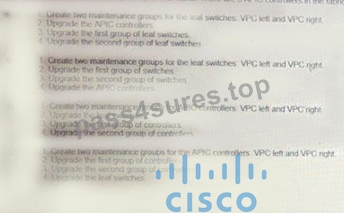
- A. Option D
- B. Option B
- C. Option A
- D. Option C
Answer: C
NEW QUESTION # 161
Where are STP BPDUSs flooded in Cisco ACI fabric?
- A. in the bridge domain VLAN
- B. in the VNID that is assigned to the FD VLAN
- C. in the native VLAN ID
- D. in the access encapsulation VLAN part of different VLAN pools
Answer: A
Explanation:
In the Cisco ACI fabric, Spanning Tree Protocol (STP) Bridge Protocol Data Units (BPDUs) are flooded within the bridge domain VLAN. This allows the BPDUs to be propagated throughout the bridge domain, enabling STP to function correctly for the associated VLAN.
NEW QUESTION # 162
Refer to the exhibit. Which Adjacency Type value should be set when the client endpoint and the service node interface are in a different subnet?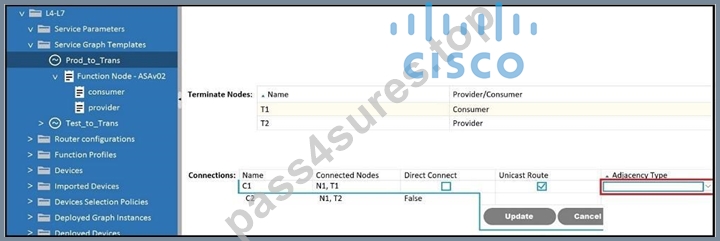
- A. Unicast
- B. L3Out
- C. L3
- D. Routed
Answer: C
Explanation:
When enabling routing, keep in mind that you must enable it in two places in the service graph:
● The bridge domain
● The graph connector
Figure 20 illustrates this point.
Figure 20. When Enabling Routing on a Bridge Domain, Make Sure That the Graph Template Connectors Are Set for Routing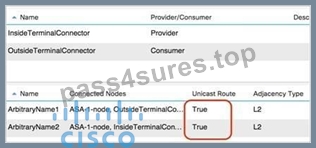
In general, these connectors are set to unicast routing by default. This setting makes the final state of the bridge domain dependent only on the routing configuration on the bridge domain.
If the connector is associated with a bridge domain that provides the Layer 3 outside (L3Out) interface function, in addition to verifying that the unicast routing option is set to true, you need to make sure that the adjacency is set to Layer 3, not Layer 2, as in Figure 21.
Figure 21. To Help Ensure That the Switch Virtual Interface Is Enabled on the Bridge Domain with L3Out, Set Adjacency to Layer 3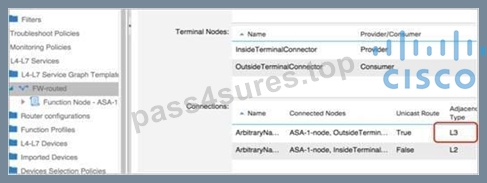
In summary, IP routing may be necessary in bridge domains that meet the following criteria:
● Bridge domains that provide routing to bridge domains that provide routing to another bridge domain or to the outside
● Bridge domains to which servers are connected, if you plan to use endpoint attachment
https://www.cisco.com/c/en/us/solutions/collateral/data-center-virtualization/application-centric- infrastructure/white-paper-c11-734298.html
NEW QUESTION # 163
Which Cisco ACI setting corresponds to the VMware MAC pinning?
- A. route based on originating virtual port
- B. route based on MAC hash
- C. route based on physical NIC load
- D. route based on IP hash
Answer: A
Explanation:
In VMware vSphere, "MAC Pinning" refers to the "Route based on originating virtual port" load-balancing algorithm. This method assigns each virtual machine (VM) vNIC to a specific uplink (pNIC) and ensures that all traffic from that VM consistently exits through the same uplink.
NEW QUESTION # 164
Refer to the exhibit. An engineer is implementing a BPDU filter on external switch interfaces that face the Cisco ACI fabric to prevent excessive TCNs from impacting the fabric. Which configuration must be applied on Cisco ACI to avoid a Layer 2 loop?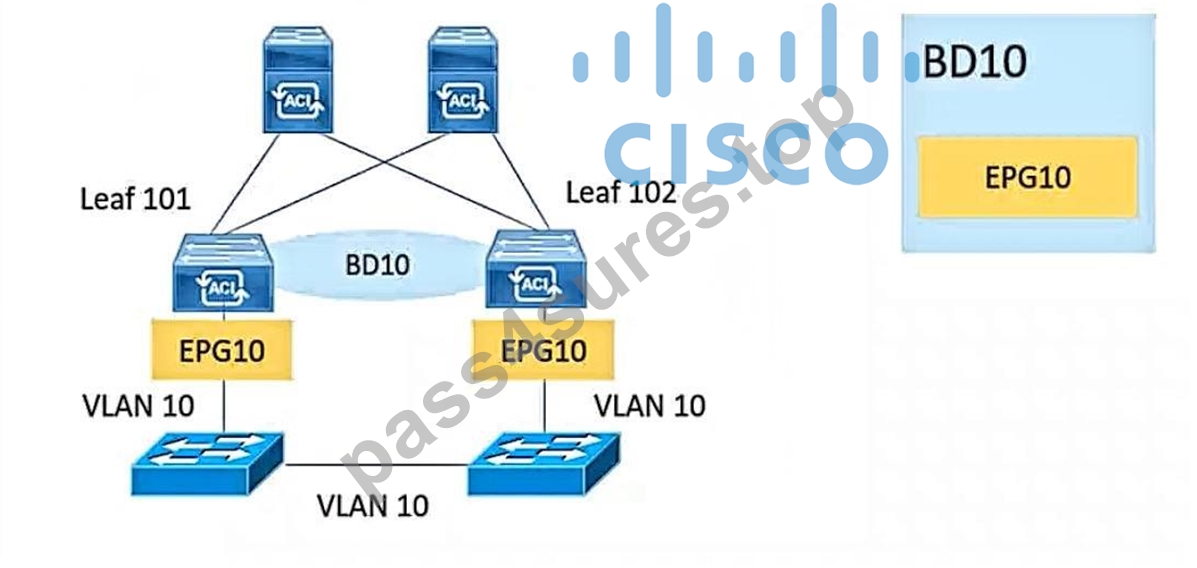
- A. Implement BPDU Guard.
- B. Apply an MSTP instance on Cisco ACI.
- C. Configure MCP globally.
- D. Enable STP on downlinks.
Answer: C
Explanation:
https://www.linkedin.com/pulse/cisco-aci-network-behaviour-stptcn-how-identify-loop-ankit- kulshresta
NEW QUESTION # 165
On which two interface types should a user configure storm control to protect against broadcast traffic? (Choose two.)
- A. endpoint-facing trunk interface
- B. fabric uplink interfaces on the leaf switches
- C. all interfaces on the leaf switches in the fabric
- D. APIC facing interfaces
- E. port channel on a single leaf switch
Answer: A,E
Explanation:
Typically, a fabric administrator configures storm control in fabric access policies on the following interfaces:
A regular trunk interface.
A direct port channel on a single leaf switch.
A virtual port channel (a port channel on two leaf switches).
https://www.cisco.com/c/en/us/td/docs/switches/datacenter/aci/apic/sw/2- x/L2_config/b_Cisco_APIC_Layer_2_Configuration_Guide/ b_Cisco_APIC_Layer_2_Configuration_Guide_chapter_01010.html
NEW QUESTION # 166
An engineer needs to deploy a leaf access port policy group in ACI Fabric to support the following requirements:
* Control the amount of application data flowing into the system
* Allow the newly connected device to auto-negotiate link speed with the leaf switch Which two ACI policies must be configured to achieve these requirements? (Choose two.)
- A. link level policy
- B. slow drain policy
- C. L2 interface policy
- D. ingress control plane policing policy
- E. ingress data plane policing policy
Answer: A,E
Explanation:
Section: ACI Fabric Infrastructure
Explanation/Reference:
https://www.cisco.com/c/en/us/td/docs/switches/datacenter/aci/apic/sw/kb/ b_Cisco_ACI_and_Forward_Error_Correction.html
https://www.cisco.com/c/en/us/td/docs/switches/datacenter/aci/apic/sw/4-x/security/Cisco-APIC-Security- Configuration-Guide-401/b_Cisco_APIC_Security_Guide_chapter_01110.html#:~:text=Use%20data%20plane
%20policing%20(DPP,dropping%20of%20packets%20occurs%20immediately.
NEW QUESTION # 167
Which two components are essential parts of a Cisco ACI Virtual Machine Manager (VMM) domain policy configuration? (Choose two.)
- A. EPG static port binding
- B. VMM domain profile
- C. IP address pool association
- D. EPG association
- E. Layer 3 outside interface association
Answer: B,D
Explanation:
https://www.cisco.com/c/en/us/td/docs/switches/datacenter/aci/apic/sw/1-x/aci-fundamentals/b_ACI-Fundamentals/b_ACI-Fundamentals_chapter_01011.html#concept_74EFC437C0AA44A391676F70ACE59DF3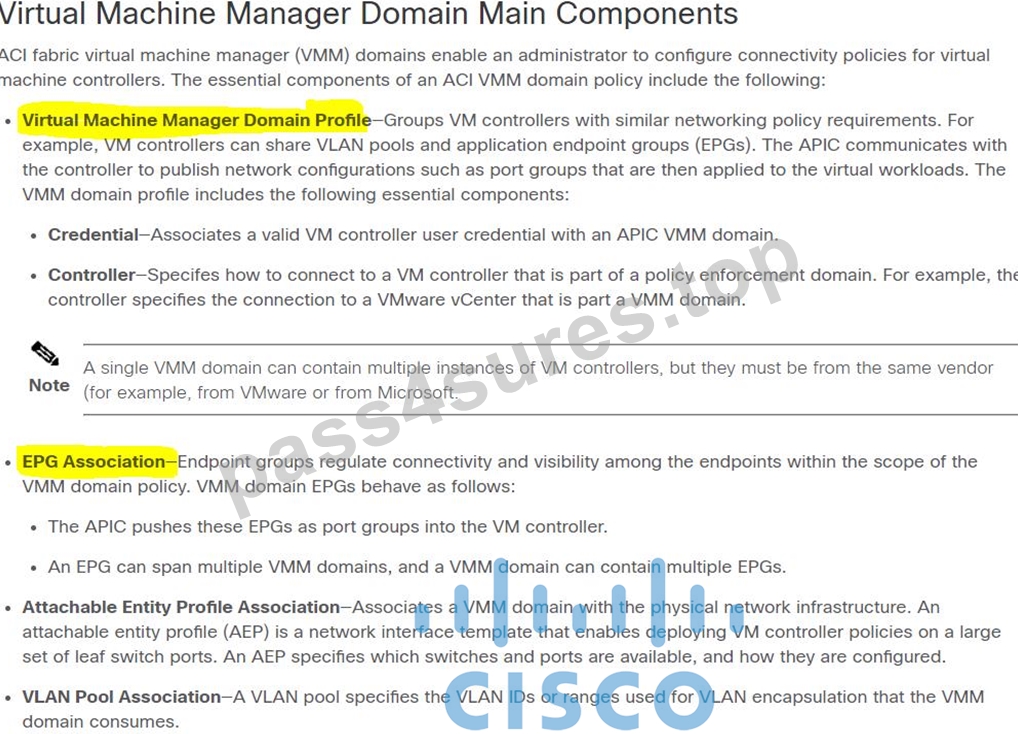
NEW QUESTION # 168
Where are STP BPDUSs flooded in Cisco ACI fabric?
- A. in the bridge domain VLAN
- B. in the VNID that is assigned to the FD VLAN
- C. in the native VLAN ID
- D. in the access encapsulation VLAN part of different VLAN pools
Answer: A
Explanation:
STP BPDUs are flooded in the bridge domain VLAN in Cisco ACI fabric.
NEW QUESTION # 169
Refer to the exhibit. An engineer must divert the traffic between VM-1 and VM-2 by using a Multi- Node service graph. The solution should prevent an insufficient number of available Layer 4 to Layer 7 devices in the first cluster. Which configuration set accomplishes this goal?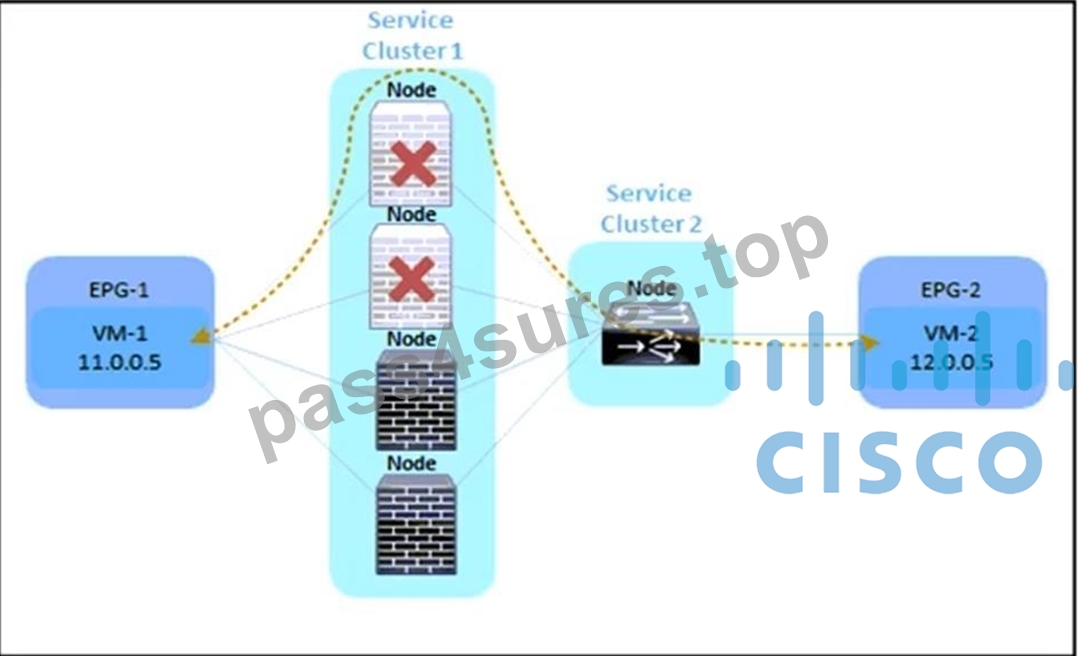
- A. PBR node tracking
tracking threshold with action permit
unidirectional PBR
resilient hashing - B. PBR node tracking
tracking threshold with action permit
symmetric PBR
resilient hashing - C. PBR node tracking
tracking threshold with action deny
symmetric PBR
unidirectional PBR - D. PBR node tracking
tracking threshold with action bypass
symmetric PBR
resilient hashing
Answer: D
Explanation: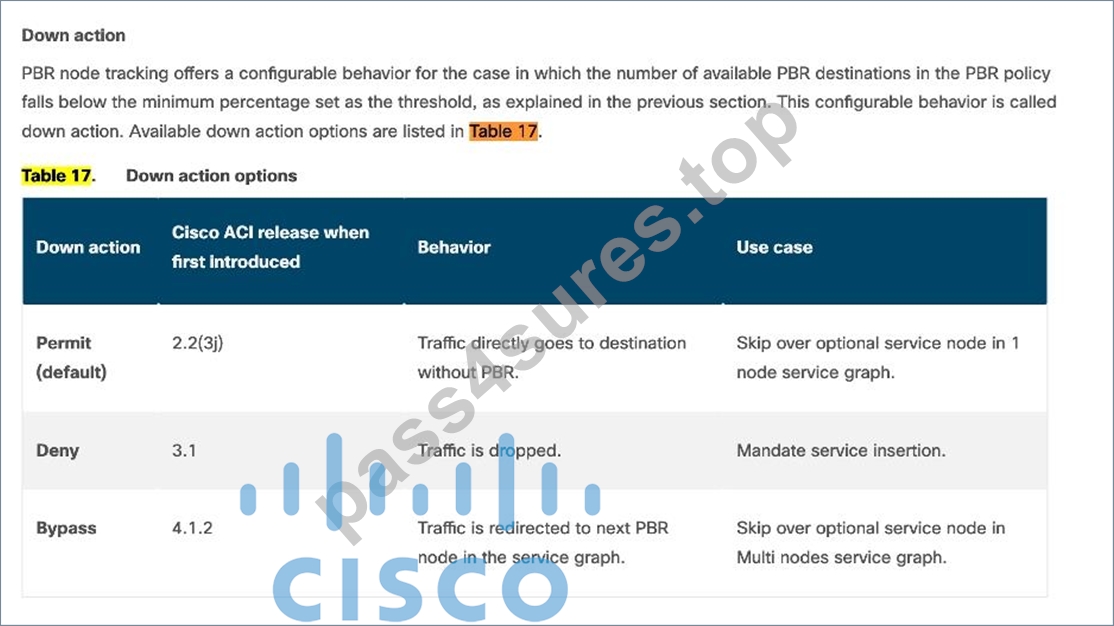
https://www.cisco.com/c/en/us/solutions/collateral/data-center-virtualization/application-centric- infrastructure/white-paper-c11-739971.html#Optionalfeatures
NEW QUESTION # 170
A network engineer must configure a new SNMP configuration and syslog servers. The requirement is for all faults and events related to endpoint groups, bridge domains, and VRFs to be sent to it. Which action must be taken to meet the requirements?
- A. Configure fabric monitoring policies and attach to the spine switch in the fabric.
- B. Implement fabric-wide monitoring policies on all nodes.
- C. Utilize common tenant monitoring policies in the Cisco APIC.
- D. Enable access monitoring policies on the required endpoint groups, bridge domains, and VRFs.
Answer: B
NEW QUESTION # 171
Which two statements regarding ACI Multi-Site are true? (Choose two.)
- A. ACI Multi-Site is a solution that allows one APIC cluster to manage multiple ACI sites.
- B. The Inter-Site network routers should run OSPF to establish peering with the spines.
- C. Routers in the Inter-Site network must run OSPF, DHCP relay, and MP-BGP.
- D. The Multi-Site orchestrator must be directly attached to one ACI leaf.
- E. ACI Multi-Site is a solution that supports a dedicated APIC cluster per site.
Answer: B,E
Explanation:
Cisco ACI Multi-Site architecture
The architecture allows you to interconnect separate Cisco ACI APIC cluster domains (fabrics), each representing a different region, all part of the same Cisco ACI Multi-Site Orchestrator domain. Doing so helps ensure multitenant Layer 2 and Layer 3 network connectivity across sites, and it also extends the policy domain end-to-end across the entire system. This design is achieved by using the following functional components:
https://www.cisco.com/c/en/us/solutions/collateral/data-center-virtualization/application-centric- infrastructure/white-paper-c11-739609.html#CiscoACIMultiSiteOrchestrator Hence, Multi-Site Orchestrator cluster nodes can be deployed securely over whatever network infrastructure is available to interconnect them.
The Cisco ACI Multi-Site Orchestrator design is based on a microservices architecture in which three MSO nodes are clustered together in an active/active fashion. The Cisco ACI Multi-Site Orchestrator nodes must communicate with the Out-Of-Band (OOB) interface of the APIC nodes deployed in different sites. MSO also provides northbound access through Representational State Transfer (REST) APIs or the GUI (HTTPS), which allows you to manage the full lifecycle of networking and tenant policies that need to be deployed across sites (Figure 17).
You can choose to deploy the Multi-Site Orchestrator cluster in one of the following two ways:
● Deploy a VM-based MSO cluster directly in VMware ESXi virtual machines (Figure 18): This is the deployment model supported from the very first release of Cisco Multi-Site Orchestrator and still available at the time of writing of this paper.
● Deploy a Cisco Application Services Engine (CASE)-based MSO cluster. This flavor, available from Cisco ACI Multi-Site Orchestrator Release 2.2(3), consists of an application (.aci format) installed on a Cisco Application Services Engine (CASE).
NEW QUESTION # 172
Which two statements regarding ACI Multi-Site are true? (Choose two.)
- A. The Inter-Site network routers should run OSPF to establish peering with the spines.
- B. Routers in the Inter-Site network must run OSPF, DHCP relay, and MP-BGP.
- C. The Multi-Site orchestrator must be directly attached to one ACI leaf.
- D. ACI Multi-Site is a solution that allows one APIC cluster to manage multiple ACI sites.
- E. ACI Multi-Site is a solution that supports a dedicated APIC cluster per site.
Answer: D,E
Explanation:
The two true statements regarding ACI Multi-Site are:
ACI Multi-Site is a solution that supports a dedicated APIC cluster per site1.
ACI Multi-Site is a solution that allows one APIC cluster to manage multiple ACI sites1.
NEW QUESTION # 173
A Solutions Architect is asked to design two data centers based on Cisco ACI technology that can extend L2/ L3, VXLAN, and network policy across locations. ACI Multi-Pod has been selected. Which two requirements must be considered in this design? (Choose two.)
- A. ACI underlay protocols, i.e. COOP, IS-IS and MP-BGP, spans across pods. Create QoS policies to make sure those protocols have higher priority.
- B. Multi-Pod requires multiple APIC Controller Clusters, one per pod. Make sure those clusters can communicate to each other through a highly available connection.
- C. ACI Multi-Pod does not support Firewall Clusters across Pods. Firewall Clusters should always be local.
- D. ACI Multi-Pod requires an IP Network supporting PIM-Bidir.
- E. A single APIC Cluster is required in a Multi-Pod design. It is important to place the APIC Controllers in different locations in order to maximize redundancy and reliability.
Answer: A,B
NEW QUESTION # 174
What are two of the three methods in integrating the Cisco ACI with existing network infrastructure? (Choose two.)
- A. as an additional data center pod
- B. as a data center policy engine
- C. as a network supervisor module
- D. as a super cloud overseeing a subcloud
- E. as an atomic network operator
Answer: A,B
NEW QUESTION # 175
A company must connect three Cisco ACI data centers by using Cisco ACI Multi-Site. An engineer must configure the Inter-Site Network (ISN) between the existing sites. Which two configuration steps must be taken to implement the ISN? (Choose two.)
- A. Configure OSPF on subinterfaces on routers that are directly connected with spine nodes.
- B. Configure ISN site extension on Cisco routers in the network.
- C. Configure BIDIR-PIM on all ISN routers.
- D. Configure encapsulation VLAN-4 between the routers and spine nodes.
- E. Configure OSPF on all ISN routers.
Answer: B,D
NEW QUESTION # 176
Which feature dynamically assigns or modifies the EPG association of virtual machines based on their attributes?
- A. application EPGs
- B. vzAny contracts
- C. standard contracts
- D. uSeg EPGs
Answer: D
Explanation:
Section: ACI Fabric Infrastructure
NEW QUESTION # 177
What must be configured to redistribute externally learned OSPF routes within the ACI fabric?
- A. PIM Sparse Mode
- B. BGP Route Reflector
- C. Route Control Profile
- D. BGP Inter-leak Route Map
Answer: B
Explanation:
Once the border leaf learns the external routes, it can then redistribute the external routes of a given VRF instance to an MP-BGP address family (VPNv4 or VPNv6). MP-BGP maintains a separate BGP routing table for each VRF instance. Within MP-BGP, the border leaf switch advertises routes to a spine switch, which is a BGP route reflector. The routes are then propagated to all the leaf switches where the VRF instances are instantiated.
https://www.cisco.com/c/en/us/solutions/collateral/data-center-virtualization/application-centric- infrastructure/guide-c07-743150.html
NEW QUESTION # 178
An engineer wants to filter the System Faults page and view only the active faults that are present in the Cisco ACI fabric. Which two lifecycle stages must be selected for filtering? (Choose two.)
- A. Soaking
- B. Retaining
- C. Soaking, Clearing
- D. Raised, Clearing
- E. Raised
Answer: A,E
Explanation:
Soaking = initial state of a fault, when problem condition first detected.
Raised = fault not resolved within soaking interval.
NEW QUESTION # 179
An engineer must configure RADIUS authentication with Cisco ACI for remote authentication with out-of-band management access. Drag and drop the RADIUS configuration steps from the left into the required implementation order on the right. Not all steps are used.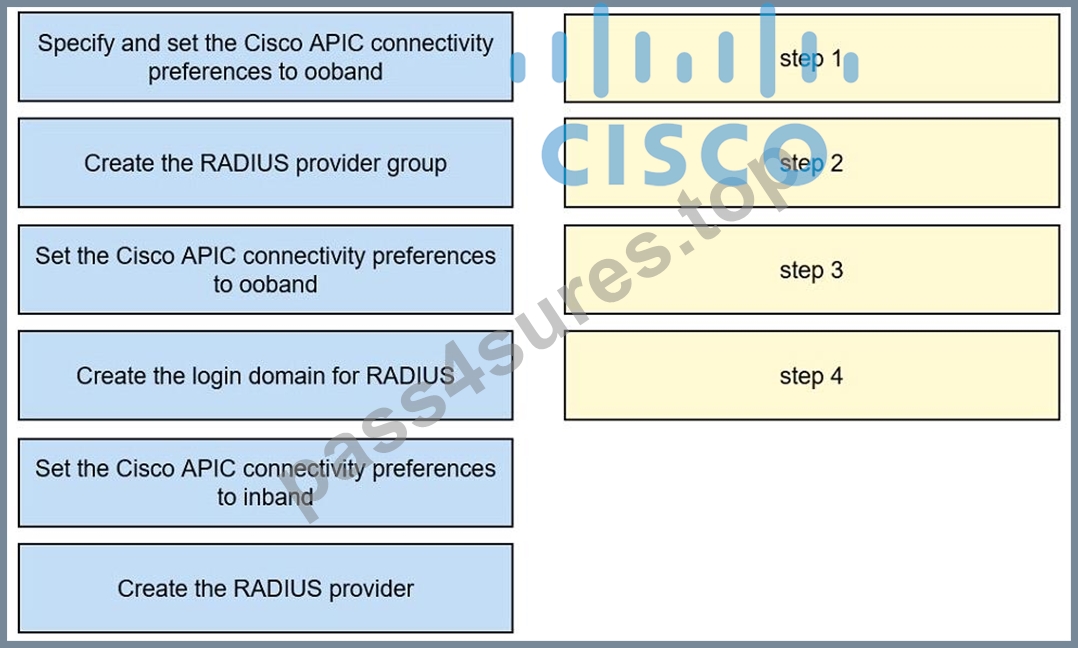
Answer:
Explanation: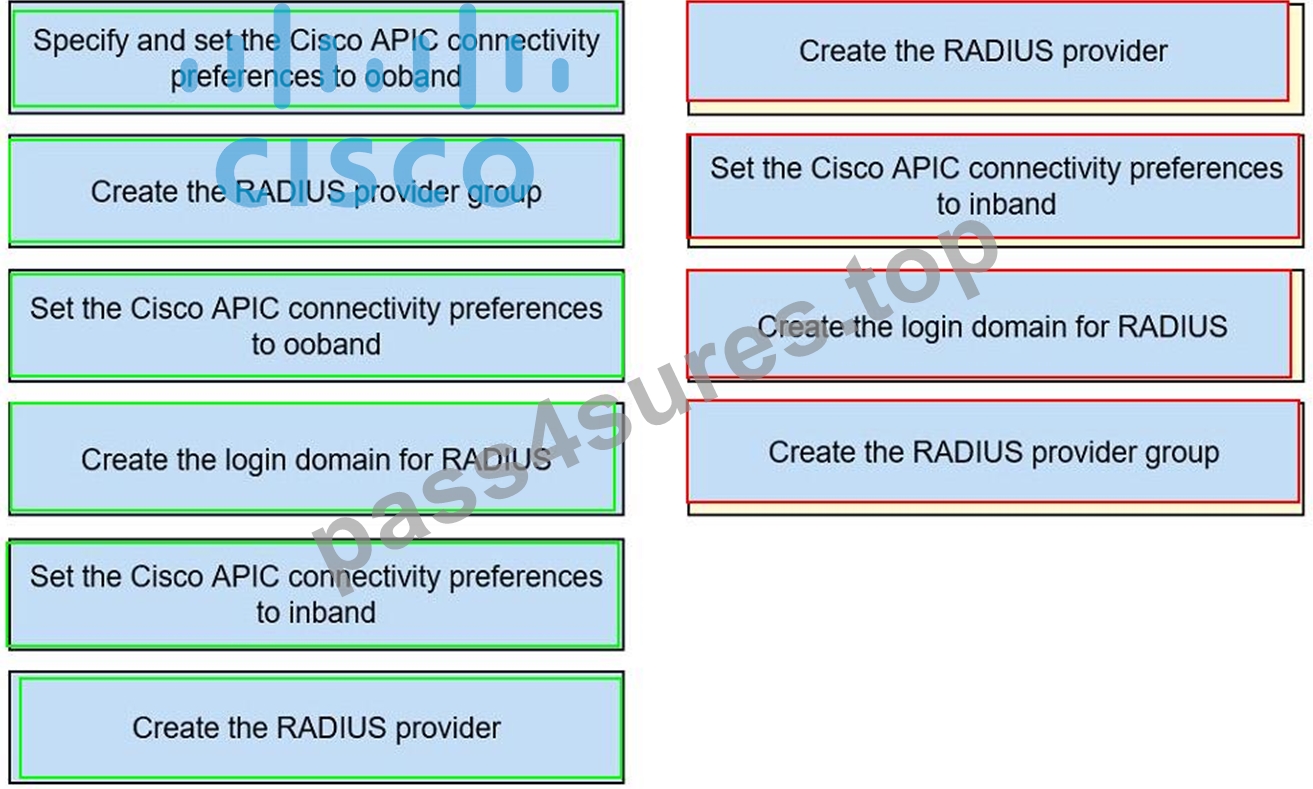
NEW QUESTION # 180
Refer to the exhibit. An engineer configures a Layer 4 to Layer 7 device object. The device is a virtual firewall with a single network adapter and it must be deployed in routed mode. Which action completes the configuration of the device object?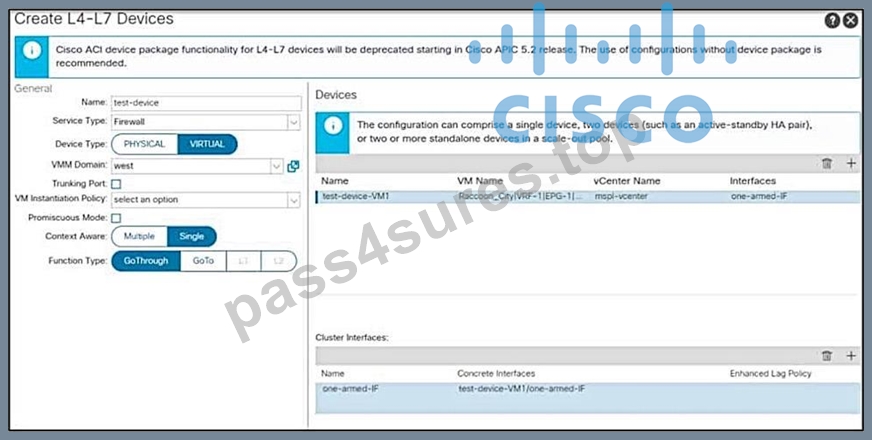
- A. Change context awareness to Multiple.
- B. Enable Promiscuous Mode.
- C. Add an outside interface to the cluster interfaces.
- D. Change Function Type to GoTo.
Answer: D
NEW QUESTION # 181
......
300-620 exam dumps with real Cisco questions and answers: https://www.pass4sures.top/CCNP-Data-Center/300-620-testking-braindumps.html
Today Updated 300-620 Exam Dumps Actual Questions: https://drive.google.com/open?id=1sryR1_eJT0873y9R6c2cqfK76N8RPfn1