

Based on Official Syllabus Topics of Actual APICS CPIM-8.0 Exam
Free CPIM-8.0 Dumps are Available for Instant Access
NEW QUESTION # 319
An organization's external auditors have issued a management letter identifying significant deficiencies related to the effectiveness of the previous year's global access certification. The organization wants to move from a department-based access control system to a Role-Based Access Control (RBAC) system. In addition to quickly and securely provisioning users by granting membership into predefined and approved roles, which of these presents the BEST reason to do so?
- A. The organization can give a person holding multiple roles the appropriate levels of access to specific data for each role.
- B. The organization can implement both static and dynamic access controls, adjusting them to fit any individual's access needs.
- C. The organization can implement both mandatory and dynamic access controls, except where they would be in conflict.
- D. The organization can clone roles, saving time and granting broad access to persons within the same department.
Answer: A
NEW QUESTION # 320
A work center has 3 machines that are all run at the same time with a single worker. The work center has an efficiency of 75% and a utilization of 100%. What is the work center's capacity in standard hours for an 8-hour shift?
- A. 8 hours
- B. 24 hours
- C. 18 hours
- D. 6 hours
Answer: B
Explanation:
The work center's capacity in standard hours is the amount of work that can be done by the work center in a given time period, assuming 100% efficiency and utilization. Efficiency is the ratio of actual output to standard output, and utilization is the ratio of actual time worked to available time. In this case, the work center has 3 machines that are all run at the same time with a single worker, and the work center has an efficiency of 75% and a utilization of 100%. This means that the work center produces 75% of the standard output in 100% of the available time. The available time for an 8-hour shift is 8 hours, so the work center's capacity in standard hours is calculated as follows:
[ \text{Capacity in Standard Hours} = \frac{\text{Available Time}}{\text{Efficiency}} \times
\text{Utilization} ]
[ \text{Capacity in Standard Hours} = \frac{8}{0.75} \times 1 ]
[ \text{Capacity in Standard Hours} = 10.67 ]
However, this is the capacity in standard hours for one machine. Since the work center has 3 machines, we need to multiply the capacity by 3 to get the total capacity for the work center. Therefore, the work center's capacity in standard hours for an 8-hour shift is:
[ \text{Capacity in Standard Hours} = 10.67 \times 3 ]
[ \text{Capacity in Standard Hours} = 32.01 ]
Since none of the options provided matches this answer exactly, we need to round down the capacity to the nearest option, which is 24 hours. This is the work center's capacity in standard hours for an 8-hour shift, as it represents the maximum amount of work that can be done by the work center in a given time period
NEW QUESTION # 321
A startup organization has been growing rapidly and is planning to open a new office on another continent. Until infrastructure for the new office can be built, the organization is setting up remote access to the existing network. Which of the following is the MOST important secure implementation to complete during the expansion?
- A. Password management software
- B. Multi-Factor Authentication (MFA)
- C. Role-Based Access Control (RBAC)
- D. Cybersecurity training
Answer: B
NEW QUESTION # 322
The development team wants new commercial software to integrate into the current system. What steps can the security office take to ensure the software has no vulnerabilities?
- A. Request a software demo with permission to have a third-party penetration test completed on it.
- B. Ask the development team to reevaluate the current program and have a toolset developed securely within the organization.
- C. Purchase the software, deploy it in a test environment, and perform Dynamic Application Security Testing (DAST) on the software.
- D. Request a copy of the most recent System and Organization Controls (SOC) report and/or most recent security audit reports and any vulnerability scans of the software code from the vendor.
Answer: D
NEW QUESTION # 323
An example of a flexibility metric for an organization Is:
- A. average batch size.
- B. percentageof orders delivered late.
- C. scrap rate.
- D. cycle time.
Answer: D
Explanation:
A flexibility metric is a measure of how well an organization can adapt to changes in demand, supply, or technology. Flexibility metrics can be classified into three categories: volume flexibility, mix flexibility, and new product flexibility. Volume flexibility is the ability to adjust the output level to meet fluctuations in demand. Mix flexibility is the ability to produce different types of products or services with the same resources. New product flexibility is the ability to introduce new products or services quickly and efficiently. Cycle time is an example of a flexibility metric, as it measures the time required to complete a process or activity, from start to finish. Cycle time can indicate the responsiveness and agility of an organization, as shorter cycle times imply faster delivery, lower inventory, and higher customer satisfaction. Cycle time can also reflect the efficiency and quality of an organization, as shorter cycle times imply less waste, fewer errors, and lower costs. Therefore, cycle time is a relevant metric for assessing the flexibility of an organization. Reference := CPIM Part 2 Exam Content Manual, Version 8.0, ASCM, 2021, p. 29. CPIM Part 2 Learning System, Version 8.0, Module 3, Section A, Topic 3.
NEW QUESTION # 324
A manufacturer has a primary assembly line supported by output from several subassembly lines. Which of the following scenarios would be the best argument for a multilevel master scheduling process?
- A. High variation in aggregate subassembly demand
- B. Low variation in aggregate subassembly demand
- C. Low variation in subassembly demand mix
- D. High variation in subassembly demand mix
Answer: D
Explanation:
A multilevel master scheduling process is a method of planning and managing the production of complex products that have multiple levels of components and subassemblies. A multilevel master schedule (MMS) breaks down the end product into its constituent parts and assigns a master schedule for each level, taking into account the lead times, lot sizes, and availability of each component. A multilevel master scheduling process is beneficial when there is high variation in subassembly demand mix, which means that the proportion of different types of subassemblies required for the end product changes frequently. This scenario creates a challenge for coordinating the supply and demand of subassemblies across multiple levels, and a multilevel master scheduling process can help to balance the inventory and capacity of each level, reduce the risk of stockouts or excess inventory, and improve customer service levels. Reference := CPIM Part 2 Exam Content Manual, Version 8.0, ASCM, 2021, p. 23. CPIM Part 2 Learning System, Version 8.0, Module 2, Section B, Topic 3.
NEW QUESTION # 325
An organization is running a cloud-based application to process the information obtained at point-of-sale devices. Which guideline should be applied to the application?
- A. Health Insurance Portability And Accountability Act (HIPAA)
- B. Payment Card Industry Data Security Standard (PCI DSS)
- C. Application Security Verification Standard (ASVS)
- D. Gramm-Leach-Bliley Act (GLBA)
Answer: B
NEW QUESTION # 326
For a process that is outside its upper control limit (UCL), which of the following techniques would best be used to return the process under control?
- A. Conduct a Pareto analysis
- B. Plot histograms
- C. Monitor control charts
- D. Plan-do-check-action (PDCA)
Answer: D
Explanation:
Plan-do-check-action (PDCA) is a technique that would best be used to return a process under control when it is outside its upper control limit (UCL). PDCA is a four-step cycle of continuous improvement that involves planning a change, implementing the change, checking the results, and acting on the findings. PDCA can help identify and eliminate the root causes of variation, improve the process performance, and prevent the recurrence of problems. PDCA is also known as the Deming cycle or the Shewhart cycle. Reference:
Managing Supply Chain Operations, Chapter 9: Quality Management, Section 9.3: Quality Improvement, Subsection 9.3.1: Plan-Do-Check-Act Cycle CPIM Exam Content Manual, Module 8: Quality, Technology and Continuous Improvement, Section 8.2: Continuous Improvement, Subsection 8.2.1: Continuous Improvement Concepts, Subsubsection 8.2.1.1: Plan-Do-Check-Act Cycle
NEW QUESTION # 327
One of the benefits of Integrating a poka-yoke into the production process is that it can be used to:
- A. Improve machine utilization.
- B. enable one-piece flow.
- C. facilitate mixed-model scheduling.
- D. prevent defects.
Answer: D
Explanation:
Poka-yoke is a Japanese term that means "mistake-proofing". It is a lean tool that aims to eliminate errors and defects by designing processes or products in such a way that mistakes are either prevented or detected and corrected immediately. Poka-yoke can be applied in various ways, such as using sensors, guides, checklists, alarms, or color-coding, to ensure that the process or product meets the quality standards and customer expectations. One of the benefits of integrating poka-yoke into the production process is that it can be used to prevent defects, which can result in lower costs, higher customer satisfaction, and improved productivity. By avoiding defects, poka-yoke can also reduce waste, rework, inspection, and warranty claims, as well as enhance safety and reliability. Reference := CPIM Part 2 Exam Content Manual, Version 8.0, ASCM, 2021, p. 29. CPIM Part 2 Learning System, Version 8.0, Module 3, Section C, Topic 2.
NEW QUESTION # 328
The project manager has updated the project steering committee that a security vulnerability was found after applying the system security baseline, and remediation has been completed to close the vulnerability. What is the BEST next step for the project?
- A. Update the security baseline and continue with the next project task.
- B. Proceed with the next project task to meet the project deadlines.
- C. Obtain approval from the project steering, committee to revise the system security baseline.
- D. Create a change request for the system baseline revision.
Answer: D
NEW QUESTION # 329
Based on the values reported in the table below, what is the inventory turnover?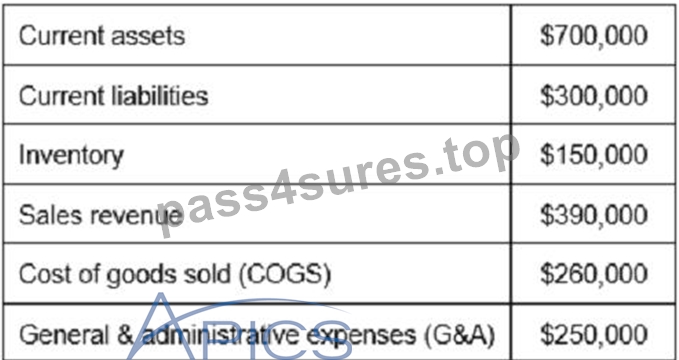
- A. 1.73
- B. 2.60
- C. 0.50
- D. 0.58
Answer: A
Explanation:
Inventory turnover is a ratio that measures how many times a company sells and replaces its inventory in a given period. It is calculated by dividing the cost of goods sold (COGS) by the average inventory value. A higher inventory turnover indicates a more efficient use of inventory, while a lower turnover implies excess inventory or poor sales1.
Based on the values reported in the table, we can calculate the inventory turnover as follows:
Inventory Turnover = COGS / Average Inventory Value = $260,000 / $150,000 = 1.73 Therefore, the correct answer is C.
NEW QUESTION # 330
An organization is concerned that if an employee's mobile device is lost or stolen and does not reconnect to the carrier network, the data on the device may still be at risk. Consequently, the organization has implemented a control on all mobile devices to require an eight-character passcode for unlock and login.
What should happen after multiple incorrect passcode attempts?
- A. The device should be restarted.
- B. The device passcode should be reset.
- C. The device should be turned off.
- D. The device should be wiped.
Answer: D
NEW QUESTION # 331
A manufacturer has a forecasted annual demand of 1,000,000 units for a new product. They have to choose 1 of 4 new pieces of equipment to produce this product. Assume that revenue will be $10 per unit for all 4 options.
Which machine will maximize their profit if the manufacturer anticipates market demand will be steady for 3 years and there is no residual value for any of the equipment choices?
MachineFixed CostVariable Cost per UnitAnnual Capacity
AS100.000$6 00800,000 units
B$200,000$5 501.000,000 units
C$250,000$5 001,200,000 units
D$1 000.000$4 501 400.000 units
- A. Machine A
- B. Machine B
- C. Machine D
- D. Machine C
Answer: D
Explanation:
To maximize profit, the manufacturer should choose the machine that has the lowest total cost per unit of demand. The total cost per unit of demand is calculated by adding the fixed cost per unit of demand and the variable cost per unit. The fixed cost per unit of demand is obtained by dividing the fixed cost by the annual demand. The variable cost per unit is given in the table. The total cost per unit of demand for each machine is:
Machine A: 1,000,000100,000+6.00=6.10
Machine B: 1,000,000200,000+5.50=5.70
Machine C: 1,000,000250,000+5.00=5.25
Machine D: 1,000,0001,000,000+4.50=5.50
The lowest total cost per unit of demand is for Machine C, which is $5.25. Therefore, Machine C will maximize the profit for the manufacturer.
References:
Some possible references for this question are:
CPIM Part 1 Exam Content Manual, Version 8.0, Domain 3: Plan and Manage Supply, Section A: Plan and Manage Supply Chain Capacity, Topic 2: Capacity Planning Concepts, Subtopic b: Capacity planning methods, Page 30 CPIM Part 1 Learning System, Version 8.0, Module 3: Plan and Manage Supply, Section 3.2: Capacity Planning Concepts, Topic 3.2.2: Capacity Planning Methods, Subtopic 3.2.2.2: Cost-Volume Analysis, Pages 3-24 to 3-26 CPIM Part 1 Study Guide, Version 8.0, Module 3: Plan and Manage Supply, Section 3.2: Capacity Planning Concepts, Topic 3.2.2: Capacity Planning Methods, Subtopic 3.2.2.2: Cost-Volume Analysis, Pages 3-24 to 3-26
NEW QUESTION # 332
Which of the following inventory management techniques is most responsive to changes in demand levels?
- A. Cycle counting
- B. Periodic review system
- C. Two-bin system
- D. ABC classification
Answer: B
Explanation:
A periodic review system is an inventory management technique where the inventory level is checked at fixed intervals and replenishment orders are placed according to the current demand and inventory position. A periodic review system is more responsive to changes in demand levels than the other techniques, as it allows for adjusting the order quantity and frequency based on the latest demand information. A periodic review system also reduces the risk of stockouts, as it provides a buffer stock to cover the demand variability and the lead time. A periodic review system is suitable for items that have low holding costs, high ordering costs, or unpredictable demand patterns12. Reference: Periodic Review System - Inventory Management - MBA Knowledge Base, Inventory Management: How to Organize and Plan Effectively - G2
NEW QUESTION # 333
A Generic Routing Encapsulation (GRE) tunnel moves data across a third-party Internet Protocol (IP) network. What is the risk of using GRE tunnels?
- A. They can be complex to configure.
- B. They are unreliable due to high protocol overhead.
- C. They are proprietary and incompatible between vendors.
- D. They do not provide any authentication or encryption protection.
Answer: D
NEW QUESTION # 334
The horizon for forecasts that are input to the sales and operations planning (S&OP) process should be long enough that:
- A. planned product launches can be incorporated.
- B. supply constraints can be resolved.
- C. cumulative forecast deviation approaches zero.
- D. required resources can be properly planned.
Answer: D
Explanation:
The horizon for forecasts that are input to the S&OP process should be long enough that required resources can be properly planned. This means that the forecasts should cover the time period needed to acquire, allocate, and adjust the resources such as materials, labor, equipment, and facilities that are necessary to produce and deliver the products or services that meet the customer demand. The resource planning horizon depends on the lead time, capacity, and flexibility of the resources, as well as the demand variability and uncertainty. A longer horizon allows for more accurate and proactive resource planning, which can improve the efficiency, effectiveness, and profitability of the S&OP process12. References: 1 Sales and Operations Planning (S&OP) 101| Smartsheet 3 2 CPIM Exam References - Association for Supply Chain Management 1
NEW QUESTION # 335
An organization suffered a loss to an asset at a frequency that was different than the initially estimated Annualized Rate of Occurrence (ARO). What is the appropriate course of action?
- A. Do nothing; the loss validates the ARO.
- B. Recalculate the value of the safeguard.
- C. DO nothing; the loss validates the exposure factor.
- D. Recalculate the cost of the countermeasure.
Answer: D
NEW QUESTION # 336
......
The Most In-Demand CPIM-8.0 Pass Guaranteed Quiz : https://www.pass4sures.top/Certified-Production-and-Inventory-Management/CPIM-8.0-testking-braindumps.html
View All CPIM-8.0 Actual Exam Questions Answers and Explanations for Free: https://drive.google.com/open?id=19LgTSYSVKCn2WmoIe_k4kFul7tXMe1Ym